
A zero-day exploit attack is a cyberattack that hits you where you’re most vulnerable—by taking advantage of a software flaw that no one, not even the developers, knows exists. The name says it all: the good guys have had zero days to create a patch before it’s used against them, letting these attacks sidestep security tools that only look for known threats.
TLDR: What You Need to Know
A zero-day exploit attack leverages a previously unknown software vulnerability that developers have had zero days to fix. Because no patch exists, traditional security measures like antivirus often fail to stop it, making it an incredibly dangerous threat. This guide explains how these attacks work, provides real-world examples, and outlines a multi-layered defence strategy involving advanced endpoint protection, diligent patch management, and employee training to protect your business.
What Exactly Is a Zero-Day Exploit Attack?

Imagine a high-security bank vault, built to be impenetrable. Now, picture a thief discovering a hidden, undocumented structural weakness in the vault’s wall—a flaw that not even the builders knew was there. The thief uses this secret to bypass all the alarms and locks, getting in and out before anyone even realises there was a problem in the first place.
This is the real-world equivalent of a zero-day exploit attack. It’s a method of cyber assault that thrives on the element of surprise, making it one of the most dangerous threats facing businesses today. To really get a handle on its impact, it helps to break down the key pieces involved.
Vulnerability, Exploit, and Attack Explained
These three terms often get thrown around interchangeably, but they actually describe distinct stages of a security incident:
- The Zero-Day Vulnerability: This is the foundational flaw. It’s an unknown bug or weakness hiding in a piece of software, an operating system, or a hardware device. Crucially, the developers are completely unaware of its existence.
- The Zero-Day Exploit: This is the specific tool or technique created to take advantage of that vulnerability. Think of it as the special drill the thief builds to get through the vault’s hidden weak spot.
- The Zero-Day Attack: This is the actual execution. It’s the moment the attacker uses their custom-built tool to breach security, deploy malware, steal data, or cause chaos.
A zero-day attack operates in the blind spot of conventional cybersecurity. Since no patch exists and the threat signature is unknown, traditional antivirus and firewalls are often powerless to stop it.
This distinction is crucial because it highlights why these attacks are so effective. They target the gap between a flaw being discovered by attackers and its discovery by the very people who can fix it. Protecting your business requires a security mindset that goes beyond just reacting to known dangers.
It means being proactive with measures like robust endpoint protection. Understanding what is endpoint security and how it forms a critical defence layer is fundamental to safeguarding your business from these unseen threats.
Right, if you’re a busy professional, you don’t have time for dense technical jargon. You just need to know what a zero-day exploit attack is and why it’s something you need to take seriously.
Think of it like this: a software developer builds a house (an application) but accidentally leaves a window unlocked. A zero-day attack is when a burglar finds that unlocked window before the builder even realises it’s there. Because nobody knows about the vulnerability, there’s no patch or fix available, giving attackers a wide-open path into your systems. This element of total surprise is what makes it one of the most potent threats your business can face.
To properly defend your organisation, you need to think beyond just putting up a firewall. It requires a proactive, layered security mindset. This means having advanced tools that can spot unusual behaviour, maintaining a strict patch management routine to close vulnerabilities the moment they’re known, and continuous training for your team.
Frameworks like the ACSC Essential Eight provide a fantastic blueprint for building this kind of resilience. This guide will take you deeper, walking you through how these attacks unfold from start to finish and giving you practical, actionable steps to protect your business from the ground up.
How a Zero-Day Attack Unfolds Step-by-Step
To have any chance of defending against a zero-day attack, you need to get inside the attacker’s head and understand their playbook. These aren’t random, chaotic events; they follow a cold, calculated process from the initial discovery of a flaw right through to the final strike. By breaking this lifecycle down, we can pinpoint exactly where our security controls can throw a spanner in the works.
The whole process starts long before a single piece of data is stolen. It begins with a quiet, patient hunt for a hidden weakness in the software that millions of us—businesses and individuals alike—rely on every single day.
This diagram shows the typical journey of a zero-day attack, from the moment a threat is found to the point it’s unleashed.
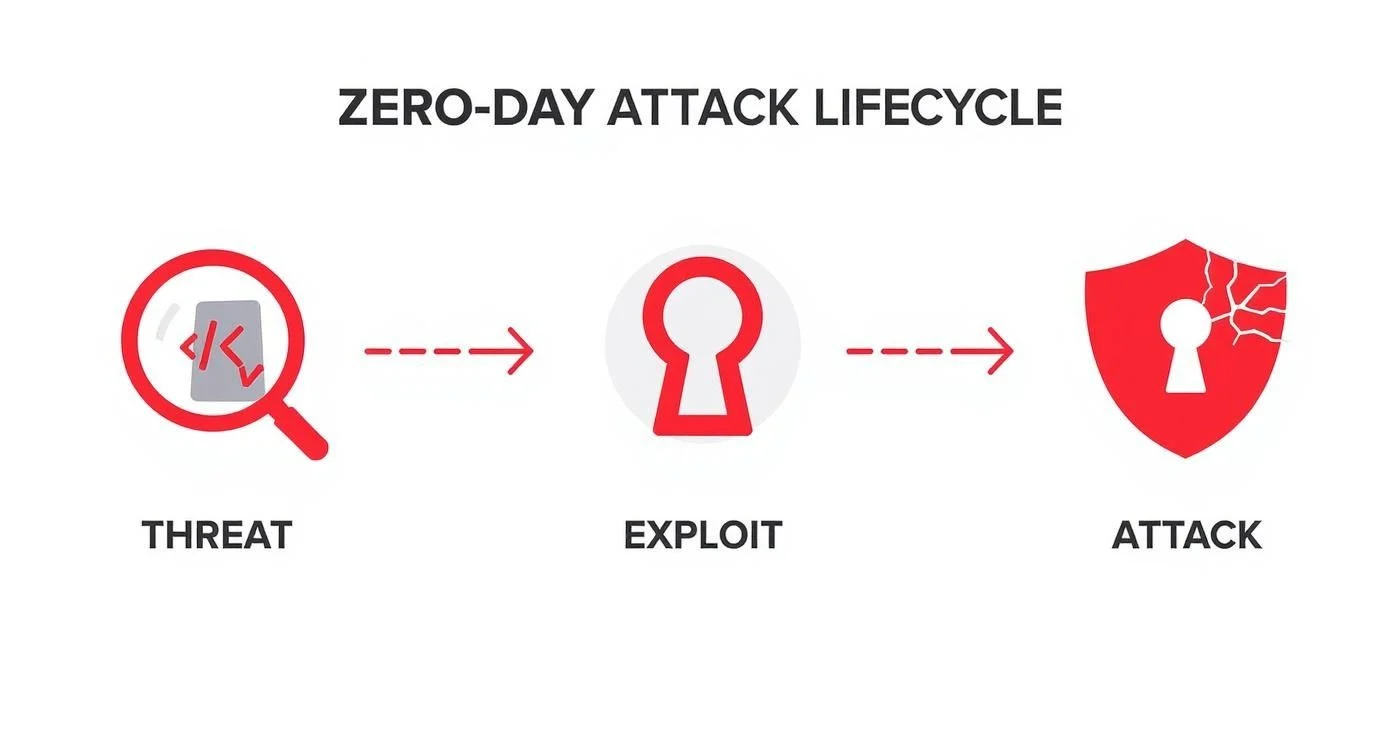
As you can see, the attacker’s path involves finding a vulnerability, building a tool to crack it open, and then launching their campaign.
Stage 1: Vulnerability Discovery
First, the attacker needs to find a zero-day vulnerability. This is a highly specialised and often incredibly time-consuming task. Attackers, security researchers, and even state-sponsored hacking groups will meticulously pick apart code, reverse-engineer software updates, and use advanced techniques like “fuzzing” to uncover previously unknown flaws.
Fuzzing is basically like throwing everything but the kitchen sink at a program. It involves bombarding it with massive amounts of random or junk data to see if it breaks. An unexpected crash can be a tell-tale sign of a memory bug or another weakness that could potentially be turned into a weapon.
Once a valuable vulnerability is found, it becomes a closely guarded secret. It might be saved for a specific operation or sold on dark web marketplaces for anywhere from a few thousand to millions of dollars, depending on the software it affects and the damage it could cause.
Stage 2: Exploit Development
Finding a flaw is one thing, but weaponising it is a whole different ball game. In this stage, the attacker writes the exploit code—the specific program or script designed to take advantage of that vulnerability. Think of it like a key crafted for a lock that nobody else even knows exists.
The goal is to create a reliable way to trigger the flaw and seize control. This could mean:
- Executing their own code on the target’s system.
- Bypassing security checks like logins or access controls.
- Escalating their privileges to gain full administrator-level access.
Developing a stable and effective exploit requires deep technical skill. The code needs to work consistently across different versions of the software and, crucially, avoid being spotted by existing security tools. This makes it a critical and painstaking phase of the attack.
Stage 3: Target Identification and Reconnaissance
With a working exploit ready to go, the attackers need to find their targets. They begin reconnaissance to identify organisations or individuals running the specific, vulnerable software. This might involve using automated scanners to scour the internet for systems that have the target software exposed.
For more focused attacks, they might gather intelligence on a single company, learning about its network setup, the software it uses, and even its key employees. This information helps them figure out the best way to deliver the exploit, whether it’s through a convincing phishing email, a compromised website, or another sneaky vector.
The ultimate goal of a zero-day exploit attack is often financial gain through data theft or system disruption. Attackers meticulously plan their approach to maximise their return on investment.
Stage 4: Attack Execution and Payloads
This is the final, most destructive stage. The attacker launches the zero-day exploit attack, delivering their malicious code to the target. If it works, the exploit triggers the vulnerability, giving the attacker their first foothold inside the network.
From there, they deploy a payload. This is the part of the malware that does the actual dirty work. The payload could be anything from ransomware that encrypts critical files to spyware that quietly siphons off sensitive data over weeks or even months.
In Australia, these attacks are increasingly linked to sophisticated criminal groups. For instance, the ACSC’s 2024–25 report noted that ransomware incidents accounted for a staggering 39% of proactive warnings issued to affected entities, with many of these attacks using zero-day vulnerabilities to get past defences. You can dig deeper into the current threat landscape in the ACSC’s report on rising cyberattacks.
Understanding this lifecycle is the first step toward building a defence that can interrupt the attack chain at any point along the way.
A Few Not-So-Gentle Reminders of What’s at Stake
The term ‘zero-day exploit’ can sound a bit like technical jargon, something for the IT department to worry about. But the real-world impact is anything but abstract. These aren’t just theoretical threats found in a textbook; they’re digital weapons that have crippled governments, sabotaged critical infrastructure, and blindsided thousands of businesses.
Looking back at some of the most infamous attacks gives us a powerful, tangible lesson on the sheer scale and severity of the risk. These stories show just how much damage can be done when attackers operate in the blind spot of our defences, and why a proactive security strategy isn’t a luxury—it’s an absolute necessity.
Stuxnet: The Worm That Jumped into the Physical World
Perhaps the most famous—or infamous—zero-day attack in history is Stuxnet, uncovered back in 2010. This wasn’t your typical smash-and-grab data theft. It was a highly sophisticated piece of malware engineered for one chilling purpose: to physically destroy equipment in Iran’s nuclear enrichment facilities.
Stuxnet was a masterclass in cyber warfare, cleverly chaining together not one, but four different zero-day vulnerabilities to hit its target.
- Getting In: It spread via infected USB drives. This was a genius move to breach the facility’s “air-gapped” security, meaning the network wasn’t even connected to the public internet.
- Spreading Out: Once inside, it used its zero-day exploits to move silently through the internal network, hunting for very specific industrial control systems made by Siemens.
- The Attack: When it found its target—the centrifuges used for enriching uranium—Stuxnet secretly manipulated their spin speeds, forcing them to tear themselves apart. All the while, it fed the control room operators perfectly normal-looking sensor data, so they had no idea anything was wrong until it was too late.
Stuxnet was the moment everyone realised code could cross the line from the digital world to cause real, physical damage. It proved that a cyber attack could have tangible, kinetic consequences.
The SolarWinds Catastrophe: Hiding in Plain Sight
Fast forward to late 2020, and we have the SolarWinds attack—a textbook example of a supply chain compromise. Here, the attackers were smart. They didn’t go after their final victims directly. Instead, they breached a trusted software provider, SolarWinds, and slipped their malicious code into an update for its Orion Platform, an IT monitoring tool used by thousands of organisations.
When those customers downloaded and installed what they thought was a routine, legitimate software update, they unknowingly installed a hidden backdoor for the attackers. This zero-day vulnerability gave the intruders a foothold inside the networks of an estimated 18,000 organisations, including major corporations and sensitive government agencies. The breach went completely undetected for months, giving the attackers free rein to steal data and burrow deeper into their victims’ systems.
Ivanti and the Crumbling Perimeter
The threat keeps evolving, and attackers are now laser-focused on the very tools we use to protect ourselves. “Edge devices” like VPN appliances and firewalls have become prime targets. In early 2024, multiple zero-day vulnerabilities were discovered in Ivanti Connect Secure VPN devices. Cybercriminals jumped on these flaws to bypass security, run commands, and steal credentials from countless organisations across the globe.
This highlights a worrying trend right here in Australia. The Australian Cyber Security Centre (ACSC) has flagged a huge surge in zero-day exploits in its latest threat report. In the last fiscal year alone, over 1,200 such incidents were reported. A huge number of these targeted edge devices, where a staggering 96% of them resulted in successful breaches. You can read more in the full ACSC Annual Cyber Threat Report.
These real-world incidents are a stark reminder of just how destructive a zero-day attack can be. From targeted industrial sabotage to widespread supply chain compromises, the fallout is severe, costly, and far-reaching. They drive home the critical need for every single business—no matter its size—to build a security strategy that can stand up to the threats you don’t see coming.
How to Build a Proactive Defence Strategy

Knowing how a zero-day exploit attack works is one thing, but actually defending your business against one is a whole different ball game. You can’t just sit back and wait for a patch to be released. By the time a fix is available, the damage has usually been done.
This calls for a more aggressive, multi-layered security game plan. The aim is to build a defence so resilient that it can handle the unexpected, making your business a much tougher and less appealing target for attackers. It’s about creating a security posture that doesn’t just block threats we already know about, but can also spot and shut down suspicious activity before it turns into a full-blown crisis.
Go Beyond Traditional Antivirus with Endpoint Protection
Your standard antivirus software works a bit like a nightclub bouncer with a list of known troublemakers. It’s great at stopping threats it’s seen before, but a zero-day attacker is a new face who isn’t on any list. This is exactly why modern businesses need something smarter, like Endpoint Detection and Response (EDR).
EDR tools are more like behavioural detectives. Instead of just checking names at the door, they monitor what’s actually happening on your devices (endpoints). They’re constantly on the lookout for suspicious actions, such as:
- A program suddenly trying to access files it has no business touching.
- Unusual network connections being made to unknown servers.
- Processes attempting to meddle with critical system files.
By focusing on how software behaves rather than just what it is, an EDR solution can flag and isolate a potential zero-day attack in its earliest stages, even if the world has never seen that specific threat before.
Master Your Patch Management Cycle
While patching alone can’t stop a true zero-day attack, a disciplined patch management process is the bedrock of good security. The longer a known vulnerability sits unpatched after a fix is released, the wider the window of opportunity you’re giving attackers. In fact, many so-called “zero-day” attacks actually exploit weaknesses that have had patches available for weeks or even months.
A consistent and rapid patch management strategy is your first line of defence. It systematically closes known security gaps, shrinking your attack surface and forcing attackers to work much harder to find an entry point.
Getting into a solid patching rhythm ensures that once a vulnerability goes public, your systems are secured as quickly as humanly possible. This can be a headache for small teams, which is why services that automate the process are so incredibly valuable. For instance, options like Windows Autopatch can help make sure critical updates are applied on time, every time, without you having to lift a finger.
Strengthen Your Network Security Monitoring
Your network is the digital battlefield where these attacks play out. Proactive network security is about more than just having a firewall; it means continuous monitoring and tight controls to stop an attacker from moving around if they manage to sneak inside.
Key network security practices include:
- Network Segmentation: This is like putting watertight doors on a ship. You divide your network into smaller, isolated sections. If one area is compromised, the attacker is contained and can’t easily get to other critical parts of your business, like your financial records or customer database.
- Intrusion Detection Systems (IDS): An IDS is like a digital alarm system. It watches network traffic for suspicious patterns and sounds the alarm, alerting you to potential threats as they happen.
- Strict Access Controls: This is all about the “principle of least privilege”—giving people and programs access only to the things they absolutely need to do their jobs. It dramatically minimises the damage an attacker can do if they compromise an account.
A combination of these layers creates a formidable defence. To help visualise this, here’s a breakdown of how different security controls work together.
Key Defence Layers Against Zero Day Attacks
This table summarises the essential security controls and their primary function in defending against unknown threats.
| Defence Layer | Primary Function | Key Action for SMBs |
|---|---|---|
| Endpoint Detection & Response (EDR) | Monitors device behaviour to detect and stop suspicious activity in real-time. | Deploy an EDR solution that focuses on behavioural analysis, not just known malware signatures. |
| Patch Management | Closes known vulnerabilities, reducing the overall attack surface. | Establish an automated patching schedule for all operating systems and critical software. |
| Network Segmentation | Contains breaches by limiting an attacker’s ability to move laterally across the network. | Isolate critical systems (like servers) from general user workstations. |
| Intrusion Detection System (IDS) | Provides early warnings by analysing network traffic for malicious patterns. | Implement an IDS to monitor traffic flowing in and out of your key network segments. |
| Security Awareness Training | Empowers employees to identify and report social engineering and phishing attempts. | Conduct regular, engaging training sessions and simulated phishing exercises. |
By layering these defences, you create a system where one control can catch what another might miss, significantly boosting your resilience.
Create a Human Firewall Through Training
Finally, technology will never be the whole answer. Your employees are a critical part of your defence, but they can also be the weakest link if they’re not prepared. Many zero-day exploits get their foot in the door through clever social engineering tactics like sophisticated phishing emails.
Regular, engaging security awareness training can transform your team into a powerful “human firewall.” When employees are trained to:
- Recognise the subtle signs of a phishing attempt.
- Understand why using strong, unique passwords is non-negotiable.
- Know exactly who to report suspicious activity to immediately.
They shift from being potential targets to active participants in your security strategy. A sharp-eyed and well-informed team can spot and report a threat before it ever gets a chance to execute, providing an essential layer of protection that no piece of software can replicate on its own.
Frequently Asked Questions About Zero-Day Exploit Attacks
Can standard antivirus stop a zero-day attack?
No, not reliably. Traditional antivirus relies on known signatures to detect threats. Since a zero-day exploit is, by definition, unknown, it bypasses signature-based detection. This is why modern defences use behaviour-based tools like Endpoint Detection and Response (EDR) to spot suspicious activity and stop attacks that have never been seen before.
Are small businesses really a target?
Yes, absolutely. Attackers often view small businesses as easier targets due to potentially weaker security controls. Furthermore, SMBs can be used as a stepping stone in a supply chain attack to gain access to larger, more valuable corporate partners. No business is too small to be a target.
How would I even know if I’ve been hit by a zero-day attack?
Detecting a zero-day attack is difficult because they are designed to be stealthy. Signs are often subtle, such as unexpected network slowdowns, unusual system behaviour, or an increase in pop-up ads. Definitive confirmation usually requires advanced security monitoring tools that can detect anomalous behaviour and a thorough investigation by cybersecurity professionals.
Once a zero-day vulnerability is found, how fast is it fixed?
The timeline varies widely. Once a vendor is aware of a vulnerability, it can take anywhere from a few hours to several months to develop, test, and release a patch. This gap is known as the “window of vulnerability,” during which your organisation is at risk. This is why having proactive defences in place is critical, rather than just waiting for patches. Investing in security awareness and training is a key part of this, as it prepares your team to spot the phishing attempts that often deliver these exploits.
How Tbourke Solutions Can Help Protect You
Let’s be honest, defending against a threat as sneaky as a zero-day exploit attack isn’t something you can solve with off-the-shelf antivirus software. It takes specialised skills, constant watchfulness, and the kind of tools most small and medium-sized businesses just don’t have lying around.
This is where having a dedicated security partner makes all the difference. At Tbourke Solutions, we become your security team, bringing the advanced expertise needed to protect your business around the clock. Our job is to handle the complexities of modern cyber threats so you can get back to what you do best—running your business.
We focus on getting ahead of threats, not just cleaning up after them. Our services are designed to build a tough, resilient defence against both the dangers you know about and the ones you don’t.
- Managed Detection and Response (MDR): Think of this as a 24/7 security guard for your network. Our team uses advanced tools to constantly hunt for any suspicious behaviour that might signal a zero-day exploit, letting us step in before real damage is done.
- Proactive Vulnerability Management: We don’t wait for attackers to find weak spots. We systematically search for and fix security gaps across your systems, effectively shrinking the target that hackers have to aim at.
- Expert Incident Response Planning: If the worst should happen, a solid plan is your best friend. We work with you to build a clear, step-by-step strategy to contain any threat, minimise the fallout, and get you back on your feet fast.
Partnering with an expert team gives you access to enterprise-grade security without the enterprise-level price tag. It’s about making top-tier protection practical and effective for your business.
Navigating the world of cybersecurity can feel overwhelming, but you don’t have to go it alone. Working with experienced managed security service providers ensures your defences are strong, current, and ready for whatever comes next.
Ready to stop worrying about zero-day threats? Let’s talk about building a security strategy that fits your unique business. To fortify your defences and gain peace of mind, reach out to us by submitting a query on our contact page at http://tbourke-solutions.com.au/contact.
Share This Story, Choose Your Platform!