
Security awareness and training is all about teaching your team to spot and react to online threats. It’s not a technical fix you can just install and forget; it’s about building a human firewall that turns your employees from potential targets into your first and best line of cyber defence.
TL;DR: Your Quick Guide to Security Training
Security awareness and training transforms your employees from a potential weak link into your strongest defence against cyberattacks. This guide explains how to build an effective program using realistic phishing simulations, clear education on core threats, and ongoing reinforcement to create a lasting security-first culture. By measuring key metrics and focusing on practical skills, you can significantly reduce your business risk and protect your organisation from the inside out.
Why Your People Are Your Best Security Asset
Think of your business’s cybersecurity like a fortress. You can have the strongest walls (firewalls) and the most advanced locks on the gates (your software), but if someone on the inside unknowingly opens a side door for an intruder, all those defences are suddenly useless.
Most cyberattacks don’t start with a hacker cracking complex code. They start with a simple human mistake, like an employee clicking a dodgy link in an email. This is where security awareness and training completely changes the game.
It’s about shifting the entire mindset from just following rules to actively defending the business. Instead of simply telling your team what not to do, great training shows them why their actions matter and gives them the practical skills to spot threats in the wild.

Turning Vulnerability into Strength
The real goal is to build a security-first culture where every single person on your team feels empowered and responsible for protecting the organisation. A well-designed program makes this happen with a few key ingredients:
- Awareness: Making sure everyone understands the kinds of threats they’re likely to face, from clever phishing emails to sneaky social engineering tactics.
- Education: Giving people clear, practical knowledge on how to identify these threats and exactly what to do when they see them.
- Reinforcement: Using tools like simulated phishing attacks to test that knowledge in a safe, controlled environment. It’s how theory becomes real-world practice.
This approach transforms your team from what is often the biggest potential vulnerability into your most active and intelligent security layer.
The hard truth is that technology alone isn’t enough. Recent data shows that over 90% of cyber incidents involve human factors like phishing or poor password habits, which really highlights the critical need for training. When you consider that the average Australian data breach costs over $4.2 million, investing in your people isn’t just a good idea—it’s a sound financial decision. You can learn more about how human factors impact security from this recent report.
A Quick Summary for Busy Leaders
Think of security awareness and training as turning your team from a potential vulnerability into your first line of defence. It’s not a one-off task, but an ongoing process that teaches everyone how to spot and handle cyber threats before they cause real damage.
A solid program is built on three key pillars: realistic phishing simulations, clear education on your company’s security policies, and regular updates to stay ahead of the latest scams. Get this right, and you’ll do more than just tick a compliance box—you’ll dramatically lower your business risk and build a genuine security-first culture. This guide shows you how to do it.
You can learn more about how this fits into a bigger IT strategy by reading our guide on the benefits of managed IT services.
The Building Blocks of an Effective Training Program
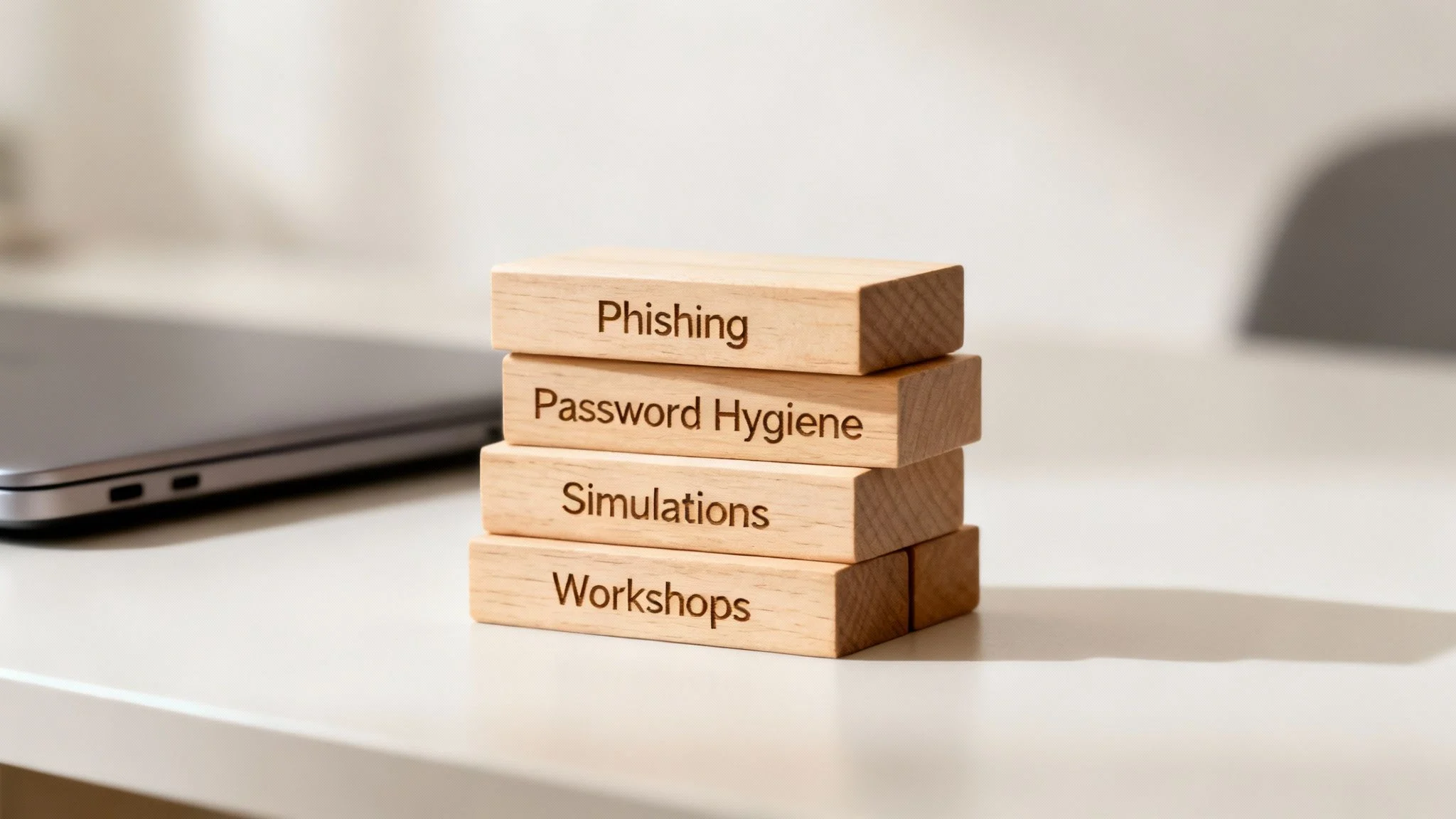
A genuinely impactful security awareness and training program is a world away from a once-a-year video and a quick quiz. Think of it less like a tick-box exercise and more like building a layered defence system directly into your team’s everyday habits. To create real, lasting change in how people behave online, you need a solid structure built on several essential pillars that all work together.
These pillars are what turn your team from being passive followers of security policies into active defenders of your organisation’s data. Each component plays a specific role, tackling different threats and reinforcing secure habits in various ways. Let’s break down what these crucial building blocks look like in the real world.
Crafting a Core Curriculum
At the heart of any solid program is a core curriculum that hits the most common threats your team will actually face. This isn’t about getting lost in the weeds of every obscure cyber threat out there; it’s about mastering the fundamentals that prevent the vast majority of incidents.
Your curriculum should be built around a few non-negotiable topics:
- Phishing and Social Engineering: Teach your team how to spot suspicious emails, dodgy text messages (smishing), and manipulative phone calls. This means showing them the red flags, like urgent requests, generic greetings, and email addresses that just don’t look right.
- Password Hygiene and Authentication: Explain why creating strong, unique passwords for every single service matters. More importantly, this is where you introduce tools like password managers and make multi-factor authentication (MFA) a non-negotiable security layer.
- Safe Web Browsing: Cover the risks of clicking on unfamiliar links, downloading files from untrusted websites, and the dangers of using unsecured public Wi-Fi networks.
- Physical Security: This is about reminding staff of the simple but vital stuff, like locking their screens when they step away, securing sensitive documents, and just being aware of who might be looking over their shoulder in a café or co-working space.
Choosing Your Delivery Methods
How you deliver the training is just as important as what you’re teaching. A one-size-fits-all approach almost never works because people learn in different ways. The best strategy blends various methods to keep the material engaging and fresh.
Try mixing and matching from the following:
- Interactive E-Learning Modules: Short, self-paced online courses with quizzes are perfect for covering the foundational topics effectively.
- In-Person or Virtual Workshops: These are fantastic for more complex topics like spotting social engineering, as they allow for real discussion and live Q&A sessions.
- Micro-Learning Content: Think short videos, infographics, or quick tips sent out via email or your internal chat platform. This keeps security top-of-mind without causing training burnout.
A program that combines different learning styles is proven to be more effective. Research shows that interactive training can boost knowledge retention by over 50% compared to passive methods like just reading a document.
The Power of Phishing Simulations
Of all the components, regular phishing simulations are probably the single most powerful tool for driving real behavioural change. These are controlled, fake phishing emails sent to your staff to see how they respond in a completely safe environment. They are absolutely not “gotcha” tests designed to punish or embarrass employees.
Their purpose is purely educational. When an employee clicks on a simulated phishing link, they should be immediately taken to a landing page that clearly explains the red flags they missed. This instant feedback loop is incredibly effective—it turns a mistake into a powerful, memorable learning moment.
Time and time again, the data shows that organisations running regular phishing tests see a dramatic drop in their click-rates. It’s the difference between telling someone how to spot a threat and letting them practice doing it.
The table below breaks down how these key components fit together to form a robust program.
Key Components of a Security Awareness Program
| Component | Objective | Example Activities |
|---|---|---|
| Core Curriculum | Build foundational knowledge of key cyber risks. | E-learning on phishing, password hygiene, and data handling. |
| Diverse Delivery | Keep employees engaged and cater to all learners. | Workshops, short videos, infographics, and email tips. |
| Phishing Simulations | Test and reinforce knowledge in a practical way. | Sending realistic but safe phishing emails to staff. |
| Clear Policies | Set clear expectations for secure behaviour. | Documenting rules for device usage and data access. |
By weaving these elements together, you create a continuous cycle of learning, testing, and reinforcing that builds a truly security-conscious culture.
Why Your Business Cannot Afford to Skip Training
In the Australian business world, skipping security awareness training isn’t just an oversight anymore—it’s a massive gamble with your company’s future. The conversation has moved on from if a cyberattack will happen, to when. Investing in your team’s security know-how isn’t an expense; it’s a direct investment in your organisation’s resilience, reputation, and financial stability.
Ignoring this critical layer of defence leaves your business wide open to increasingly clever threats. It’s time for a clear-eyed look at the real-world risks and rewards, making the need for training undeniable.
The Rising Tide of Cyber Threats in Australia
Cybercriminals are actively targeting Australian businesses, and their tactics are getting sharper every day. Phishing, in particular, has exploded, turning the everyday inbox into the main entry point for attackers. The damage from just one successful attempt can be devastating, leading to data breaches, serious financial loss, and operational chaos.
The numbers tell a sobering story. According to the Australian Cyber Security Centre (ACSC), there was a 140% jump in the monthly average of employees clicking on phishing links compared to last year. This huge increase proves that automated security filters just aren’t enough. What’s even more alarming is that 41% of employees reported never having received any cybersecurity training, leaving a massive hole in our national business defences. You can dig into more insights on this growing threat from recent Australian industry commentary.
A well-trained employee is your most effective sensor for detecting threats. They can spot a suspicious email that a security filter might miss, question an unusual request for information, and report potential incidents before they escalate into full-blown crises.
This human element is exactly why ongoing security awareness and training is so crucial. It gives your team the skills to spot and react to these threats, effectively shutting them down at the source.
More Than Just Avoiding Attacks
The payoff from a solid training program goes way beyond just stopping breaches. It directly strengthens key areas of your business, making your whole operation tougher from the inside out. A security-savvy team is a huge asset that protects your bottom line in more ways than one.
- Meeting Compliance Obligations: Here in Australia, the Privacy Act and the Notifiable Data Breaches (NDB) scheme place serious duties on businesses to protect personal information. Showing you have a proactive training program is a key part of meeting these legal rules and can massively reduce penalties if an incident occurs.
- Protecting Your Brand Reputation: A data breach can instantly destroy the trust you’ve worked so hard to build with your customers. The damage to your reputation is often far more costly and long-lasting than the initial financial hit. A strong security culture shows clients you take their data seriously, reinforcing their confidence in your brand.
- Boosting Employee Confidence: When employees know how to handle security threats, they feel more empowered and less anxious in their day-to-day work. This confidence leads to a more secure and productive team, where people feel like part of the solution, not the problem.
Ultimately, skipping training is like leaving your front door unlocked and just hoping for the best. It’s a risk no modern business can afford to take. You can read our guide on other critical steps to take to prevent data breaches in your organisation. A small investment in education now can prevent catastrophic losses down the track.
How to Measure Your Training Program’s Success
You’ve invested in security awareness and training for your team, which is a fantastic first step. But how do you actually know if it’s working? It’s a fair question. Proving the value of your program means looking beyond simple things like who completed a course.
Real success is measured by a genuine shift in your team’s behaviour—when they move from just knowing about threats to actively defending against them. You need to see that your “human firewall” is getting stronger. This data-driven approach not only justifies the ongoing cost but also gives you the insights needed to fine-tune your strategy.
The infographic below really drives home why this is so critical for Australian organisations.
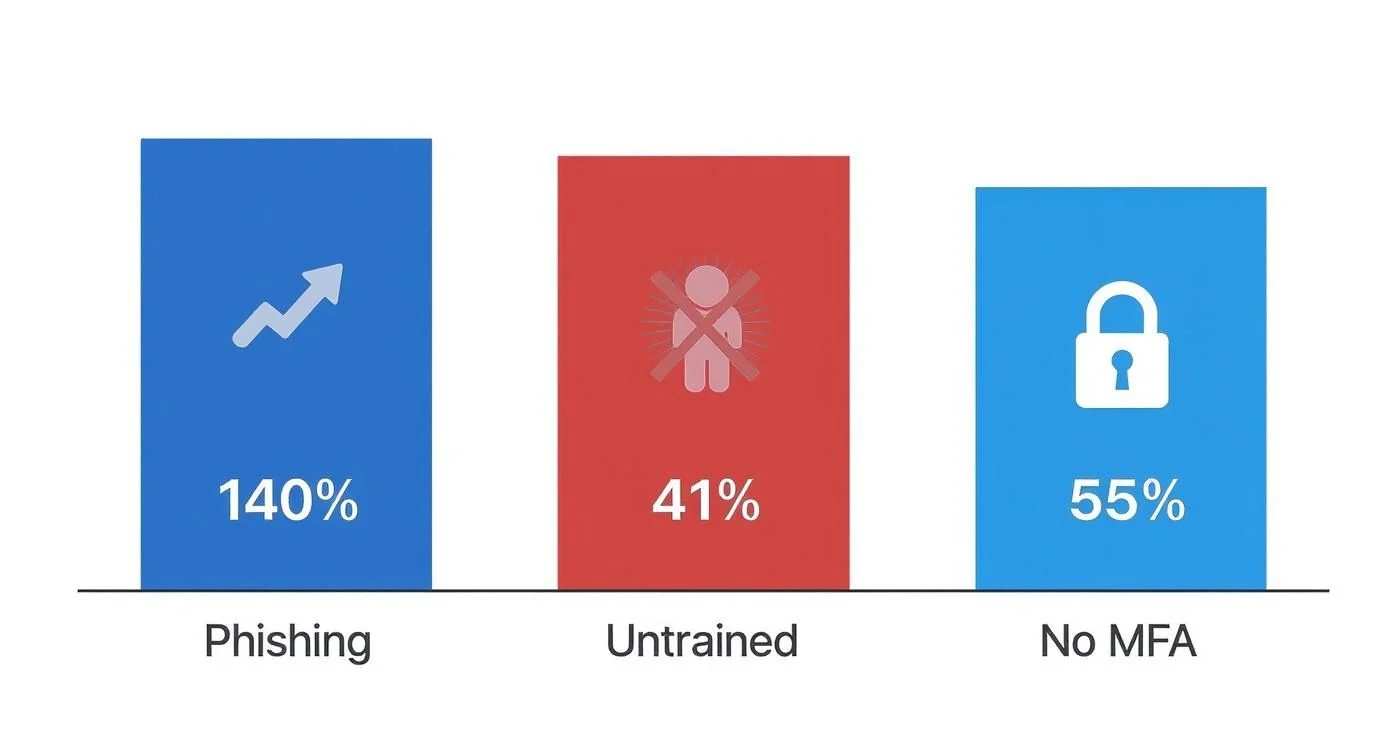
These numbers highlight an urgent need for training programs that tackle the most common threats head-on, like phishing, while closing those big gaps in staff knowledge.
Key Metrics That Signal Real Progress
To get a clear picture of how effective your program is, you need to focus on a few key metrics that directly show changes in behaviour and a reduction in risk. These numbers tell a story about how well your team is absorbing and, more importantly, applying their security training in the real world.
Here are the essential metrics to track:
- Phishing Simulation Click Rates: This is the gold standard. It tracks the percentage of employees who fall for a simulated phishing email. Your goal is simple: to see this number go down, and stay down, over time as your team gets sharper.
- Incident Reporting Rates: This one might seem counterintuitive, but an increase in employees reporting suspicious emails is a brilliant sign. It means your team isn’t just spotting threats but also knows exactly what to do about them, turning every staff member into an active part of your defence.
- Knowledge Assessment Scores: Quick quizzes after training modules help you see if the information is sticking. Tracking improvements in these scores over time confirms that the core security concepts are being retained.
Measuring these behavioural changes provides a tangible way to demonstrate ROI. When you can show leadership a 40% reduction in phishing clicks in just a few months, the value of the training becomes undeniable.
Benchmarking and Demonstrating Value
Tracking your own metrics is powerful, but seeing how they stack up against industry benchmarks adds a whole new layer of context. For example, recent data shows that the baseline phishing click rate for untrained employees in Australia and New Zealand was a startling 36.8%.
But here’s the good news: after just three months of consistent security awareness training, that rate dropped by 40%. After a full year, it fell by a massive 86%. These are powerful statistics that prove a dedicated program can dramatically lower your organisation’s vulnerability. You can dig deeper into these training effectiveness findings.
Aligning Metrics with Broader Goals
The data you gather doesn’t just live in a vacuum. It can also support wider business goals, like meeting regulatory compliance.
For instance, demonstrating a measurable reduction in human risk is a key part of frameworks like ISO 27001. By tracking these KPIs, you create a documented record of your commitment to security, which is invaluable during an audit.
Ultimately, measuring success is about creating a continuous feedback loop. Use the data you gather to spot areas where your team might need a bit more support, tweak your phishing simulations for better results, and remember to celebrate the wins. It keeps everyone motivated and engaged in building a stronger security culture together.
Partnering With Tbourke Solutions to Build Your Defenses
Knowing you need security awareness and training is one thing. Actually designing and running a program that works is a whole different ball game. This is where a dedicated partner can turn a simple compliance task into a genuine cultural shift that protects your business from the ground up.
At Tbourke Solutions, our goal is to build robust security cultures, not just tick boxes on a checklist. We understand that every organisation is different. A local school has completely different risks and day-to-day realities compared to a small business or a growing startup. That’s why we work right alongside you to build a program that makes sense for your specific industry, budget, and team.
Customised Programs for Real-World Threats
Our entire approach is built on a simple idea: if training isn’t relevant and engaging, it’s a waste of time. We steer clear of dry, forgettable content that puts people to sleep. Instead, we focus on practical, real-world scenarios your team will actually see in their inbox. This way, the lessons stick and translate into stronger, instinctual security habits.
We offer a complete suite of services designed to build and maintain your human firewall:
- Tailored Training Content: We develop a curriculum just for your team, zeroing in on the threats most likely to target your industry. Think sophisticated invoice fraud for a finance team or social engineering tactics aimed at school administrators.
- Managed Phishing Simulations: We run realistic but safe phishing campaigns to test and sharpen your team’s skills. You get clear, insightful reports that show progress over time, highlighting where a little more focus is needed.
- Ongoing Support and Consultation: Building a security-savvy culture isn’t a one-and-done project. We provide continuous support to help you adapt your program as new threats pop up and your business evolves.
Partnering with an expert doesn’t just save you time; it gives you access to specialised knowledge and tools. We handle the heavy lifting of program management, so you can focus on running your business, confident that your team is ready for modern cyber threats.
Your Local Melbourne Security Partner
Based right here in Hillside, Melbourne, Tbourke Solutions is passionate about making strong cybersecurity accessible for local small and medium businesses. We get the unique challenges you face and offer practical solutions that deliver real value without breaking the bank.
Our approach goes beyond just training. As part of our commitment to your business’s overall security, we offer a full range of managed cybersecurity services that protect your entire technology environment. This integrated strategy makes sure your technical defences and your human firewall are working together seamlessly.
Ready to turn your team into your strongest line of defence? Let’s build a security awareness and training program that actually makes a difference.
To start the conversation and chat about your specific needs, please submit a query on our contact page. We’re here to help you strengthen your defences.
Frequently Asked Questions About Security Awareness and Training
Here are answers to some of the most common questions business leaders ask when developing a security awareness and training program.
How often should we conduct security training?
Think of it as an ongoing fitness program, not a one-time event. The old model of a single annual training session is no longer effective against threats that evolve weekly. A continuous approach is best:
- Initial Onboarding: All new hires should receive foundational security training on day one.
- Regular Reinforcement: Use bite-sized content like short monthly videos, tips, or quarterly quizzes to keep security top-of-mind.
- Frequent Phishing Simulations: Running phishing tests at least quarterly (ideally monthly) builds practical skills and muscle memory for spotting real-world threats.
What makes a phishing simulation effective?
A successful phishing simulation is less about catching people out and more about creating a memorable learning experience. The most effective simulations are:
- Realistic: The fake emails should mimic the genuine threats your team is likely to face.
- Educational: When an employee clicks a link, they should land on an immediate “teachable moment” page that clearly explains the red flags they missed.
- Non-Punitive: The goal is education, not punishment. Fostering a positive, blame-free culture encourages people to report real threats without fear.
Do small businesses really need this training?
Yes, absolutely. Cybercriminals often target small and medium-sized businesses precisely because they assume they have weaker security controls and less training. A single data breach can be financially devastating for an SMB, making security awareness training one of the most cost-effective investments you can make in your company’s resilience.
How can Tbourke Solutions help my business?
At Tbourke Solutions, we specialise in creating customised security awareness and training programs that actually work for your team and your budget. We go beyond generic content to deliver:
- Managed Phishing Simulations: We run realistic campaigns and provide clear reports to track your team’s progress.
- Tailored Training Content: Our curriculum is designed to address the specific threats your industry faces, making the learning relevant and engaging.
- Ongoing Expert Support: We partner with you to adapt your program as new threats emerge, ensuring your human firewall stays strong.
If you’re ready to empower your team and turn them into your best security asset, we’re here to help. To get started, please reach out and submit a query on our contact page.
Share This Story, Choose Your Platform!