Figuring out whether to go with a private or public cloud really comes down to one thing: the trade-off between control and convenience.
Think of it like this: a public cloud is a bit like renting a fully-serviced apartment. It’s cost-effective, you can get more space whenever you need it, and someone else handles all the maintenance. The catch? You’re sharing the building with other tenants. A private cloud, on the other hand, is like owning your own house. You have total control, top-notch security, and everything is exclusively yours, but it comes with a hefty upfront investment and the responsibility of ongoing upkeep.
Choosing Your Cloud Path: An Introduction
Deciding on the right cloud model is a foundational step for any modern Australian organisation. This choice ripples through everything, from your annual budget and security strategy to how quickly you can grow your operations. This guide is here to demystify the private vs. public cloud debate, cutting through the jargon to focus on what actually matters for small businesses, schools, and even families.
TL;DR: The Bottom Line
Choosing between a private vs public cloud is a trade-off between control and convenience. Public clouds offer pay-as-you-go scalability, which is ideal for businesses with fluctuating needs or those wanting to avoid large upfront costs. Private clouds provide maximum security and control over your hardware and data, making them perfect for organisations with strict compliance requirements. A hybrid cloud combines both, offering a flexible middle ground for more complex operational needs.

Core Differences at a Glance
Before we dive deep, it helps to see the fundamental distinctions side-by-side. We’ll explore these points in more detail, but this table gives you a quick overview.
| Feature | Public Cloud | Private Cloud |
|---|---|---|
| Ownership | Owned and run by a third-party provider (like AWS or Azure). | Owned and run by a single organisation for its own use. |
| Cost Model | Pay-as-you-go, based on what you use (operational expense). | Upfront capital investment for hardware, plus ongoing maintenance. |
| Control | Limited control over the underlying infrastructure and hardware. | Full control over hardware, software, and security settings. |
| Security | A shared responsibility; the provider secures the cloud, you secure your data. | The organisation is completely responsible for all security measures. |
Our goal here is to give you a clear framework to figure out which cloud strategy best fits your unique needs, budget, and long-term goals.
A Quick Guide to Making Your Cloud Decision
If you need a fast answer, here’s the bottom line on the private vs. public cloud choice.
Public clouds, like AWS and Azure, offer incredible scalability with pay-as-you-go pricing. This makes them a perfect fit for startups and businesses with fluctuating workloads, allowing you to grow quickly without sinking a huge amount of cash into hardware upfront. This model is a core part of effective infrastructure as a service strategies.
On the other hand, private clouds deliver unmatched security and control. They’re the go-to for organisations that handle sensitive data and must meet strict compliance rules, like medical centres or financial advisors. You get a dedicated environment where your resources are never shared.
A hybrid cloud setup offers a practical middle ground, blending the public cloud’s cost-effectiveness with the robust security of a private cloud.
The Quick Summary
The whole private vs. public cloud debate really boils down to a trade-off: control versus convenience. Public clouds give you scalable, pay-as-you-go services that are brilliant for changing demands. Private clouds offer maximum security and control for your most sensitive data. The hybrid model mixes both, giving you a flexible, best-of-both-worlds solution for more complex needs.
This quick summary should help you figure out the best starting point for your business before we dive into the nitty-gritty details.
A Nuanced Comparison of Cloud Models
Choosing between cloud models is not just a technical decision; it’s a business one that impacts your budget, security, and day-to-day operations. Moving past the simple definitions is key. The private vs public cloud debate really comes down to a handful of critical factors, each with trade-offs that can make or break your IT strategy.
To make the right call, we need to compare them across five key areas: how you pay for it, who controls security, raw performance, how much management it needs, and how much you can tweak it to your needs. Getting these details right will make it crystal clear which path aligns with your specific goals.
Cost Structures: Capital vs. Operational Expense
The first and most obvious difference you’ll feel is in your bank account. The public cloud runs on a pay-as-you-go operational expense (OpEx) model, which is a massive draw for businesses wanting to avoid big upfront costs. You just pay for the resources you use, like a utility bill.
This flexibility is driving huge growth. Australian businesses are on track to spend nearly $26.6 billion on public cloud services in 2025, up a whopping 18.9% from 2024. This is not just a small shift; it’s a fundamental move away from traditional IT spending. You can dig into the numbers in Gartner’s latest report on Australian public cloud spending.
On the flip side, a private cloud demands a significant upfront capital expense (CapEx). You’re buying, installing, and setting up your own hardware, which is a major initial investment. While this can lead to a lower total cost of ownership over many years for stable, predictable workloads, that first financial hurdle is a high one.
Key Takeaway: The public cloud’s OpEx model offers financial agility, making it perfect for startups and businesses with fluctuating demand. The private cloud’s CapEx model is a better fit for larger organisations with predictable workloads and the capital to invest for the long term.
Security and Compliance: The Control Trade-off
When we talk about security, what we’re really talking about is control. In a public cloud, security is a partnership. The provider secures the fundamental infrastructure, the data centres, servers, and networking, but you’re still on the hook for securing your own data, applications, and user access within that environment.
This decision tree gives you a quick visual to see how priorities like security and control can point you toward one model or another.
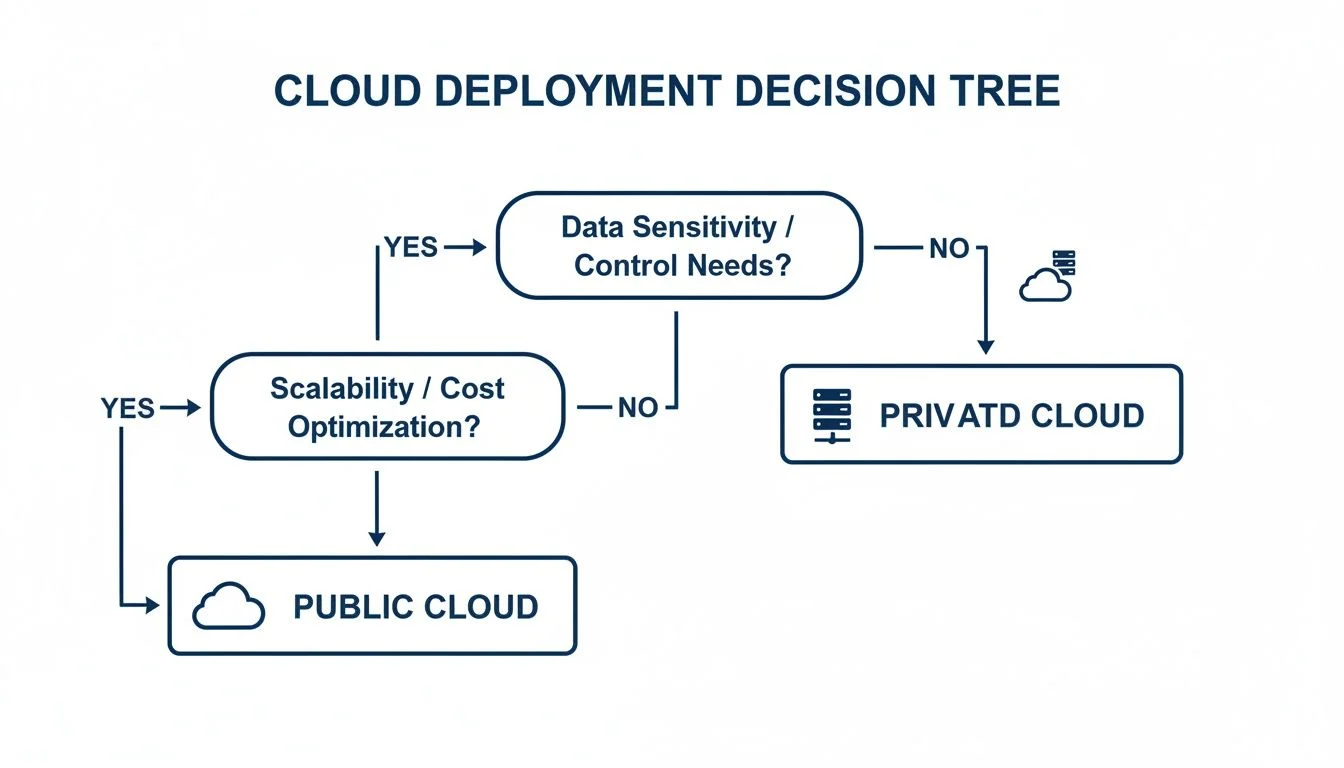
As you can see, the more you need to lock things down, the more the needle moves from public towards private or hybrid solutions.
A private cloud, in contrast, gives you the ultimate level of control. Because the hardware is all yours, you can enforce incredibly specific security policies and custom configurations. This is non-negotiable for businesses in sectors like finance or healthcare that have to meet strict compliance rules. It’s also vital for data sovereignty, where laws require that your data physically stays within Australia’s borders.
Performance and Scalability
Public clouds are famous for offering what feels like limitless scalability on demand. Need to handle a sudden traffic spike from a marketing campaign? You can ramp up your resources in minutes. That said, performance can sometimes be unpredictable due to the “noisy neighbour” effect, where another customer on the same shared hardware hogs resources and slows you down.
Private clouds deliver consistent, reliable performance because all the resources are dedicated to you and only you. The catch? Scalability is limited by the physical hardware you own. If you need more capacity, you have to buy and install new servers, a process that can easily take weeks or months. This is where your choice of virtualisation platform really matters; our guide comparing Proxmox vs VMware vs Hyper-V dives deeper into the engines that power private clouds.
Real-World Scenarios: Choosing Your Cloud
Theory is great, but the real test comes when you have to apply it. The best cloud choice, private, public, or hybrid, really boils down to your specific situation. Are you a growing business, a school, a fast-moving startup, or just a family wanting to keep precious memories safe?
To make it tangible, let’s walk through how different cloud models fit distinct needs. Each scenario shows how to match the cloud’s strengths to your budget, security needs, and operational goals.

Small to Medium Businesses in Australia
For many Australian SMEs, a hybrid cloud model hits the sweet spot. Picture a financial advisory firm in Melbourne that needs to protect sensitive client data under strict compliance rules. They can run their core financial systems and client databases on a private cloud, giving them maximum control and security over that critical information.
At the same time, they can use the public cloud for their customer-facing website, email marketing, and everyday office apps. This approach gives them the cost savings and scalability of the public cloud where it makes sense, without ever compromising the security of their most important assets. Getting the numbers right is key, and our experts can assist with cloud services for finance departments.
Educational Institutions and Schools
Schools and universities deal with massive fluctuations in demand. Student enrolment, exam periods, and research projects create huge peaks and valleys in resource usage. The public cloud was practically built for this.
A public cloud’s elasticity allows a school to instantly scale up computing resources to support thousands of students during online exams and then scale back down just as quickly, paying only for what was used. This avoids the cost of maintaining expensive on-premises hardware that sits idle most of the year.
Startups Aiming for Rapid Growth
For a startup, speed is everything. The public cloud is the ultimate launchpad, eliminating the need for a huge upfront investment in servers and IT gear. A new tech company can get its application up and running globally in minutes, using a pay-as-you-go model that’s perfect for a lean budget.
This low barrier to entry means startups can pour their limited funds into developing their product and winning customers, not managing hardware.
Families Storing Personal Data
Even at home, the private vs public cloud question comes up. For most families, public cloud services like Google Drive or iCloud are a simple, affordable, and reliable fix. They’re perfect for backing up family photos, storing important documents, and securely sharing files with relatives. All the maintenance is handled by the provider, giving you peace of mind without any technical headaches.
As you weigh these real-world scenarios, it’s also important to think about how you’ll manage development within your chosen environment. For some great insights on this, check out A CTO’s Guide to Developing in the Cloud for Maximum Impact.
The Growth of Public Cloud in Australia
The shift towards public cloud solutions here in Australia is not just a passing trend; it’s a fundamental change in how businesses operate. Companies of all shapes and sizes are turning to public and hybrid cloud models to get a real competitive edge, and it’s easy to see why. This movement is being supercharged by a perfect storm of government encouragement and huge local investments from global tech giants.
Hyperscalers like Google and AWS are pouring billions into building and expanding their data centres in Sydney and Melbourne. This is a game-changer. For years, concerns about data sovereignty, keeping sensitive information within Australia’s borders, were a major roadblock. With local facilities, that worry is off the table. It also means a massive performance boost and lower latency for Australian users, making the public cloud a faster, more responsive choice than ever before.
Government Initiatives and Market Confidence
It’s not just the private sector driving this change. Government policies are actively building trust in cloud technology. The Digital Transformation Agency’s ‘cloud first’ policy is a massive vote of confidence, encouraging public sector agencies to prioritise cloud solutions. This has a powerful ripple effect, showing private businesses that these platforms are secure and reliable enough for government use. For a deeper dive into how this technology is helping businesses across the country, check out these insights on cloud computing in Australia.
The numbers tell the story loud and clear. Across the ANZ region, cloud spending is expected to reach USD 10.89 billion in 2025 and skyrocket to USD 30.45 billion by 2030, with public cloud leading the way. This growth is fuelled by major projects like Google Cloud’s new Sydney zones and NEXTDC’s carbon-neutral facility in Melbourne, both designed to handle the heavy-duty AI workloads that are becoming essential for businesses and schools.
Key Insight: The combination of local data centre investments and supportive government policies has created a perfect environment for public cloud growth, making it the default choice for Australian organisations focused on agility and innovation.
All this market momentum really highlights how important it is to have a clear cloud strategy. The conversation is no longer about if you should move to the cloud, but how you should tackle the private vs. public cloud decision to set your organisation up for the future.
Frequently Asked Questions
Even after breaking down the differences between private vs public cloud, a few key questions always pop up. We hear them from businesses all the time. Let’s tackle them head-on to clear up any lingering doubts you might have.
Is the public cloud secure enough for my business data?
For the vast majority of businesses, the answer is a resounding yes. Big players like Microsoft Azure and AWS invest billions of dollars into security infrastructure, far more than any single organisation could ever dream of spending. They hold certifications for just about every compliance standard under the sun.
But there’s a catch: it’s a shared responsibility. The provider secures the global infrastructure, but you’re still on the hook for securing your own data and applications within that environment. While this is perfectly fine for most, businesses handling extremely sensitive or tightly regulated data might still lean towards the absolute control a private or hybrid cloud offers.
What’s the biggest hidden cost of a private cloud?
Without a doubt, the most overlooked cost of running a private cloud is the ongoing operational overhead. Everyone budgets for the initial hardware purchase, but it’s the long-term expenses that really start to bite. People often forget about the constant need for management, maintenance, and specialised IT staff.
These recurring costs quickly add up:
- Power and cooling for your server room or data centre.
- Software licensing and annual subscriptions.
- Regular hardware refreshes every three to five years.
- The salaries for the expert IT team needed to keep it all running smoothly.
This is where the public cloud’s pay-as-you-go model shines. It bundles all those operational costs into a much more predictable monthly fee, which makes budgeting a whole lot simpler.
When does a hybrid cloud make the most sense?
A hybrid cloud is your go-to option when you need to balance two competing needs, like airtight security and affordable scalability. It’s the perfect fit for an organisation with sensitive data or legacy systems that, for compliance or technical reasons, absolutely must stay on-premise in a controlled private environment.
At the same time, that same organisation can tap into the public cloud for everything else, think development and testing environments, or a public-facing website that needs to handle traffic spikes. This “best of both worlds” approach gives you a level of flexibility that a pure public or private model just can’t match.
How complicated is it to actually move to the cloud?
The complexity of a cloud migration really depends on your starting point and where you want to go. Shifting a single, modern application to the cloud can be pretty straightforward. But trying to move an entire ecosystem of tangled, legacy applications? That requires meticulous planning to avoid disrupting your business, causing downtime, or losing data.
This is exactly where having an experienced IT partner in your corner becomes a game-changer. A good partner can properly assess your current setup, map out a phased migration strategy, and handle the whole process from start to finish. The goal is always a smooth, secure transition with as little interruption to your daily operations as possible.
How Tbourke Solutions Can Guide Your Cloud Journey
Picking the right cloud model is a big decision, but it’s really just the starting point. The real work, and where things can get complicated, is in the migration, setup, and day-to-day management. That’s where we come in. At Tbourke Solutions, we partner with businesses, schools, and families across Melbourne to turn that cloud strategy into a reality that’s both secure and efficient.
With over 20 years of hands-on experience, we provide practical, jargon-free IT advice to help you navigate the choice between private, public, and hybrid cloud setups. We don’t just point you in a direction; we build the solution and manage it for you. Our goal is to make your transition seamless and your operations effortless, providing peace of mind so you can focus on what you do best.
Custom Cloud Solutions
Whether you need a straightforward public cloud for its simplicity, a high-security private cloud for sensitive data, or a flexible hybrid solution, our team has the expertise to design, implement, and support the perfect fit. Our managed IT services are designed to ensure your cloud environment stays optimised, secure, and perfectly aligned with your goals.
For anyone planning a major shift to the cloud, our detailed Azure Migrate guide gives you a clear look at the structured, careful approach we take. We believe in complete transparency with no hidden costs, delivering solutions that genuinely make life easier.
Start Your Cloud Conversation Today
Making the right choice between private and public cloud can define your organisation’s security and agility for years to come. Let our experienced team help you make that call with confidence.
Ready to talk about your cloud needs? The easiest way to start is to visit our contact page and submit a query. We’re here to help you get the right technology working for you.
Share This Story, Choose Your Platform!