When you hear “infrastructure as a services,” it’s easy to get lost in the jargon, but understanding it could be the key to unlocking major cost savings and flexibility for your business. Simply put, it’s a way of renting the essential building blocks of IT—like servers, data storage, and networking—over the internet instead of buying and managing expensive physical hardware yourself. This guide breaks down what these services are, how they work, and why they are a game-changer for businesses looking to become more agile and efficient.
This model is known as Infrastructure as a Service (IaaS), and it offers incredible flexibility and cost savings, especially for small and medium businesses. You only pay for what you actually use, turning a large capital expense into a predictable operational cost.
What is Infrastructure as a Service, Really?
Think of it like leasing a fully-equipped workshop instead of buying the land and building one from scratch. You get immediate access to all the heavy machinery (servers), shelving (storage), and power (networking) you could ever need.
You’re in complete control of what you build inside that workshop, but you don’t have to worry about maintaining the building or fixing the equipment. That’s the core idea behind infrastructure cloud services. All the headaches of managing physical hardware are handed over to a provider, freeing up your team to focus on what actually grows your business.
The provider owns and operates massive data centres, making sure everything is secure, up-to-date, and running smoothly. Your business just plugs into this huge pool of resources through the internet.
The Key Building Blocks
At its heart, IaaS gives you three core components that form the foundation for almost any digital operation. We’ve put together a quick table to show how these building blocks shift the responsibility from your team to the cloud provider.
Key Components of Infrastructure Cloud Services at a Glance
| Component | Description | Business Benefit |
|---|---|---|
| Compute | The virtual servers and machines that provide the raw processing power to run your applications. | Instantly scale your power up or down without buying new hardware. |
| Storage | Highly scalable data storage, from super-fast databases to affordable long-term archival solutions. | Never run out of space and only pay for what you use, avoiding big upfront costs. |
| Networking | The virtual routers, switches, and connections that link your resources together and to the internet. | Securely connect your applications and users without managing complex network gear. |
This setup is powerful because it lets you build exactly what you need, piece by piece, without being locked into expensive hardware that might be outdated in a couple of years.
IaaS is a game-changer because it flips a huge, upfront capital expense (buying servers) into a predictable, operational expense (a monthly bill). This shift allows businesses to be more agile, scaling resources up or down as customer demand changes.
Common Questions We Hear
What’s the biggest benefit of IaaS?
Without a doubt, it’s agility. You can spin up a new server in a few minutes, not the weeks or months it takes to order and install a physical one. This lets you test new ideas, launch products faster, and respond to market changes at a speed that just wasn’t possible with old-school IT.
But is it secure?
Yes. Major cloud providers invest billions in security measures that are far beyond what most small businesses could afford. They handle the physical security of the data centres—the fences, cameras, and guards—while you manage the access and settings for your virtual resources. Understanding your options is key, and platforms like the Windows Azure Platform provide robust tools to help you lock down your environment properly.
Understanding IaaS, PaaS, and SaaS
The world of infrastructure cloud services isn’t a one-size-fits-all solution. To figure out the right path for your business, you first need to get your head around the three main models: Infrastructure as a Service (IaaS), Platform as a Service (PaaS), and Software as a Service (SaaS).
A simple pizza analogy is a great way to break down the differences in control and responsibility.
Think of IaaS as renting a fully-equipped professional kitchen. You get the ovens, benches, and tools, but you’re in complete control of the ingredients and the entire pizza-making process, right from scratch. This model offers the most flexibility for businesses with specific or custom IT needs.
PaaS is more like getting a pizza-making kit delivered to your door. The provider gives you the dough, sauce, and cheese, but you get to choose and add all your own toppings. You manage the application (the toppings), but not the underlying platform (the pizza base).
Finally, SaaS is the equivalent of just ordering a finished pizza. It arrives ready to eat, with zero cooking required from you. This is the most common model, where you simply use the software—like your email or accounting program—without ever worrying about how it’s built or maintained.
This chart shows how the cloud provider manages the core components—servers, storage, and networking—that form the foundation of all these services.
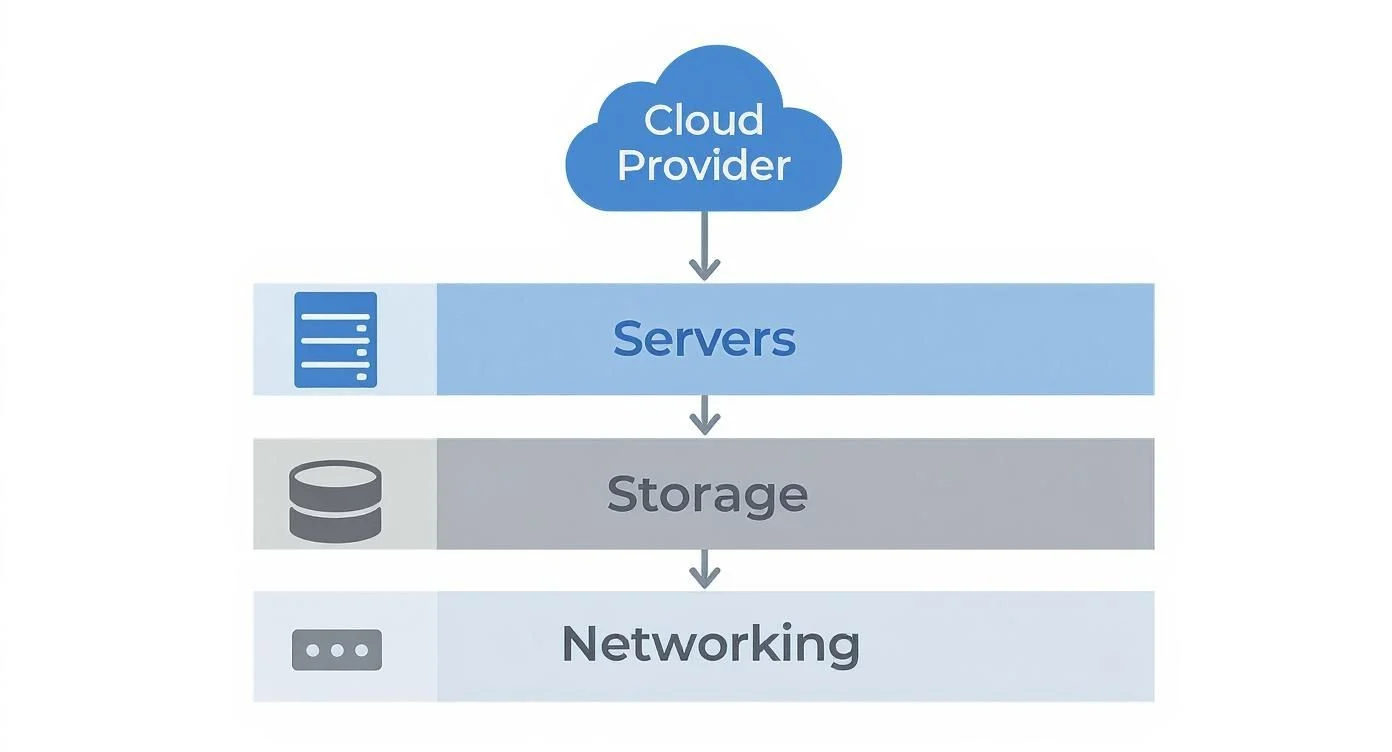
As the infographic shows, those fundamental building blocks are entirely managed by the provider, freeing you up to focus on building your own solutions on top.
Comparing IaaS vs PaaS vs SaaS Management Responsibilities
To make it even clearer, let’s look at who manages what in each model. The table below breaks down the technical layers, showing where your responsibility ends and the provider’s begins.
| IT Layer | You Manage (IaaS) | You Manage (PaaS) | You Manage (SaaS) |
|---|---|---|---|
| Applications | Yes | Yes | No |
| Data | Yes | Yes | No |
| Runtime | Yes | No | No |
| Middleware | Yes | No | No |
| Operating System | Yes | No | No |
| Virtualisation | No | No | No |
| Servers | No | No | No |
| Storage | No | No | No |
| Networking | No | No | No |
As you can see, IaaS gives you the keys to the kingdom from the operating system up, while SaaS handles everything for you. PaaS sits right in the middle, giving developers a ready-made workshop to create their applications.
Common Questions People Ask
Understanding these models usually brings up a few key questions. Here are some straight answers to the queries we hear most often from business owners.
- Which model gives me the most control?
IaaS provides the highest level of control, hands down. You manage everything from the operating system upwards, including applications, data, and middleware. This is ideal for complex setups, like managing specific versions of a Windows Server, which you can learn more about in our detailed guide. - Which model is the easiest to use?
SaaS is by far the easiest. You just log in and start using the software, like an email service or CRM. The provider handles all the updates, security, and maintenance behind the scenes. - When would I choose PaaS?
PaaS is perfect for developers who want to build and deploy applications quickly without getting bogged down managing the underlying infrastructure. It provides the tools and environment, letting them focus purely on writing code.
Australian Cloud Adoption on the Rise
The appeal of these models is driving serious investment across the country. Australian organisations are forecast to spend nearly A$26.6 billion on public cloud services in the coming year, an 18.9% jump that outpaces global averages.
IaaS is leading this growth with a projected surge of 24.2%, while SaaS remains the largest slice of the pie by spending.
The key takeaway is this: IaaS offers foundational flexibility, PaaS accelerates development, and SaaS delivers immediate convenience. Your choice comes down to your business needs, technical expertise, and how much control you want.
Key Benefits of Adopting Cloud Infrastructure
Moving to the cloud isn’t just a tech upgrade; it’s a strategic shift that delivers some serious, real-world advantages for your business. For many Australian small businesses, the most immediate and compelling benefit is the way it completely changes how you handle IT costs.
Forget about sinking thousands into physical servers that start losing value the moment you plug them in. Instead, you switch to a flexible, pay-as-you-go model. You only pay for the computing power, storage, and networking you actually use, turning a massive capital expense (CapEx) into a predictable operational expense (OpEx).

This change in thinking is exactly why the Australian cloud market is growing so fast. What was a USD 14.98 billion market is on track to hit an incredible USD 60.75 billion by 2030. Infrastructure as a Service (IaaS) is the fastest-growing piece of that pie, driven by businesses chasing this exact cost-effective adaptability.
Effortless Scalability and Agility
Picture this: your e-commerce site gets a surprise feature on national television. With old-school on-site hardware, that sudden flood of traffic would almost certainly crash your servers. The result? Lost sales and a damaged reputation.
With cloud infrastructure, you can automatically scale up your resources in minutes to handle the spike. When traffic returns to normal, it scales back down. This elasticity means you’re never paying for power you don’t need, but you always have it ready for those peak moments.
This ability to adapt on the fly gives your business incredible agility. You can launch new applications or test new markets without the months-long process of buying and setting up new hardware. It massively shrinks your time-to-market.
Superior Business Continuity and Disaster Recovery
What would happen if your office had a fire, a flood, or a major blackout? For businesses relying on servers tucked away in a back room, it could be catastrophic, leading to permanent data loss and days or even weeks of downtime.
Cloud providers have built-in redundancy and disaster recovery plans that are simply too expensive for most small businesses to build themselves. Your data can be automatically backed up and copied across multiple, geographically separate locations.
In the event of a disaster at your main site, you can failover to a secondary location and have your systems back online in a fraction of the time it would take with a traditional setup. This kind of resilience is no longer a luxury for big corporations; it’s an accessible advantage for everyone.
Global Reach and Reduced Maintenance
Thinking of expanding internationally? It used to mean setting up physical data centres in different countries—a logistical and financial nightmare. With a global IaaS provider, you can deploy your applications in data centres around the world with just a few clicks. This lets you serve customers in new regions with low latency while staying compliant with local data laws.
On top of that, moving to the cloud means you can finally offload the thankless task of hardware maintenance. Your team no longer has to worry about replacing busted components, managing cooling systems, or patching physical machines. This frees up your IT staff to work on projects that actually grow the business.
Common Questions About Cloud Benefits
- Will I really save money?
For most businesses, yes. The total cost of ownership is lower because you eliminate expenses for hardware, electricity, cooling, and the physical space for a server room. The pay-as-you-go model also stops you from overspending on capacity you aren’t using. - How does this help my small business compete?
IaaS levels the playing field. It gives you access to the same enterprise-grade technology, security, and reliability that the big players use. This helps you innovate faster and respond to customer needs more effectively. For a deeper look at how a platform like Azure helps, check out our guide on the benefits of Azure cloud for small businesses.
Essential Security in the Cloud
Moving your business into the cloud gives you access to serious, enterprise-grade security tools, but it absolutely requires a new way of thinking. Many business owners I talk to worry about data safety, yet major providers like Amazon and Microsoft invest billions in physical and network security—far more than any individual business could ever hope to match.
The trick is understanding your role in this security partnership.
It’s a concept called the Shared Responsibility Model. The best way to think of it is like renting a high-security storage unit. The facility owner is responsible for securing the building itself—the gates, the cameras, the alarms, and the guards. But you are responsible for what you put inside your unit and, crucially, who you give a key to.

In the cloud, the provider secures the global infrastructure—the data centres, the physical servers, and the core network. Your job is to secure your data, applications, and user access within that powerful environment.
Managing Who Has the Keys
Your first and most critical layer of security is Identity and Access Management (IAM). This is how you control who can get into your cloud resources and exactly what they’re allowed to do once they’re in.
Poorly managed access is one of the biggest risks out there. IAM allows you to enforce the principle of least privilege, which is a fancy way of saying people only get access to the specific things they absolutely need to do their jobs, and nothing more.
This means setting up detailed permissions for different roles in your organisation, making sure a junior developer can’t accidentally delete your entire customer database.
The real goal of IAM isn’t just to keep bad actors out; it’s to minimise the potential damage if an account is ever compromised. By strictly limiting what each user can do, you contain the blast radius of any security breach.
Putting strong IAM policies in place, including multi-factor authentication (MFA) for every single user, is a non-negotiable first step for a secure cloud setup.
Protecting Your Data
Once you’ve locked down access, the next focus is protecting the data itself with encryption. Your data needs to be encrypted in two states:
- At Rest: This protects data sitting on virtual hard drives or in databases. If someone somehow got their hands on the physical storage, the data would be unreadable without the encryption key.
- In Transit: This secures data as it travels between your servers and your users over the internet, preventing anyone from snooping on the connection. This is standard practice, handled by protocols like TLS.
Most cloud providers offer powerful and easy-to-use encryption tools, and many are even switched on by default. Your job is to make sure these features are correctly configured for all your sensitive information.
Common Questions About Cloud Security
Is my data safer in the cloud than in my office?
For most small businesses, the answer is a firm yes. Major cloud platforms have huge, dedicated teams of security experts working 24/7 to fend off threats. The catch is that you have to correctly configure your side of the shared responsibility model.
What is the biggest security mistake businesses make?
Hands down, it’s misconfiguration. This includes simple but devastating errors like leaving a storage bucket open to the public, using weak passwords, or forgetting to apply security patches to virtual machines. These simple oversights are what create major vulnerabilities.
Partnering for a Secure Cloud Journey
Securing your cloud infrastructure isn’t a “set and forget” task; it’s a continuous process of management and monitoring. Implementing a framework like the ACSC Essential 8 provides a fantastic baseline for protecting your Australian business against common cyber threats.
At Tbourke Solutions, we help businesses navigate the complexities of cloud security every day. We can audit your current setup, design a secure architecture from the ground up, and implement best practices for IAM, data protection, and network security.
If you want to be sure your cloud environment is secure and resilient, reach out to our team by submitting a query at http://tbourke-solutions.com.au/contact. We’ll help you build a cloud foundation you can actually trust.
Choosing the Right IaaS Provider
Picking the right partner for your infrastructure cloud services is one of the most important business decisions you’ll make. This choice goes way beyond a simple feature list; it’s about finding a provider whose performance, pricing, and support genuinely line up with how you operate today and where you want to grow tomorrow. A strong partnership can supercharge your business, while the wrong one can lead to spiralling costs, sluggish performance, and major compliance headaches.
Making a confident choice starts by asking the right questions and measuring providers against a clear set of criteria.

Performance and Reliability Guarantees
The first thing to look at is the Service Level Agreement (SLA). Think of an SLA as a formal contract that promises a minimum level of service, usually measured in uptime. For instance, a provider might guarantee 99.99% uptime, which translates to less than an hour of potential downtime over an entire year.
But the real test is what happens if they don’t meet that promise. A solid SLA will offer service credits or financial compensation, proving they stand behind their infrastructure. This isn’t just a technical detail; it’s a direct measure of their commitment to keeping your business online.
Transparent Pricing and Cost Management
Cloud pricing can get complicated, fast. That’s why transparency is key. A good provider will have clear, predictable pricing models and give you powerful tools to manage your costs. These tools should let you see your spending in real-time, set budgets, and get alerts before you’re hit with a surprise bill.
Steer clear of providers with confusing pricing or hidden fees. Your goal is to find a partner who makes it easy to understand what you’re paying for and helps you control your spending as your needs change.
The real value isn’t just in the per-hour cost of a server; it’s in the provider’s ability to give you the visibility and control needed to manage your total cloud expenditure effectively.
Data Sovereignty and Australian Regulations
For any Australian business, data sovereignty is a non-negotiable. This is the legal requirement that certain data, especially in sensitive fields like finance and healthcare, must be stored within Australia’s borders. Choosing a provider with local data centres isn’t just a good idea—it’s crucial for compliance.
This very need is shaping the entire market. In fact, the Australian public cloud sector is projected to hit USD 150.97 billion by 2033, driven partly by the demand for sovereign cloud options that meet our strict local rules. As you can discover more about the growing Australian public cloud market, making sure your provider ticks this box is absolutely vital.
Common Questions About Choosing a Provider
Here are a few answers to the questions we hear most often from businesses starting their cloud journey.
- How important is customer support?
It’s incredibly important. When something goes wrong, you need quick, effective support from experts who actually understand your setup. Check out their support options—do they offer 24/7 phone support, or are you stuck with just email tickets? The quality of support can be the difference between a minor hiccup and a major business disruption. - Do I have to stick with just one provider?
Not at all. Many businesses now use a multi-cloud strategy, mixing and matching services from two or more providers to get the best of all worlds. For example, you might use one for its powerful data analytics and another for its cheap and cheerful storage. This approach prevents you from being locked into a single vendor and gives you ultimate flexibility.
How We Help You Succeed with Cloud Services
Figuring out the world of infrastructure cloud services can feel like a huge challenge for any business. At Tbourke Solutions, we make the process simple by designing, implementing, and managing cloud strategies built specifically for Australian businesses. Our job is to cut through the confusion and deliver real results.
Whether you’re just starting out, need to get better performance from your existing setup, or want expert advice on security, our team is here to help. We provide complete support, from the first chat and planning session to a smooth migration and ongoing management.
Cloud Options Built Around Your Business
We get it—no two businesses are the same. That’s why we offer a range of services designed to fit your specific needs, handling all the technical details so you can stay focused on growing your business.
Here’s where we can help:
- Initial Strategy and Consultation: We sit down with you to understand your goals, then design a cloud roadmap that actually makes sense for your budget and what you want to achieve.
- Seamless Cloud Migration: Our team manages the entire move to the cloud, making sure the transition is smooth and causes minimal disruption to your daily operations.
- Ongoing Management and Optimisation: We keep a close eye on your cloud environment to make sure it stays secure, cost-effective, and perfectly aligned with your business needs as they change.
- Security and Compliance: We ensure your cloud infrastructure meets industry best practices and Australian regulations, implementing frameworks like the ACSC Essential 8 to protect your business.
A great cloud strategy is about more than just technology. It’s about building a solid foundation that lets your business thrive. Let us build that foundation for you.
Common Questions We Answer for Clients
Business owners often ask us about the practical side of moving to the cloud. Here are some quick answers to the questions we hear most often.
How do I know which cloud services I actually need?
We always start with a proper look at your current operations and where you want to go in the future. This helps us recommend the right infrastructure cloud services—like those available through our specialised Cloud Azure services—that will give you the most bang for your buck.
Can you help me reduce what I’m already spending on the cloud?
Absolutely. Cost optimisation is one of our specialities. We help businesses pinpoint and get rid of wasteful spending on unused or inefficient resources, ensuring you only pay for what you truly need.
Ready to see what the cloud can really do for your business? Head over to our contact page to submit a query and book a no-obligation consultation today.
Got Questions? We’ve Got Answers
Stepping into the world of cloud services can feel a bit like learning a new language. It’s normal to have questions about how it all works, what it costs, and whether it’s genuinely better than the old way of doing things. We hear these questions all the time from business owners just like you.
Here are some straight answers to the most common queries, designed to cut through the jargon and give you the clarity you need.
What’s the Real Difference Between Cloud Services and Traditional Hosting?
The biggest difference boils down to one word: flexibility.
Think of traditional hosting like leasing a physical office. You sign a contract for a fixed amount of space for a year or two. If your team suddenly doubles, you’re stuck until the lease is up. You pay for that whole space, even if half the desks are empty.
Infrastructure cloud services (IaaS) are more like a modern co-working space. Need an extra desk for a week? No problem. Need a whole floor for a massive project next month? You can book it instantly. You scale up or down as you need and only pay for the resources you actually use, right down to the hour. This agility saves money and lets your technology keep pace with your business, not hold it back.
Is the Cloud Actually Secure Enough for a Small Business?
Yes, and in many cases, it’s far more secure than what most small businesses could build themselves.
The big cloud providers like Amazon, Microsoft, and Google spend billions of dollars a year on security. They have teams of the world’s best experts working 24/7 to protect their data centres. That’s a level of investment and expertise that’s simply out of reach for the average SMB.
The key is understanding the Shared Responsibility Model. The provider looks after the security of the cloud (the physical hardware, the network), and you’re responsible for security in the cloud (managing who has access, securing your data, and configuring your applications correctly). It’s a partnership.
Moving to the cloud isn’t about handing over control of your security. It’s about gaining access to enterprise-grade security tools and letting experts handle the heavy lifting of physical protection. Your focus shifts from worrying about a server in a cupboard to simply managing your digital front door.
How Hard Is It to Actually Move to the Cloud?
Honestly, it depends on what you’re moving. A modern, cleanly-built application can often be shifted over with minimal fuss. But older, more complex legacy systems—the ones that have been humming away in the corner for a decade—might need some rework to truly benefit from the cloud’s features.
A successful move always, always starts with a solid plan. Before you move a single file, you need to map out your current setup, identify any potential hiccups, and create a clear roadmap. This is where getting some expert help can make all the difference, turning a potentially disruptive project into a smooth, well-managed transition.
What Does “Pay-As-You-Go” Really Mean for My Budget?
Pay-as-you-go is exactly what it sounds like: you only get billed for the resources you use, for the time you use them.
Instead of a huge upfront bill for a server that might sit half-empty, you’re charged for specific things. For example, you might pay for a virtual machine by the second, for storage by the gigabyte per month, and for network traffic by how much data you move.
This model flips IT spending on its head. It gets rid of the massive capital outlay and turns IT into a predictable operating expense that scales directly with your business activity. You’ll never pay for power you don’t use.
Your Partner in Cloud Success
At Tbourke Solutions, our job is to build and manage powerful, no-nonsense cloud strategies for Australian businesses. Whether you’re thinking about your first move to the cloud, need to get your current setup running better, or just want some straight advice, we’re here to help. We translate technical complexity into real-world business results by offering services like:
- Cloud Strategy and Consulting: We design a roadmap that aligns with your specific business goals and budget.
- Seamless Migration: Our team handles the entire process of moving your systems to the cloud with minimal disruption.
- Managed Cloud Services: We provide ongoing management, optimisation, and security to ensure your cloud environment is always performing at its best.
To see how we can build a secure, cost-effective, and scalable cloud foundation for you, get in touch via our contact page and let’s start the conversation.
Share This Story, Choose Your Platform!