Aged care providers in Werribee are custodians of some of Australia’s most sensitive information. It’s not just about patient records; it’s about family details, medical histories, and personal finances. In a field built entirely on trust, a single cyber incident can unravel years of hard-earned reputation.
This guide isn’t just another IT document. It’s a practical action plan designed to help you secure your facility, protect your residents, and safeguard your organisation’s future.
TL;DR
This guide provides a practical action plan for Werribee aged care providers to defend against cyber threats like phishing and ransomware. We cover essential, non-negotiable steps including conducting risk assessments, enforcing multi-factor authentication (MFA), and creating reliable data backups. The key takeaway is that turning staff into a “human firewall” through targeted training is just as crucial as implementing technical safeguards to protect sensitive resident data.

Why Cybersecurity Is Critical for Werribee Aged Care
For aged care facilities, cybersecurity isn’t a background IT task—it’s a core component of resident safety and operational integrity. The healthcare sector, which includes aged care, consistently leads the nation in data breaches reported to the Office of the Australian Information Commissioner (OAIC). The fallout from these events is more than just financial; it causes massive operational chaos and shatters the trust you’ve built with residents and their families.
The data you manage is a goldmine for cybercriminals. Think about what’s stored on your network:
- Protected Health Information (PHI): Detailed medical charts, complex medication schedules, and individual care plans.
- Personally Identifiable Information (PII): Full names, addresses, Medicare numbers, and banking details for residents and staff.
- Operational Data: Staff rosters, supplier details, and internal communications that keep your facility running day-to-day.
A breach doesn’t just mean a fine. It can lead to crippling reputational damage and, most importantly, directly compromise the quality of care you provide. For providers in Werribee, strong cybersecurity for aged care providers Werribee isn’t optional; it’s an essential shield for our community’s most vulnerable. If you’re looking for a broader perspective, you might also find our overview of IT services for retirement homes helpful.
This guide will walk you through real, actionable strategies to defend your facility. We’ll cover everything from identifying your specific risks to implementing the right technical safeguards and turning your staff into your strongest line of defence.
Your Quick Cybersecurity Checklist
In aged care, protecting your residents goes far beyond physical safety. It extends to their most sensitive personal data. For providers here in Werribee, the biggest threats we see aren’t hypotheticals—they are targeted phishing campaigns designed to steal resident information and ransomware attacks that can shut down your entire facility.
Getting your defences in order needs to be a priority. Right now.
To get started, here’s what you absolutely must focus on first:
- Figure out exactly where your sensitive resident and operational data lives with a detailed risk assessment.
- Put a stop to unauthorised access by enforcing multi-factor authentication (MFA) on every critical system and email account. No exceptions.
- Make sure you have reliable, regularly tested data backups. An untested backup is just a hope, not a plan.
- Turn your staff into a human firewall. Train them to spot and report suspicious emails, as we cover in our guide on how to prevent phishing attacks.
When it comes to handling health information, the standards are incredibly high. For a deeper dive into the principles of protecting patient data, this practical guide to HIPAA compliance for small businesses offers some excellent insights that are relevant even outside the US.
This guide is designed to give you the practical steps to build that resilience, meet your compliance obligations, and protect the people in your care.
Why Cybercriminals Have Aged Care in Their Sights
Let’s be blunt: the aged care sector is a goldmine for cybercriminals, and they know it. It’s not hard to see why. Providers hold a perfect storm of sensitive information—deeply personal health records, private financial details, and the contact information of residents’ families. This isn’t just data; it’s a powerful weapon attackers can use for financial extortion or to bring your operations to a standstill.
For an aged care facility in Werribee, this isn’t some abstract threat you see on the news. It’s a local and immediate risk. The very thing that defines your work—providing uninterrupted, quality care—is your biggest vulnerability. Criminals understand that any disruption to your systems, even for a few hours, can directly impact resident safety, creating enormous pressure to pay a ransom demand.
The heart of the problem is this: aged care providers are a unique blend of a healthcare clinic, with its high-value data, and a 24/7 service business where any downtime is a crisis. This combination makes you a prime target for attacks designed to paralyse your facility and force a payout.
The Avenues Attackers Use to Get In
Understanding how these attacks happen is the first step toward building a defence that actually works. From what we see on the ground, criminals tend to favour a few tried-and-true methods to break into aged care networks.
Phishing and Social Engineering: This is, without a doubt, the most common way in. Attackers send carefully crafted emails that look like they’re from a supplier, a government body like Medicare, or even a resident’s worried family member. The goal is to trick a busy staff member into clicking a bad link or giving up their password. One wrong click is all it takes.
Ransomware: Once they’re inside your network, attackers can unleash ransomware. This nasty software encrypts everything—resident care plans, rosters, financial records—locking you out completely. They then demand a huge payment, usually in cryptocurrency, to restore your access. They are, quite literally, holding your ability to provide care hostage.
Data Theft: Before or during a ransomware attack, criminals will almost always steal a copy of your data first. This information is then either sold on the dark web or used for a double-extortion threat. They’ll threaten to publicly release the private data of your residents and staff if you refuse to pay, adding another layer of pressure.
When to get help
If you do not have a dedicated IT person, feel unsure about your compliance with the Privacy Act, or lack a written plan for what to do when an incident hits, those are all clear signs it’s time to get professional help. Trying to navigate these complex threats on your own can lead to critical, and costly, mistakes. Don’t wait for a crisis to force your hand; a good first step is to get some expert advice by reaching out via our contact page.
The Real-World Fallout for Australian Providers
These threats are far from theoretical. In Australia, the healthcare sector (which includes aged care) has consistently reported the highest number of data breaches since mandatory reporting began in 2018.
Look at the cyber attack on St Vincent’s Health Australia, one of the country’s largest not-for-profit health and aged care providers. The incident crippled services across its network. It showed exactly how a system breach can delay care, block access to vital health records, and directly harm the wellbeing of vulnerable people. You can find more insights from Aon on the significant cyber risks facing providers.
For a facility in Werribee, the ripple effects of a similar attack would be devastating. We’re not just talking about financial losses or regulatory fines. We’re talking about the risk of medication errors because a care plan is inaccessible, or the complete breakdown of trust with the families and community you serve. This harsh reality makes robust cybersecurity for aged care providers Werribee a non-negotiable part of delivering care today.
The Cybersecurity Playbook Every Werribee Aged Care Facility Needs
Knowing you need better cybersecurity is one thing. Actually putting a plan into action is another entirely. This is about moving from theory to practice with a clear, no-nonsense playbook for protecting your Werribee aged care facility. It’s not about expensive, complicated tech; it’s about building smart, layered defences starting with the most effective steps first.
First, Know What You’re Protecting
Before you can defend your data, you need a clear map of what you have and where it lives. A practical risk assessment doesn’t have to be a month-long audit. It’s a focused exercise to understand your facility’s digital weak spots.
Start by asking these simple, yet critical, questions:
- What sensitive data are we holding? Go beyond just resident health records. Think about staff payroll details, family contact information, financial statements, and supplier contracts.
- Where is it all stored? Is it on a server in the back office, within a cloud platform like Microsoft 365, on individual staff laptops, or managed by a third-party software provider?
- Who can access it? You need to map out access permissions. Does every staff member really need to see financial records? This is where the principle of least privilege comes in—staff should only have access to the bare minimum information required to do their job.
This exercise will quickly highlight your most critical assets and give you a prioritised to-do list for securing them. It’s the foundation of your entire security strategy.
The flowchart below shows how quickly a single threat can escalate. It’s a sobering look at how one lapse can lead to a major incident.
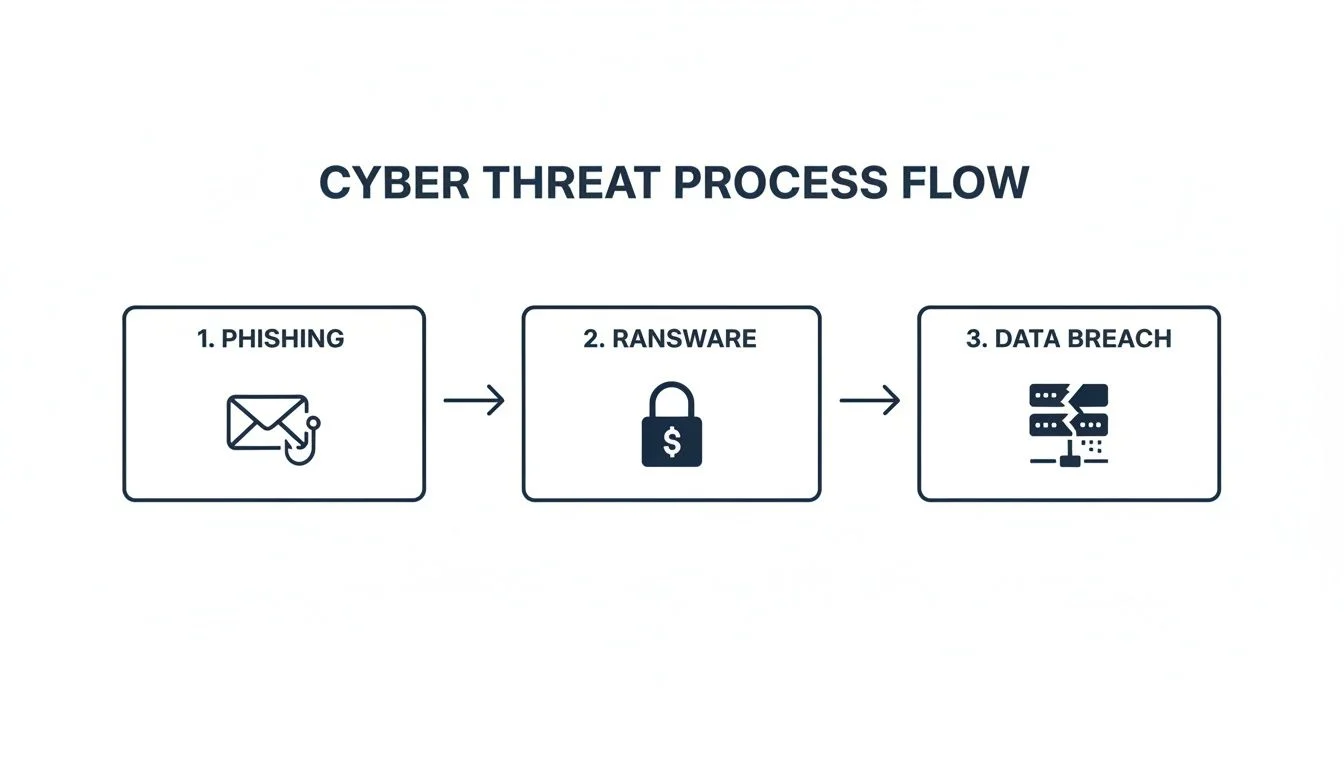
As you can see, what starts as a harmless-looking email can spiral into a full-blown ransomware attack and data breach, which is why having multiple layers of defence is non-negotiable.
Nail Down the Technical Must-Haves
With your risk map in hand, it’s time to put the essential technical controls in place. These aren’t optional extras; they are the absolute baseline for any modern aged care facility.
We’ve put together a table outlining the most critical controls you should focus on first. These are the non-negotiables that form the bedrock of a strong security posture.
Priority Cybersecurity Controls for Aged Care Facilities
| Control | Why It’s Critical for Aged Care | Implementation Tip |
|---|---|---|
| Multi-Factor Authentication (MFA) | This is your single biggest security win. It stops attackers who have stolen a password from accessing your systems and resident data. | Enforce it everywhere, especially on email (like Microsoft 365), remote access systems, and any software holding personal information. |
| Strong Password Policies | Weak or reused passwords are one of the easiest ways for criminals to get in. | Ditch simple passwords. Enforce passphrases (e.g., “Correct-Horse-Battery-Staple”) and use a password manager to help staff create unique credentials for every service. |
| Modern Endpoint Protection | Every PC, laptop, and tablet is a potential entry point. Basic antivirus software from years ago is no longer enough. | You need an Endpoint Detection and Response (EDR) solution. It actively hunts for suspicious behaviour, not just known viruses. |
These measures are fundamental for a reason—they work. They address the most common ways that attackers breach networks and are proven to drastically reduce your risk.
Many of these controls are central to the Australian Cyber Security Centre’s official recommendations. You can get a deeper understanding of these government-backed strategies in our guide on the ACSC Essential 8.
Build a Bulletproof Backup and Recovery Plan
When an attack like ransomware hits, your ability to get back on your feet hinges entirely on your backups. A solid backup plan isn’t just about having copies of your files; it’s about having a tested, reliable way to restore them quickly.
Your recovery plan absolutely must include:
- The 3-2-1 Rule: This is the gold standard. Keep three copies of your critical data, on two different types of media, with one of those copies stored completely off-site and offline. That offline copy is your last line of defence against ransomware that tries to encrypt your backups, too.
- Regular Testing: An untested backup is just a hope. You must regularly perform test restores to prove you can actually recover the data and that it’s not corrupted. We’ve seen too many businesses discover their backups have been failing silently for months, but only after it’s too late.
- Clear Recovery Goals: Know your Recovery Time Objective (RTO)—how fast you need to be operational again—and your Recovery Point Objective (RPO)—how much data (e.g., a few hours’ worth) you can afford to lose. These goals will shape your entire backup strategy.
The threat here is very real. The latest ASD Cyber Threat Report highlights that ransomware remains a persistent and damaging threat. With nearly 94,000 cybercrime reports logged—that’s one every six minutes—the risk for Werribee facilities, especially those running older systems, is undeniable.
Building Your Human Firewall Through Staff Training
You can spend a fortune on the best firewalls and endpoint protection, but your facility’s security really comes down to the people using the systems every single day. Your staff are your most valuable asset, but without the right training, they can accidentally become your biggest security risk.
With the right skills, they become your most powerful defence—a human firewall.

Effective training isn’t a tick-a-box presentation once a year. It needs to be an ongoing program that builds a genuine culture of security, where everyone from clinical staff to administrators feels personally responsible for protecting resident data.
Making Training Stick
Generic cybersecurity advice is forgettable and doesn’t work. For lessons to be meaningful, they must be grounded in the specific, busy environment of an aged care facility in Werribee. Staff need to see threats in the context of their daily tasks.
Focus on real-world scenarios they will actually run into:
- The Urgent Supplier Email: An email pops up, seemingly from a regular supplier. It claims their bank details have changed and an “overdue” invoice needs paying immediately to the new account.
- The “Concerned Family Member” Phish: A message pretending to be from a resident’s family member includes a link to “important documents about mum’s care,” but it’s really designed to steal login credentials.
- The Fake Medicare Update: An official-looking email directs staff to a fraudulent portal to “update facility compliance details.” It’s a trap to capture passwords.
Using these specific, relatable examples moves cybersecurity from an abstract chore to a practical, daily skill. You can learn more about crafting these targeted lessons in our deeper dive into security awareness and training.
How to Know if the Training is Working
So, how do you know if your training is actually sinking in? The best way is to measure awareness through controlled, simulated phishing tests. These are harmless, fake phishing emails we send to your staff to see who clicks.
This isn’t about catching people out. It’s about finding knowledge gaps in a completely safe environment.
The goal of a phishing simulation is to provide a “teachable moment.” When a staff member clicks, they can be immediately directed to a short training module explaining the specific red flags they missed. This targeted, just-in-time learning is far more effective than a generic yearly seminar.
This data-driven approach lets you see which departments or individuals might need a bit more support and which types of phishing attacks are most effective against your team. It helps you focus your training budget where it’s needed most.
Fostering a True Culture of Security
The ultimate goal is to create an environment where security becomes second nature. This means shifting away from a culture of blame and towards one of empowerment and shared responsibility.
Here are a few key principles we always recommend:
- No-Blame Reporting: Staff must feel completely safe reporting a suspected phishing email or admitting they clicked on something they shouldn’t have. Fast reporting is critical for a fast response, and punishing mistakes only encourages people to stay silent.
- Regular, Bite-Sized Updates: Ditch the long annual session. Instead, provide short, regular updates in team meetings or via internal newsletters. A five-minute tip on spotting fake invoices is far more memorable.
- Make It Part of Onboarding: Security training cannot be an afterthought. It must be a core part of the induction process for every new employee, from their very first day.
By consistently reinforcing these messages, you transform cybersecurity for aged care providers Werribee from a dry technical issue into a shared team mission, turning every staff member into an active defender of your facility.
When to Partner with a Cybersecurity Expert
Recognising you can’t do it all yourself isn’t a weakness—it’s smart leadership. For many aged care providers, trying to wrangle complex cyber threats internally isn’t just difficult; it’s a serious risk to your residents, your staff, and your reputation.
Knowing when to call in a professional is the first real step toward building a facility that’s genuinely secure. The signs are usually there long before a crisis hits.
So, when is it time to bring in an expert? If your facility doesn’t have dedicated IT staff, or if keeping software and systems updated feels like a constant battle, you’re already on the back foot. Those frequent, small IT glitches that plague your team? They’re often symptoms of deeper, unaddressed vulnerabilities just waiting to be exploited.
The Telltale Signs You Need Help
If you’re even slightly unsure about your compliance with the Privacy Act or the Aged Care Quality Standards, it’s time to seek expert advice. Uncertainty is a liability you can’t afford.
Other clear red flags include:
- You don’t have a formal, written incident response plan ready to go.
- Staff are using shared or overly simple passwords for systems containing sensitive resident data.
- Your data backups are happening, but you haven’t actually tested them to make sure you can restore everything.
Trying to tackle modern threats without specialist knowledge often leads to costly mistakes and, in the worst-case scenario, a devastating data breach. Getting to grips with the available support, including options like Cybersecurity Consulting, can completely change your security posture for the better.
Don’t wait for an incident to force your hand. If this sounds like your facility, it’s time to find a partner who understands the unique demands of cybersecurity for aged care providers in Werribee.
A proactive partnership with a cybersecurity expert shifts the burden from your already stretched team to specialists whose only job is to stay ahead of threats. This frees you up to focus on what matters most: providing exceptional care to your residents.
If you recognise these challenges in your facility, the time to act is now. You can get professional, no-nonsense advice by getting in touch via our contact page.
How Tbourke Solutions Can Help
Choosing an IT partner is about more than just tech support; it’s about trust. At Tbourke Solutions, we understand the immense responsibility Werribee aged care providers carry. As a local Managed Service Provider (MSP) based in Melbourne with over 20 years of experience, we specialise in delivering robust, no-nonsense IT security solutions tailored to the unique needs of the aged care sector. We don’t just fix problems; we prevent them.
Our approach is a partnership. We start with a comprehensive assessment to understand your facility’s specific risks, budget, and compliance obligations. From there, we offer a range of services designed to take the weight of cybersecurity off your shoulders:
- Managed Cybersecurity Services: We act as your dedicated IT security department, providing 24/7 network monitoring, automated patch management, and advanced threat detection. This proactive service ensures your systems are always protected without you needing to manage them.
- Cybersecurity Consulting: If you have an existing IT team but need specialised guidance, we can provide expert consulting. We help you develop a robust security strategy, create an incident response plan, and navigate compliance requirements like the Notifiable Data Breaches scheme.
- Targeted Staff Training: We go beyond generic presentations to deliver practical, engaging training that turns your staff into a vigilant human firewall, empowering them to recognise and report threats confidently.
We aim to be your long-term partner, providing enterprise-grade security that is both affordable and effective, allowing you to focus completely on resident care. Ready to secure your facility? Submit a query through our contact page and let’s start the conversation.
Frequently Asked Questions (FAQ)
We’re a small facility. Are we really a target?
Yes, absolutely. Cybercriminals often view smaller organisations as easier targets because they assume they have weaker security. Your facility holds highly valuable health and personal data, making you a prime target for ransomware and data theft, regardless of your size. A breach can cripple operations and damage your reputation within the Werribee community.
What is the single most important security step we can take?
Implement Multi-Factor Authentication (MFA) on all your systems, especially email (like Microsoft 365) and any software containing resident data. MFA adds a crucial second layer of security that can stop an attacker even if they have a stolen password. The Australian Cyber Security Centre strongly recommends it as a baseline security measure for all organisations.
Cybersecurity seems expensive. How can we afford it?
Think of cybersecurity as a core operational cost, like insurance, not an optional IT extra. The cost of recovering from a data breach is almost always far higher than the investment in prevention. Partnering with a Managed Service Provider (MSP) is often the most cost-effective solution, giving you access to expert knowledge and enterprise-grade tools for a predictable monthly fee, without the high cost of hiring an in-house security expert.
How do we stay compliant with the Notifiable Data Breaches (NDB) scheme?
Compliance with the NDB scheme involves three key steps: preventing breaches with strong security controls, detecting them with monitoring tools, and having a documented incident response plan to follow. If a breach occurs that is likely to cause serious harm, you must notify the Office of the Australian Information Commissioner (OAIC) and the individuals affected. An expert partner can help ensure you have the right processes and documentation in place to meet your legal obligations confidently.
At Tbourke Solutions, we specialise in making robust cybersecurity accessible and manageable for aged care providers across Werribee. Our team is here to help you understand your risks and build a security plan that protects your residents, your staff, and your reputation.
Ready to talk about your facility’s specific needs? Reach out through our contact page, and let’s get you the professional advice you deserve.
Share This Story, Choose Your Platform!