When people talk about IT services for retirement homes, they’re talking about much more than just fixing a slow computer or setting up a printer. They’re referring to a whole ecosystem of specialised tech solutions built to handle the unique demands of an aged care facility: a place that’s part-home, part-clinic, and part-community hub.
These services are the invisible backbone of modern care, focusing on resident safety, staff efficiency, and rock-solid data security through things like managed IT support, reliable Wi-Fi, and cybersecurity. It’s a critical investment, not just for modernising care, but for meeting the high standards our industry is held to.
TL;DR
This guide explains why specialised IT services are essential for retirement homes, covering the core pillars of technology like managed services, networking, cybersecurity, and data backup. It explores how technology such as electronic health records and telehealth directly enhances resident care and safety. We also break down the critical data privacy laws you must follow and provide practical advice on choosing the right IT partner for your facility’s unique needs.
Why Specialised IT is Essential for Modern Aged Care

Retirement homes are incredibly complex environments, blending hospitality, healthcare, and residential management under one roof. This unique mix means generic, off-the-shelf IT solutions just don’t cut it anymore. Specialised it services for retirement homes have quickly moved from being a “nice-to-have” to a core requirement for success.
Meeting Modern Expectations
Today’s residents are more tech-savvy than ever. They expect fast, reliable Wi-Fi for video calls, streaming their favourite shows, and staying in touch with the world. A network that’s slow, patchy, or insecure is a fast track to resident dissatisfaction and can do real damage to your facility’s reputation.
On top of that, the aged care sector is growing fast. As of 30 June 2023, residential aged care services in Australia were supporting 190,683 people, a 2.4% increase from the previous year. This growth is putting huge pressure on facilities to modernise their systems and use technology to improve the quality of care they deliver.
The Role of an IT Partner
Instead of seeing technology as just another overhead, it’s far smarter to view it as a vital investment in safety, efficiency, and resident wellbeing. This is where partnering with a specialist who genuinely understands the aged care environment becomes crucial.
A good IT partner can implement solutions that:
- Ensure Compliance: Help you navigate the maze of complex regulations like the Privacy Act.
- Boost Staff Productivity: Provide reliable, easy-to-use tools that let your caregivers focus on what they do best: caring for residents.
- Protect Sensitive Data: Defend against the ever-present cyber threats targeting sensitive healthcare information.
Working with an expert, often called a Managed Services Provider (MSP), ensures your technology foundation is strong, secure, and built for the long haul. If that term is new to you, our guide explains what MSPs are and how they can make a world of difference to your organisation.
A Quick Guide for the Busy Administrator
As a facility manager, you’re juggling a dozen priorities at once. Modernising your IT might feel like just another task on a very long list, but it’s become absolutely critical for staying compliant and competitive.
This guide is designed to cut through the noise. We’ll show you how smart cybersecurity isn’t just about computers, it’s about protecting sensitive resident data. We’ll explain how a reliable Wi-Fi network supports both your staff’s workflow and your residents’ happiness, and how the right software can genuinely improve care management.
The simple truth is that effective technology is no longer an optional extra in aged care. It has a direct, daily impact on resident safety, staff productivity, and the reputation you’ve worked so hard to build.
Finding an IT partner who actually understands the unique pressures of the aged care sector is the key. They can help you build a secure, efficient, and modern environment, letting you get back to what you do best: delivering exceptional care. This guide gives you the practical insights you need to make the right calls for your facility’s future, ensuring your operations and your residents are supported by technology you can count on.
The Core Pillars of Modern Aged Care IT
Building a secure and efficient retirement home isn’t just about bricks and mortar anymore; it requires a rock-solid technology framework. Think of it like constructing a modern building, each IT service is a critical component holding the entire structure up.
Getting your head around these core pillars demystifies the tech and shows how a smart IT strategy supports every corner of your operations, from resident care right through to back-office administration.
This diagram breaks down the essential IT pillars for aged care, showing how foundational services branch out into specialised areas like cybersecurity, network management, and software support.
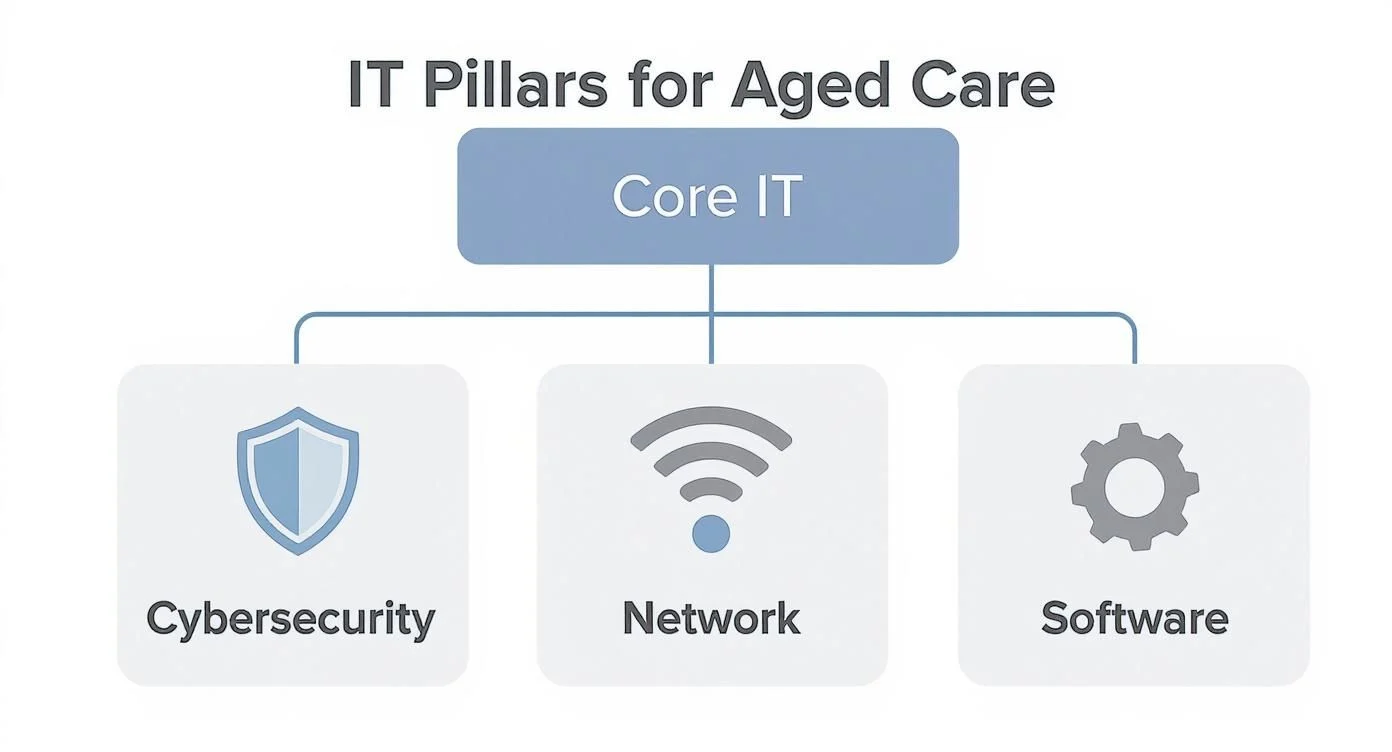
It’s a great way to see how interconnected modern IT really is. A strong foundation lets you build advanced capabilities across your entire facility.
To help you get a clearer picture of these essential IT services, here’s a quick overview of what they do and why they matter.
| IT Service Pillar | Primary Function | Key Benefit |
|---|---|---|
| Managed IT Services | Proactive management of all IT systems, from servers to user support. | Frees up staff to focus on resident care, not tech issues. |
| Networking & Wi-Fi | Provides fast, reliable connectivity for staff, residents, and smart devices. | Enables seamless communication, telehealth, and a positive resident experience. |
| Cybersecurity | Protects sensitive resident and financial data from unauthorised access. | Builds trust, ensures privacy compliance, and prevents costly data breaches. |
| Data Backup & Disaster Recovery | Ensures you can restore data and operations after a system failure or attack. | Guarantees business continuity and resilience against unforeseen events. |
Let’s unpack what each of these pillars means for your day-to-day operations.
Managed IT Services: The Foundation
Think of Managed IT Services as both the foundation and the project manager for your building. This service is all about proactive, day-to-day management of your entire technology environment. Instead of waiting for something to break, a managed service provider (MSP) constantly monitors your systems to prevent problems before they even start.
This covers everything from routine software updates and system health checks to providing a reliable helpdesk for your staff. When a caregiver has trouble logging into a system or a printer stops working, they have an expert to call immediately. That means less downtime, less frustration, and a team that can focus on what they do best: caring for residents.
Networking and Wi-Fi: The Wiring
If Managed IT is the foundation, then networking and Wi-Fi are the electrical wiring and plumbing. This infrastructure is the invisible force connecting everyone and everything in your facility. A robust and secure network is completely non-negotiable.
It’s the backbone for essential daily activities, including:
- Staff Devices: Caregivers rely on tablets and other mobile devices to access resident records and document care in real-time.
- Resident Connectivity: Residents expect seamless Wi-Fi for video calls, streaming entertainment, and staying connected with loved ones.
- Smart Technology: A strong network is crucial for supporting modern tools like IoT sensors for fall detection, telehealth consultations, and smart security cameras.
A poorly designed network leads to dead zones, slow speeds, and security holes, disrupting care and causing immense frustration for everyone.
Cybersecurity: The Security System
Every modern building needs a robust security system, and for your retirement home, that system is cybersecurity. You hold a huge amount of sensitive information: resident health records, financial details, and personal data. This makes aged care facilities a prime target for cybercriminals.
A single data breach can have devastating consequences, leading to significant financial penalties, reputational damage, and a complete loss of trust from residents and their families.
Effective cybersecurity isn’t a single product; it’s multiple layers of protection. This includes firewalls to block unauthorised access, antivirus software to detect malware, and regular staff training to prevent human error, like falling for phishing scams. It’s a constant process of identifying risks and putting safeguards in place to protect your most valuable digital assets.
Data Backup and Disaster Recovery: The Insurance Policy
No matter how strong your building is, you still need an insurance policy for unforeseen events like fires or floods. In the digital world, your insurance policy is a comprehensive Data Backup and Disaster Recovery (DR) plan.
This is all about ensuring business continuity. Should a critical system fail, a ransomware attack occur, or a natural disaster strike, a solid backup and DR strategy ensures you can restore your data and get your operations back online quickly. This means regular, automated backups of all critical information, stored securely both on-site and off-site.
The Australian senior living market is expanding rapidly, with projections showing it will reach USD 4.39 billion by 2030. This growth is driven by the increasing demand for technology-driven solutions, making robust IT infrastructure more critical than ever.
These foundational pillars work together to create a resilient and efficient technological environment. Just as many small businesses require a solid tech foundation to operate, so too do aged care facilities. You can explore our insights on IT solutions for small businesses to see how these core principles apply across different sectors.
Using Technology to Enhance Resident Care
While the foundational IT keeps your facility running smoothly in the background, the right resident-facing technology can directly elevate the standard of care you provide. Modern IT services for retirement homes aren’t just about back-office efficiency; they’re about creating a safer, more connected, and responsive environment for every single person you look after.
This is where technology stops being just an operational tool and becomes a cornerstone of exceptional care. By weaving specialised applications and devices into your team’s daily workflows, you empower them with the information they need, right when they need it most. This shift makes a real, tangible difference in the lives of your residents, enabling a more personalised and dignified approach to aged care.
Centralising Information With Electronic Health Records
One of the most significant leaps forward in aged care is the move to Electronic Health Record (EHR) systems. Gone are the days of wading through cumbersome paper files, deciphering illegible handwriting, or frantically searching for misplaced notes. An EHR system acts as a single, secure digital hub for all resident health information.
This centralisation gives your care staff an immediate, complete picture of each resident’s history, medications, allergies, and care plans. Efficient and accurate record-keeping is critical, with solutions like healthcare documentation automation helping to refine workflows. The result? Fewer documentation errors, better-coordinated care between team members, and more time spent on what truly matters: direct interaction with residents.
Expanding Access With Telehealth Platforms
Telehealth has quickly become an indispensable tool in modern healthcare, and aged care is no exception. For residents with limited mobility, a simple trip to a specialist can be a stressful and physically demanding ordeal. Telehealth platforms completely remove this barrier, allowing for convenient virtual consultations right from the comfort of their own room.
This technology delivers some powerful benefits:
- Faster Access to Specialists: It dramatically cuts down on long wait times for appointments and eliminates the hassle of travel.
- Improved Chronic Disease Management: It enables regular, easy check-ins with physicians to monitor ongoing conditions without disruption.
- Reduced Hospital Admissions: It allows for early intervention the moment a resident’s condition changes, often avoiding the need for a trip to the emergency room.
Telehealth isn’t just a convenience; it seamlessly integrates specialist medical care into your facility. This promotes better health outcomes and provides genuine peace of mind for residents.
Proper implementation hinges on a stable network and user-friendly devices, but the return in resident wellness is immense. We cover how to integrate these services as part of a cohesive strategy in our unified communications guide.
Fostering Community With Resident Engagement Apps
Technology can also play a vital role in combating loneliness and building a strong sense of community within your facility. Custom resident engagement apps, easily accessible on tablets or communal touchscreens, can become the central hub for daily life.
These apps can display everything from activity schedules and dining menus to important facility announcements. More importantly, they can offer features like family portals for sharing photos and messages, instantly connecting residents with loved ones, whether they’re across town or across the country. This digital connection helps maintain those vital social bonds and keeps everyone in the loop.
Enhancing Safety With Smart Technology
Beyond software, the Internet of Things (IoT) is introducing powerful new safety measures into aged care. Smart sensors are a perfect example, offering a discreet yet highly effective way to monitor resident safety without ever feeling intrusive.
These clever devices can be set up to:
- Detect Falls: Motion sensors can automatically detect a fall and alert staff immediately, ensuring a rapid response when every second counts.
- Monitor Activity: Bed sensors can notify caregivers if a resident at high risk of falling has gotten up during the night.
- Provide Personal Alerts: Wearable pendants give residents the ability to call for help with the simple press of a button, no matter where they are in the facility.
By integrating these smart devices, you create an invisible safety net that operates 24/7. This proactive approach to safety empowers residents with greater independence while assuring staff and families that help is always just a moment away. The right technology truly transforms care from being reactive to proactive.
Navigating Data Privacy and Compliance in Aged Care
When you’re looking after residents, you’re also responsible for their sensitive health and personal information. This isn’t just about good practice; for Australian retirement homes, it’s a serious legal and ethical duty. Trust is the absolute bedrock of your relationship with residents, and having a rock-solid approach to data security is how you protect it.
Getting this right means understanding your obligations under Australian law. The two big ones you need to know inside and out are the Privacy Act 1988 and the Notifiable Data Breaches (NDB) scheme. These regulations are the rulebook for how you must collect, store, and protect personal information, ensuring every piece of resident data is handled with the highest level of care.
Understanding Your Legal Obligations
The Privacy Act is built around the Australian Privacy Principles (APPs), which are the cornerstone of data protection in this country. These principles cover the entire lifecycle of data, from being transparent about how you collect it to making sure it’s securely destroyed when it’s no longer needed. A core rule is that you must take reasonable steps to shield the information you hold from misuse, loss, and unauthorised access.
On top of that, the NDB scheme adds another layer of responsibility. If your facility suffers a data breach that’s likely to cause serious harm to anyone whose information was compromised, you are legally required to notify both the affected people and the Office of the Australian Information Commissioner (OAIC). This makes having a clear, well-rehearsed incident response plan non-negotiable.
Essential Security Measures for Data Protection
To meet these legal duties and truly safeguard resident data, you need a security strategy with multiple layers. Just installing antivirus software and calling it a day won’t cut it. Real data protection is a mix of smart technology, clear policies, and constant vigilance.
Key security measures include:
- Data Encryption: Think of this as scrambling data so it’s unreadable to anyone without the right key. All sensitive resident information must be encrypted, whether it’s sitting on your servers (data at rest) or being sent across your network (data in transit).
- Strict Access Controls: Not every staff member needs to see every piece of resident data. By setting up role-based access, you ensure employees can only view the information essential for their job. It’s a simple move that dramatically cuts the risk of an internal breach.
- Regular Security Audits: You can’t fix a vulnerability you don’t know about. Independent security audits are like a regular health check-up for your IT systems, helping you find weaknesses, from unpatched software to insecure Wi-Fi, so you can fix them before they’re exploited.
Strong data security isn’t just about dodging fines; it’s a fundamental part of providing quality care. It shows you respect your residents’ privacy, cementing your facility’s reputation as a safe and secure home.
A Practical Compliance Checklist
Taking stock of where you currently stand is the first step. This simple checklist can help you spot any gaps and figure out where to focus your efforts.
- Do we have a clear data privacy policy? Is it reviewed regularly and easy for staff, residents, and their families to find?
- Is all sensitive data encrypted? This includes files on servers, laptops, phones, and even your backup drives.
- Are access controls strictly enforced? Do you review who has access to what, and immediately revoke permissions for former employees?
- Do we conduct regular staff training? Does your team know how to spot a phishing email or other common cyber threats?
- Is there a tested data breach response plan? In an emergency, does everyone know their role and what to do?
- How do we handle old equipment? When retiring old computers that hold sensitive data, you need to prove you’ve handled it correctly. This involves obtaining a certificate of destruction for hard drives to ensure you’re legally covered.
Getting all this right can feel complex. Following an internationally recognised framework like ISO 27001 accreditation can provide a clear roadmap. This standard offers a comprehensive, structured approach to keeping all your information assets secure.
How to Choose the Right IT Partner
Picking a managed IT provider is one of the biggest calls you’ll make for your retirement home. This isn’t just about hiring a contractor to fix a glitchy printer; you’re bringing on a long-term partner who will be responsible for your facility’s daily stability, the security of sensitive data, and the safety of your residents.
A generic provider just won’t get it. They won’t understand the unique pressures of the aged care environment. The right partner feels like an extension of your own team. They get that a network outage can throw medication schedules into chaos and that compliance isn’t just a buzzword, it’s a serious legal requirement. Taking the time to ask detailed, sector-specific questions is the only way to find a provider who truly gets your mission.
Questions to Ask Potential IT Providers
Before you even think about signing a contract, you need to do a proper evaluation. A provider’s answers to these questions will tell you everything about their experience and whether they’re cut out for the unique demands of providing IT services for retirement homes.
Here’s a checklist of essential questions to guide your conversations:
- Aged Care Experience: Can you show us case studies or give us references from other retirement homes or healthcare facilities you’ve worked with?
- Software Familiarity: What’s your experience supporting industry-specific software like Electronic Health Record (EHR) systems?
- Compliance Knowledge: How do you make sure your solutions comply with the Australian Privacy Act and the Notifiable Data Breaches (NDB) scheme?
- Support Availability: What are your standard support hours? Do you offer 24/7 support for critical issues? This is a non-negotiable in an aged care setting.
These first few questions will quickly separate the generalists from the true specialists.
Evaluating Service Levels and Scalability
Beyond their direct experience, you need to dig into the practical details of how a potential partner operates. Their Service Level Agreement (SLA) is your guarantee of performance, so it’s crucial to read the fine print.
Key factors to compare include:
- Guaranteed Response Times: The SLA must clearly define how quickly they’ll jump on both critical and non-critical support requests.
- On-site Support: Confirm they have the ability to provide hands-on, on-site help when remote support just won’t cut it. Being local can be a massive advantage here.
- Scalability: Can their services grow with you? Talk about how they would handle adding a new wing to your facility or integrating new medical technologies down the track.
A strong IT partner should offer more than just reactive support. They should act as a strategic advisor, helping you plan for future technological needs and ensuring your IT infrastructure can adapt as your facility evolves.
Choosing the right managed IT services provider is a decision that will ripple through every part of your operations. By focusing on industry experience, clear service guarantees, and a forward-thinking approach, you can find a partner who will not only solve today’s problems but also help secure your facility’s future. This careful selection process ensures your technology becomes a powerful asset for enhancing resident care.

How Tbourke Solutions Can Help
Choosing an IT provider for a retirement home is a decision with significant weight. You operate at a unique intersection of healthcare, hospitality, and residential management, and you need a partner who understands that complexity. At Tbourke Solutions, we see beyond the servers and software to the immense responsibility on your shoulders.
Our entire approach is built around the real-world challenges of Australian aged care facilities. We are specialists in this sector, not a generic IT company trying to fit you into a predefined box. We tailor our services directly to your needs, from robust cybersecurity that keeps resident data safe and compliant, to reliable 24/7 support that keeps your facility running smoothly around the clock.
We offer a range of options designed to empower your staff, protect your data, and ultimately, improve the quality of life for your residents. Our managed IT services packages are structured to provide the right level of support, allowing you to focus on care while we manage the technology. We become an extension of your team, providing the proactive advice and responsive support that aligns with your operational goals.
Ready to build a secure and efficient technology backbone for your facility? Let’s start a conversation. You can learn more and reach out to our expert team by submitting a query on our contact page.
Frequently Asked Questions
Navigating the world of IT services brings up plenty of questions for retirement home administrators. We’ve put together clear, straightforward answers to some of the queries we hear most often, helping you make the right calls for your facility’s technology.
How Much Should We Budget For IT Services?
Budgeting for IT is a common concern, but there’s no single magic number. A healthy starting point is to allocate between 3% and 6% of your annual operating budget to technology. This figure usually covers services, software subscriptions, and hardware upgrades.
The exact amount really depends on a few factors:
- Facility Size: Larger communities with more residents and staff naturally have a bigger technology footprint.
- Current Systems: If your tech is showing its age, you might need a larger initial investment to get it up to modern standards.
- Service Level: The scope of services, like 24/7 monitoring versus standard business hours support, will influence the cost.
The best approach is to get a detailed assessment from a provider who can build a quote based on what you actually need.
What Are The Biggest Security Threats?
For aged care facilities, the most significant cybersecurity threats often boil down to human error and targeted attacks on sensitive health data. Phishing emails, where criminals impersonate a trusted source to steal login details, remain a major issue for staff.
The other major threat is ransomware. This is where attackers lock up all your files and demand a hefty payment to release them, grinding your operations to a halt. Protecting against these threats requires a multi-layered approach: solid staff training, advanced email filtering, and robust data backup systems so you can restore everything without ever paying a ransom.
What Should We Expect During Implementation?
A smooth implementation always starts with a thorough discovery phase. Your IT partner should take the time to assess your current setup, pinpoint vulnerabilities, and properly understand how your team works day-to-day. From there, they’ll create a detailed project plan with clear, realistic timelines.
The rollout will likely be staged to minimise disruption to residents and staff. For example, a network upgrade might happen overnight or on a weekend, while training staff on new software would be scheduled during quieter periods.
Good communication is essential. Your provider should keep you in the loop every step of the way, making sure the transition to a more secure and efficient environment feels seamless.
Partnering with an IT provider who genuinely understands the unique demands of aged care is crucial. Tbourke Solutions specialises in delivering secure, reliable, and compliant IT services tailored for retirement homes across Australia. Let us manage your technology so you can focus on what you do best: delivering exceptional care.
To build a secure and efficient technology backbone for your facility, submit a query on our contact page.
Share This Story, Choose Your Platform!