Are you looking for a way to reduce hefty IT hardware costs, improve business flexibility, and ensure your data is secure? Infrastructure cloud services offer a powerful solution by letting you rent the fundamental building blocks of IT—like servers, storage, and networking—over the internet. Instead of buying and maintaining expensive physical hardware, you can leverage a pay-as-you-go model that scales with your needs, providing a cost-effective and agile foundation for your business growth.
What Are Infrastructure Cloud Services?

Imagine you wanted to open a commercial kitchen. The old-school way would be to buy the land, construct a building from scratch, and then spend a fortune fitting it out with ovens, freezers, and every other piece of equipment yourself. It’s a massive upfront investment in both time and money.
Infrastructure as a Service (IaaS), a key part of cloud services, offers a totally different approach. It’s like leasing a fully equipped, state-of-the-art kitchen. You get instant access to everything you need, without the headaches of ownership. If your catering business booms, you can easily rent more space and equipment. If things slow down, you can scale back your lease.
The Digital Version of Renting
This analogy perfectly captures what IaaS is all about. It lets you rent the essential computing resources you need from major providers like Microsoft Azure or Amazon Web Services (AWS). This model is a powerful alternative to the costly and rigid method of owning and managing your own physical data centre.
By moving to IaaS, you swap a huge capital expense (CapEx) for a predictable operating expense (OpEx). You only pay for what you use, when you use it—a total game-changer for budgeting and financial planning. This shift is fuelling massive growth, and the Australian cloud market is set to expand at a staggering rate of 25.4% annually from 2025 to 2030, with IaaS leading the charge.
To help you understand the difference more clearly, here’s a quick comparison:
On-Premise IT vs. Infrastructure Cloud Services (IaaS)
| Aspect | On-Premise IT | Infrastructure Cloud Services (IaaS) |
|---|---|---|
| Initial Cost | High: Requires large upfront capital for hardware. | Low: No hardware costs, pay-as-you-go model. |
| Maintenance | Your Responsibility: You manage all hardware. | Provider’s Responsibility: They manage the physical infrastructure. |
| Scalability | Slow & Expensive: Adding capacity takes time. | Fast & Flexible: Scale resources up or down in minutes. |
| Accessibility | Limited: Often tied to your physical location. | Global: Access your infrastructure from anywhere. |
| Financial Model | CapEx: A large, one-time investment. | OpEx: A predictable, ongoing operational cost. |
This table highlights the core reasons why so many businesses are making the switch. The agility and cost-efficiency of IaaS are hard to ignore.
Common Questions We Hear About IaaS
Here are a few quick answers to the questions that come up most often:
- Who manages the actual hardware? The cloud provider handles all the physical servers, storage drives, and networking gear. This frees up your IT team to focus on work that actually grows your business.
- Is it secure? Yes. Major providers invest billions in security, often far exceeding what a small or medium-sized business could afford. You still have a part to play in securing your data, but the foundation is incredibly robust.
- What if my needs change? This is where the cloud really shines. You can add or remove resources in minutes, not months. This agility lets your business respond instantly to market changes or spikes in customer demand.
- Is it expensive? It doesn’t have to be. The pay-as-you-go model means you only pay for what you use, eliminating the waste of over-provisioning hardware. With smart management, it’s often more cost-effective than on-premise solutions.
- How hard is it to migrate? The complexity varies depending on your current systems. However, with expert guidance and a phased approach, the migration can be managed smoothly with minimal disruption to your daily operations.
Your Partner in the Cloud
Navigating all the options and figuring out the right strategy can feel overwhelming. At Tbourke Solutions, we specialise in helping businesses like yours make sense of infrastructure cloud services. We can guide you through powerful platforms like the Windows Azure Platform to build a solution that fits your specific needs and budget.
Understanding the Core Components
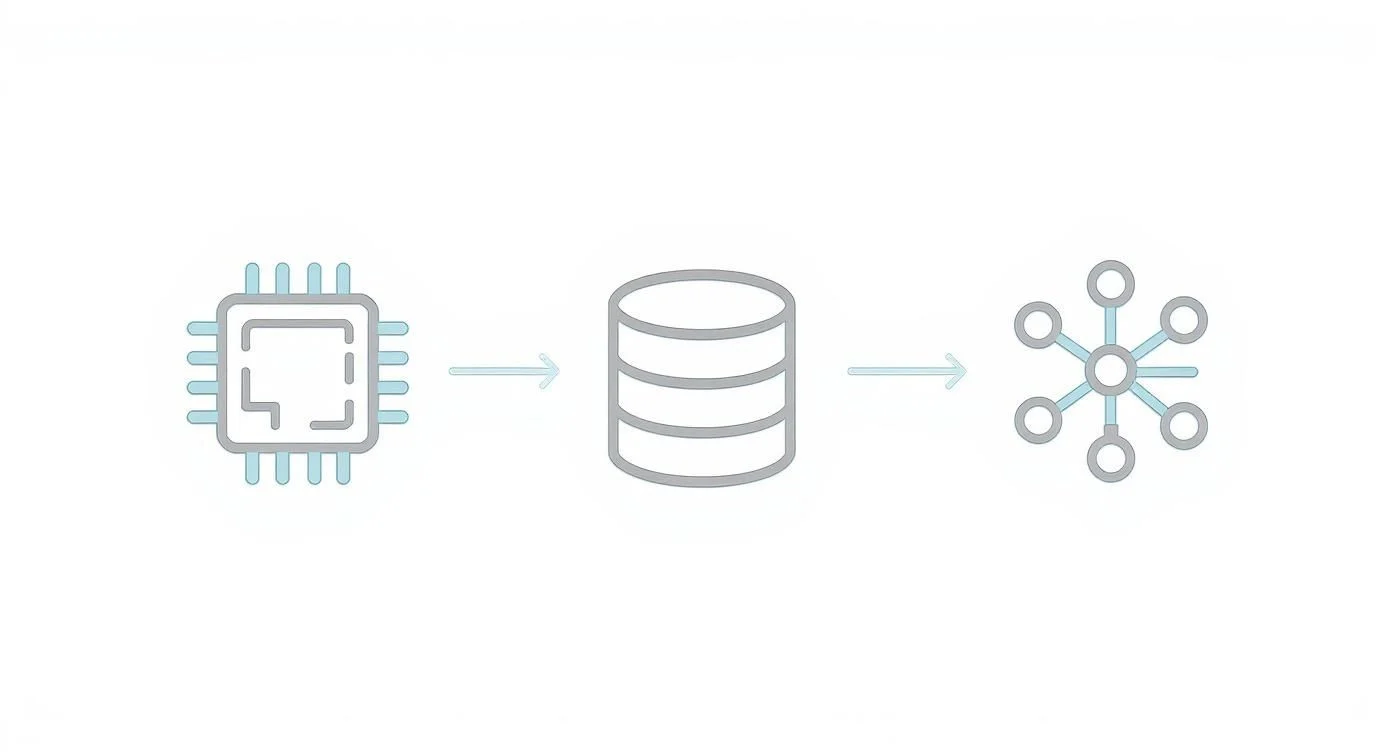
To really get what infrastructure cloud services can do, you need to look under the hood. Don’t worry, we’ll skip the confusing tech jargon. Instead, let’s break down the three fundamental building blocks—Compute, Storage, and Networking—using simple analogies to show how they directly impact your business.
Think of these components as the essential utilities for your digital business. Just like a physical office needs power, space, and phone lines, your online presence relies on these core cloud elements to run. Understanding them helps you see how everything from your company website to your internal workflows is supported.
Compute: Your Digital Engine
Compute is the raw processing power, the “engine” that runs your applications and software. Imagine it as the chefs in a commercial kitchen you’ve rented—they do all the work, whether it’s running a simple accounting program or powering a complex e-commerce website that serves thousands of customers at once.
When you use an infrastructure cloud service, you’re essentially renting virtual servers (often called virtual machines or VMs). These VMs act just like physical servers but are far more flexible. If you’re launching a big marketing campaign and expect a surge in website traffic, you can instantly “hire more chefs” by adding more compute power. When the campaign ends, you can scale back down just as quickly.
This on-demand scalability is a massive advantage. You only pay for the processing power you actually use, which stops you from wasting money on expensive, idle hardware sitting in a server room.
Storage: Your Infinite Warehouse
Next up is storage, which acts as your infinitely expandable digital warehouse. It’s where you keep everything your business needs: customer databases, important documents, website files, and critical backups. Unlike a physical warehouse with fixed walls, cloud storage can grow or shrink whenever you need it to.
Think about all the data your business generates. With traditional IT, you’d constantly be buying and managing new hard drives. With infrastructure cloud services, you just request more space from your provider. This is perfect for:
- Hosting website content: Storing all the images, text, and videos your customers see.
- Backing up critical data: Making sure you can recover quickly from any disaster without needing physical tapes or external drives.
- Archiving old files: Keeping historical records for compliance without cluttering up your active systems.
This flexibility means you never run out of space, and your data is kept safe and accessible in highly secure data centres.
Networking: Your Secure Highway
Finally, networking is the secure highway system that connects everything. It lets your compute engines and storage warehouses talk to each other, and it connects your employees and customers to your applications. A well-designed network makes sure data flows quickly and securely.
This includes managing how data moves between your virtual servers, how it’s delivered to a customer browsing your website, and how your remote team securely accesses internal files. Properly configured network infrastructure is essential for both performance and security. At Tbourke Solutions, we help design and manage these digital highways to keep your business running smoothly.
Choosing Your Cloud Deployment Model
Deciding to jump into infrastructure cloud services is a great first step, but it’s definitely not a one-size-fits-all deal. The real win comes from picking the right deployment model—one that lines up perfectly with your business’s unique needs for security, budget, and control.
Think of it like choosing a place to live. Your options range from a flexible, modern apartment to a custom-built house, and each comes with its own set of rules and benefits. Getting your head around the differences is key to making a smart investment that will shape everything from your day-to-day operations to your long-term strategy.
The Public Cloud Model
Think of the Public Cloud as leasing a secure, high-end apartment. It’s managed by a third-party provider, like Microsoft Azure or AWS, who handles all the maintenance, security, and upkeep of the physical building (the data centre). You share the building with other tenants, but your apartment (your virtual environment) is completely private and secure.
This model is incredibly cost-effective because you’re sharing the cost of the massive underlying infrastructure. It also gives you almost limitless scalability, letting you add or remove resources in minutes. It’s no wonder it’s become such a popular choice for so many Australian businesses.
The Private Cloud Model
On the flip side, the Private Cloud is like owning your own custom-built house. The entire infrastructure is dedicated solely to your business, giving you total control over security, how it’s configured, and where your data lives. You can build this “house” on your own premises or have a third party host it for you, but either way, it’s exclusively yours.
This approach is perfect for organisations with strict data compliance or regulatory requirements, particularly in sectors like finance or healthcare. While it offers unmatched control and privacy, it also comes with a much higher price tag and more management overhead—just like owning a home.
The decision between public and private cloud often comes down to balancing cost-effectiveness against the need for granular control. There’s no single “best” option; only the best option for your specific operational and compliance needs.
This visual helps show the relationship between different cloud service and deployment models.
As the diagram shows, IaaS is the foundational layer that other services like PaaS and SaaS are built on, and it can be run across any of the deployment models.
The Hybrid Cloud Model
The Hybrid Cloud gives you the best of both worlds. Imagine owning your secure house (Private Cloud) but also being connected to the city’s power grid and water supply (Public Cloud) for specific needs. This model lets you keep sensitive data and critical systems in your private environment while using the public cloud for more scalable, less-sensitive tasks like web hosting or development work.
This flexible approach is gaining huge traction. In fact, Australian spending on IaaS is tipped to jump by 24.2% in 2025, a trend driven largely by businesses adopting hybrid strategies to meet tough local data residency laws. You can read more about it in this deep dive into Australian public cloud spending.
Common Questions About Cloud Models
- Which model is cheapest? The public cloud almost always has the lowest entry cost. Its pay-as-you-go model and shared resources make it very budget-friendly to get started.
- Which is most secure? A private cloud offers the highest level of direct control over security. However, it’s important to remember that the major public clouds are incredibly secure environments built by global experts.
- Can I switch models later? Yes, you can migrate between models, but it requires careful planning to avoid disruption. A hybrid approach is often a great starting point because it gives you flexibility from day one.
How Tbourke Solutions Can Help
Choosing the right deployment model is a critical business decision. At Tbourke Solutions, we specialise in getting to know your business—from your security and compliance needs to your budget and performance goals—to map out the ideal cloud strategy. We can help you design a public, private, or hybrid solution that sets your business up for success.
The Real-World Business Wins of IaaS
Moving to infrastructure cloud services is about so much more than a simple tech upgrade. It’s a strategic shift that delivers real, measurable value, directly fuelling your business’s growth and making you more efficient. By trading in physical hardware for a flexible, on-demand model, you unlock some serious financial and operational advantages.
This move fundamentally changes how you think about your tech budget and your ability to react to the market. Let’s break down the key benefits.
Financial Transformation from CapEx to OpEx
Traditionally, growing your IT meant sinking huge amounts of cash into servers and hardware—big upfront capital expenditures (CapEx) that started losing value the moment you plugged them in. Infrastructure cloud services completely flip this outdated model on its head.
Instead of a massive, risky investment, you pay a predictable monthly operational expense (OpEx). This pay-as-you-go approach is a game-changer for cash flow, makes budgeting a breeze, and removes the financial headache of owning and maintaining depreciating assets.
Scenario: An Adelaide-based retail business used to spend thousands on new servers before every holiday season. After switching to IaaS, they now pay a simple monthly fee. This freed up cash to invest in more stock and marketing, leading to a 20% increase in holiday sales.
Effortless and Instant Scalability
One of the most powerful perks of the cloud is the ability to scale your resources up or down in minutes. This elasticity means you always have the exact amount of computing power you need, right when you need it.
Did a marketing campaign just go viral? You can handle the unexpected traffic spike without your website crashing. Things quieter in the off-season? You can scale down to save money. This agility puts an end to the waste that comes from over-provisioning expensive hardware “just in case.”
Enhanced Disaster Recovery and Business Continuity
Think about it: what happens if your office has a fire, flood, or a major power outage? If your servers are on-site, that could mean catastrophic data loss and days, or even weeks, of downtime.
IaaS providers build their data centres with incredible resilience—we’re talking redundant power, cooling, and multiple network connections. By hosting your infrastructure in the cloud, your data is automatically backed up and protected in a secure, remote location. This means you can get your business back online quickly after a disaster, often within minutes instead of days.
Gaining a Competitive Edge with Agility
In today’s fast-moving market, speed is everything. The ability to quickly roll out new applications and services can be the difference between leading the pack and falling behind. With IaaS, you can get a new project off the ground in hours, not months.
This newfound agility allows you to test new ideas, enter new markets, and respond to customer demands with unprecedented speed. For small businesses, this can truly level the playing field, allowing them to compete with much larger enterprises. To learn more about how platforms like Azure can specifically help smaller operations, explore the key benefits of Azure Cloud for small business.
Let Tbourke Solutions Unlock These Benefits for You
Understanding these advantages is the first step. The next is putting a cloud strategy in place that actually aligns with your business goals. At Tbourke Solutions, we specialise in helping Australian businesses harness the full power of infrastructure cloud services.
We’ll guide you through the whole process, ensuring a smooth transition that maximises your return on investment and makes your business more agile, resilient, and financially efficient.
Navigating Cloud Costs and Security

When businesses first move to the cloud, two big hurdles almost always pop up: keeping costs under control and keeping data secure. Getting these right from the start is absolutely crucial.
This section gives you clear, practical strategies to manage both, so you can make the most of what the cloud offers without any nasty surprises on your bill or a security breach on your hands. We’ll start by breaking down the common pricing models to help you avoid bill shock, then clarify who’s responsible for what when it comes to security.
Demystifying Cloud Pricing Models
One of the best things about cloud services is the flexible pricing, but it can also be a huge source of confusion if you’re not careful. Understanding your options is the first step toward getting your costs sorted.
- Pay-as-you-go: This is the most common model. It’s a lot like your electricity bill—you only pay for the exact amount of server power, storage, and networking you actually use. It’s perfect for workloads with unpredictable traffic, like a brand-new website or a temporary development environment.
- Reserved Instances: Now, if you have a steady, predictable workload (think a core database server that’s always running), you can commit to a one- or three-year term. In exchange, you get a massive discount, often up to 75%. This is a fantastic way to slash costs on your core infrastructure.
The public cloud market in Australia is set to explode, projected to hit USD 150.97 billion by 2033. This growth is being driven by businesses needing secure and sovereign data solutions, which makes smart cost and security management more important than ever.
Understanding the Shared Responsibility Model
A common—and dangerous—misconception is that the cloud provider handles all your security. That’s not how it works. Security in the cloud is a partnership, often explained using the shared responsibility model.
Think of it like renting a secure self-storage unit. The facility owner is responsible for securing the building—the locks on the main gate, the perimeter fence, and the surveillance cameras. This is like the cloud provider (Amazon, Microsoft, Google), who secures the physical data centres, the servers themselves, and the core network.
However, you are responsible for what you put inside your unit and who has the key. In the cloud, this means it’s your job to handle:
- Securing your data, usually through encryption.
- Managing who has access to your systems (user accounts and permissions).
- Configuring your applications and firewalls correctly.
The provider secures the cloud itself, but you are always responsible for securing your data in the cloud. Getting this right is fundamental to protecting your business.
How Tbourke Solutions Can Help
Navigating the complexities of cloud costs and security takes real-world experience. At Tbourke Solutions, we help Australian businesses build secure, cost-effective cloud setups from the ground up. We analyse your specific needs to recommend the right pricing models and put robust security controls in place to protect your valuable data.
Our team can help you implement best practices and offer ongoing support through our managed cybersecurity services to ensure your infrastructure stays protected against new and evolving threats. We also guide you on meeting Australian data residency laws, making sure your business stays compliant.
How Tbourke Solutions Guides Your Cloud Journey
Making the move to cloud infrastructure is a significant business decision, not just a technical task. Having an expert partner in your corner makes all the difference, ensuring you hit your goals without stumbling into common, costly traps.
At Tbourke Solutions, our job is to translate your business needs into a clear, practical cloud strategy. We handle the complexities of IaaS—from picking the right services to managing costs and locking down security from day one—so you can stay focused on what you do best: growing your business.
Frequently Asked Questions
When businesses start thinking about the cloud, a few key questions always come up. Here are some of the most common ones we hear.
- How do we start without disrupting our day-to-day work?
The key is a phased migration. We help you pinpoint low-risk applications to move first. This builds momentum and minimises disruption before we even touch your core systems. - How can we be sure our data is safe?
We don’t bolt on security at the end; we build it in from the beginning. This means setting up robust access controls, data encryption, and continuous monitoring to ensure your information stays protected. - What if our cloud costs spiral out of control?
This is a genuine concern, and proactive cost management is the answer. We help set up budget alerts, select the right pricing models for your specific workloads, and run regular reviews to make sure there are no nasty surprises on your bill.
Our Proven Approach
Our services are built to de-risk your transition to the cloud and get you a return on your investment faster. We offer a structured, straightforward approach that covers everything from the initial assessment and migration planning right through to ongoing optimisation.
We believe that a successful cloud journey is built on a foundation of clear strategy and expert execution. Our goal is to make the process straightforward, secure, and perfectly aligned with your business objectives.
Our comprehensive IT consultancy services provide the strategic oversight you need for such a critical business move. We make sure every technical choice supports a larger business goal.
We’ve structured our support to fit your needs, whether you want us to handle everything or just need expert guidance on specific areas.
- Full Migration Management: We manage the entire process for you, from planning and execution all the way through to post-migration support.
- Security & Compliance Consulting: We ensure your cloud environment meets the necessary industry standards and keeps your data protected.
- Cost Optimisation Services: Our team actively manages your cloud spending to ensure you’re always getting the best value for money.
Navigating the cloud can feel complex, but with the right partner, it becomes a powerful tool for growth. The table below shows how we break down the journey into clear, manageable stages.
Your Cloud Journey with Tbourke Solutions
| Phase | How We Help | Your Business Outcome |
|---|---|---|
| 1. Strategy & Planning | We assess your current setup, listen to your business goals, and create a customised cloud roadmap. | A clear plan that aligns technology with your budget and long-term objectives. |
| 2. Migration & Execution | Our team handles the technical heavy lifting, moving your applications and data securely with minimal disruption. | A smooth, seamless transition to the cloud without impacting your daily operations. |
| 3. Security & Compliance | We implement best-practice security from the start, ensuring your data is protected and compliant. | Peace of mind knowing your critical business information is secure and meets industry standards. |
| 4. Cost Optimisation | We continuously monitor your cloud usage and adjust services to prevent overspending and maximise value. | Predictable monthly costs and confidence that you’re not paying for resources you don’t need. |
| 5. Ongoing Management | We provide ongoing support, monitoring, and optimisation to ensure your cloud environment evolves with your business. | A reliable, high-performing cloud infrastructure that supports your business as it grows. |
Each phase is designed to build on the last, ensuring your investment in the cloud delivers real, measurable results for your business.
Still Have Questions About IaaS?
Jumping into infrastructure cloud services always brings up a few questions. That’s perfectly normal. Getting straight answers is the key to feeling confident about the decisions you make for your business, so let’s tackle the common queries we hear from business owners every day.
One of the biggest worries is how complicated it is to move to the cloud. The honest answer? It depends. Shifting a simple website might take a day, but a complex, older system with lots of integrations needs careful planning over several months. The smartest way forward is usually a phased approach, guided by an experienced partner who can handle the move without causing headaches for your daily operations.
Understanding the Main Differences
It’s easy to get tangled up in the jargon, especially when it comes to the different cloud service models. It helps to think of them as different levels of a service you’re buying.
- IaaS (Infrastructure as a Service): This is the ground floor. It gives you the raw ingredients of IT—servers, storage, and networking—that you get to control and set up yourself.
- PaaS (Platform as a Service): This is the next level up. It builds on IaaS, giving developers a ready-made platform to build and run their applications without worrying about the hardware underneath.
- SaaS (Software as a Service): This is the finished product. Think of your email service or your accounting software. You just log in and use it, and someone else handles all the backend management.
Security and Keeping Costs in Check
Two other big topics that always come up are security and cost. Is the public cloud really safe enough for sensitive business data? Absolutely, but only if you set it up correctly. Big providers like Amazon Web Services and Microsoft Azure have world-class security for their own infrastructure. However, under the ‘shared responsibility model’, you are still responsible for securing your own data, who can access it, and the applications you run on it.
Controlling cloud spend isn’t a ‘set and forget’ task. It’s an ongoing process of tuning your resources to match what you actually need, so you only pay for what you use.
To keep your cloud bills from spiralling, you need to be proactive. Simple things like setting up budget alerts can prevent nasty surprises. It’s also about choosing the right pricing models. For servers that are always on, using reserved instances can save you a huge amount compared to pay-as-you-go rates. Regularly checking your usage to spot and shut down anything you’re not using is essential for keeping things efficient and affordable.
Ready to Take the Next Step?
Ready to see how infrastructure cloud services could work for your business, without all the guesswork? At Tbourke Solutions, we provide the expert guidance to make your move to the cloud smooth, secure, and cost-effective. We offer a range of services tailored to your needs:
- Cloud Readiness Assessment: We’ll analyse your current IT setup and business goals to determine the best cloud strategy for you.
- Migration Services: Our team can manage your entire migration, ensuring a seamless transition with minimal business disruption.
- Managed Cloud Services: We provide ongoing management, monitoring, and cost optimisation to ensure your cloud environment performs at its best.
Let us help you build a powerful cloud foundation that fuels your growth. To start a no-obligation chat, submit a query through our contact page at http://tbourke-solutions.com.au/contact.
Share This Story, Choose Your Platform!