
Is your team your biggest security risk or your strongest defence? In a world where 90% of cyberattacks involve human error, cybersecurity awareness training is the single most effective investment you can make to protect your business. This practical guide breaks down what effective training looks like, the threats it stops, and how to build a security-conscious culture that turns your employees from potential targets into a proactive human firewall, safeguarding your data and reputation.
Why Cybersecurity Training Is Your Best Defence

Think of your business’s security like a fortress. Your firewalls and antivirus software are the high walls and strong gates, but they don’t mean much if someone inside willingly opens a side door for an intruder.
This is exactly what happens when an employee clicks a malicious link or falls for a convincing phishing scam. Effective cybersecurity awareness training is simply the practice of showing your team how to spot these tricks and secure the potential entry points. This isn’t just an IT issue; it’s a core business strategy that builds resilience against attacks that cause operational chaos and severe reputational damage.
The Human Element in Cyber Defence
Technology alone can’t stop every threat. Cybercriminals are masters of psychological manipulation, using tactics like urgency and authority to trick people into making mistakes. This is where your team becomes critical.
A well-trained employee who pauses to question a suspicious email is often more effective than the most advanced software filter. The need for this is especially sharp here in Australia. The Australian Cyber Security Centre (ACSC) reported that over 90% of cyber incidents in 2023 involved human factors like phishing and weak passwords.
With the average cost of a data breach in Australia now topping $4.2 million, ignoring the human factor is a gamble most businesses can’t afford to take.
Your employees are not the weakest link; they are your first and most important line of defence. Empowering them with knowledge is the single most effective security measure you can take.
Beyond a Compliance Tick-Box to a Security Culture
Too many businesses treat security training as just another compliance checkbox to tick off. But its real value is in fostering a security-conscious culture where everyone understands their role in protecting the organisation.
This cultural shift is vital for long-term security. To get a better handle on the risks involved, check out our guide on how to prevent data breaches and protect your business.
A strong training program has a direct and measurable impact on your business’s health and resilience. The difference between a well-trained team and an untrained one is stark.
The Business Impact of Effective vs. Ineffective Training
| Business Area | With Effective Training | Without Effective Training |
|---|---|---|
| Incident Rate | Significantly fewer security incidents; staff actively report threats. | High rates of phishing clicks, malware infections, and credential theft. |
| Financial Cost | Lower costs associated with breaches, downtime, and regulatory fines. | Higher financial losses from fraud, ransomware payments, and recovery efforts. |
| Productivity | Minimal disruption from security issues; smooth and secure operations. | Frequent downtime, locked accounts, and time spent on incident response. |
| Reputation | Increased client and partner trust; seen as a secure and reliable business. | Damaged brand reputation and loss of customer confidence after a public breach. |
| Compliance | Easily meets regulatory requirements (e.g., GDPR, APRA CPS 234). | Fails compliance audits, leading to potential fines and legal trouble. |
Ultimately, investing in your people is one of the smartest financial and operational decisions you can make.
At Tbourke Solutions, we believe in building this protective culture from the ground up. We create customised cybersecurity awareness training programs designed for Australian businesses, turning theoretical knowledge into practical, everyday habits. Our approach ensures your team is not just aware of threats but is equipped and confident enough to act.
If you’re ready to strengthen your organisation’s human firewall, visit our contact page to submit a query and learn about our tailored options.
Building Blocks of a Strong Training Program

A successful cybersecurity awareness program is much more than a once-a-year seminar. Think of it as a dynamic system built on key pillars, all designed to create lasting behavioural change in your team.
The goal here isn’t just about ticking a compliance box. It’s about cultivating a genuine security-first mindset and turning your staff into a proactive human firewall.
This requires a layered approach, combining practical training with clear, enforceable policies. By understanding the core components, you can build a new strategy from scratch or check if your current one covers all the critical angles of human-centric security.
Practical and Realistic Phishing Simulations
One of the most powerful tools in your training arsenal is the phishing simulation. These are essentially fire drills for your inbox, allowing your team to practise spotting and reacting to malicious emails in a completely safe, controlled environment.
When an employee clicks on a simulated phishing link, it becomes a valuable, private learning moment—not a catastrophic data breach. This hands-on experience is incredibly powerful. In fact, studies show that regular, realistic simulations can slash the click-through rate on actual malicious emails by over 70%. The key is to make them believable, mimicking the tactics cybercriminals are using right now.
This practical application helps bridge the gap between knowing what a phishing email is and actually being able to identify one under the pressure of a busy workday.
Clear and Consistent Security Policies
Training works best when it’s backed by clear, easy-to-understand organisational policies. These policies act as the official rulebook for secure behaviour, giving your team a definitive guide on what’s expected of them.
Your program should include foundational policies covering several key areas:
- Password Security: Establish clear rules for creating strong, unique passwords, mandate the use of password managers, and enforce multi-factor authentication (MFA) wherever possible.
- Acceptable Use Policy (AUP): Clearly define how company devices and networks should be used, including rules around personal use, downloading software, and accessing sensitive data.
- Incident Reporting: Create a simple, blame-free process for employees to report suspected security incidents immediately. Staff need to feel confident reporting a mistake without fear of punishment.
These policies provide the structure needed for your training to take root and become part of your company culture.
Foundational Security Frameworks
Integrating established security frameworks provides a robust structure for your training efforts. For Australian businesses, aligning with guidelines from the Australian Cyber Security Centre (ACSC) is a very smart move. You can learn more about the ACSC Essential 8 in our detailed guide, which outlines key mitigation strategies.
A well-rounded program doesn’t just teach employees to spot threats; it empowers them with the knowledge and tools to actively participate in the company’s defence, making them a core part of your security posture.
How Tbourke Solutions Can Help
Designing and implementing a comprehensive cybersecurity awareness program can feel like a huge task. At Tbourke Solutions, we specialise in creating customised training solutions that are engaging, effective, and tailored to the unique risks your business faces. We handle everything from realistic phishing simulations to policy development and ongoing education.
Our goal is to build a resilient security culture within your organisation, transforming your team into your greatest security asset. We offer a range of options to suit businesses of all sizes, ensuring your defence is strong and your people are prepared.
To learn more about how we can help fortify your human firewall, please reach out through our contact page to submit a query.
Getting to Know Today’s Most Common Cyber Threats
To build a solid defence, your team first needs to know what they’re up against. Cybercriminals are always coming up with new tricks, but many of their attacks boil down to a few old-school tactics that exploit human psychology—things like creating a false sense of urgency or tapping into our fear of getting in trouble.
Good cybersecurity awareness training cuts through the technical jargon. It’s all about showing your people the real-world threats they could genuinely run into any day of the week, whether in their inbox or on their phone.
Once your team can spot the subtle red flags of an attack, they stop being potential victims. They become the first line of defence for your entire business.
Phishing and BEC: The Dangers Hiding in Your Inbox
Often, the most damaging threats arrive disguised as a harmless email. Phishing is when scammers send emails pretending to be from a legitimate company—think Australia Post, a bank, or even a supplier—to trick someone into giving away sensitive information like passwords or credit card details.
A far more dangerous and targeted version of this is Business Email Compromise (BEC).
Picture this: your accounts person gets an email that looks like it’s straight from the CEO. It’s marked “URGENT” and demands an immediate wire transfer to a new vendor to lock in a confidential deal. The sender’s email address is just one letter off—an easy detail to miss on a busy Friday afternoon. That’s a classic BEC scam. It works by impersonating someone with authority to pressure an employee into skipping the usual security checks.
These attacks are a massive problem for Australian businesses. The 2025 CyberCX Threat Report found that BEC was the number one incident type in 2024, with a shocking 75% of these attacks managing to get past multi-factor authentication (MFA). You can get more details on these trends in their full threat report analysis.
Ransomware: When Your Data Is Held Hostage
Another huge threat lurking out there is ransomware. This is nasty malicious software that gets into your network and encrypts all your files, locking you out completely. The attackers then demand a hefty payment, usually in cryptocurrency, to give you the key to get your data back.
A ransomware attack can bring your entire business to a grinding halt. The costs aren’t just the ransom payment; you’re also looking at huge losses from downtime, recovery efforts, and serious damage to your reputation.
And how do these attacks usually start? More often than not, with a simple phishing email. Someone unknowingly clicks a dodgy link or opens an infected attachment, and just like that, the ransomware has a backdoor into your system. This is why protecting every single device is so important. If you want to dive deeper, have a read of our guide explaining what is endpoint security.
Common Cyber Threats and Key Defence Tactics
To help your team spot these dangers in the wild, it helps to break them down into simple, recognisable patterns. The table below outlines the most common threats your team will face and the single most important action they can take to stop an attack in its tracks.
| Threat Type | Description | Your Team’s First Defence |
|---|---|---|
| Phishing | Emails, often in bulk, designed to steal credentials by impersonating trusted brands (e.g., Microsoft, your bank). | Verify the Sender. Check the email address carefully and hover over links to see the real destination before clicking. |
| Business Email Compromise (BEC) | Highly targeted emails that impersonate a senior executive or supplier to trick staff into making urgent payments or sharing data. | Verify the Request. Use a separate, trusted communication channel (like a phone call) to confirm any unusual financial request. |
| Ransomware | Malicious software that encrypts files and demands a ransom payment for their release, often delivered via phishing links or attachments. | Don’t Click or Download. Treat all unexpected attachments and links with suspicion, especially from unknown senders. |
| Smishing & Vishing | Phishing attacks carried out via SMS text messages (Smishing) or voice calls (Vishing), using urgency to prompt a quick response. | Don’t Trust, Verify. Never provide sensitive information over the phone or click links in texts unless you can 100% verify the source. |
Each of these threats relies on one thing: getting an employee to act impulsively without thinking. The key is to build a culture where pausing and verifying is second nature.
The goal of an attacker is to make you act before you have a chance to think. A core part of cybersecurity awareness training is teaching staff to pause, scrutinise, and verify any unusual or urgent request, no matter who it appears to come from.
How Tbourke Solutions Can Help
At Tbourke Solutions, we get that spotting these threats takes more than just reading a manual. We provide practical, engaging cybersecurity awareness training designed specifically for Australian businesses. Our programs use realistic scenarios and simulated phishing attacks to give your team the hands-on practice they need to confidently shut down threats like BEC and ransomware.
We have a range of options, from foundational training modules to ongoing phishing simulations, all aimed at building a strong, security-aware culture.
To give your team the skills to spot modern cyber threats, head over to our contact page and send us a query.
Implementing a Training Program That Sticks
Launching an effective cybersecurity awareness program isn’t about just rolling out new software; it’s about changing mindsets. If you want to genuinely embed security into your company culture, you need a deliberate, ongoing strategy. Think of it like building the foundation for a house – it requires consistent effort over time, not just a single day of work.
This means moving away from the old idea of a one-off annual training session. Instead, the focus needs to be on a continuous learning model that keeps security front-of-mind all year round.
Getting Leadership on Board
Your first and most critical step is getting enthusiastic buy-in from the leadership team. When leaders actively champion cybersecurity awareness, it sends a powerful message across the entire organisation that this is a genuine priority.
This support needs to be more than just a signature on a budget approval. Leaders should be participating in the training, talking about security in company-wide meetings, and leading by example. That visible commitment is what turns a training initiative from a simple IT project into a core part of your company culture.
From One-Off Events to Continuous Learning
The threat landscape changes constantly, so your training has to keep up. A single annual training session is easily forgotten and becomes outdated within months. A continuous learning approach is far more effective.
This model involves:
- Bite-Sized Content: Short, regular learning modules, like a 5-minute video or quiz each month, are much easier to digest and retain than a long, yearly seminar.
- Regular Phishing Simulations: Consistent, realistic phishing tests keep your team’s threat-spotting skills sharp and give you valuable data on their progress.
- Timely Threat Briefings: When a new scam or threat emerges, send a quick, clear alert to your team so they know exactly what to look out for.
This ongoing reinforcement helps make security awareness a habit, not just a memory. It helps create a simple, repeatable process for responding to threats.
This infographic shows a simple, effective process for employees to follow when they encounter something suspicious.
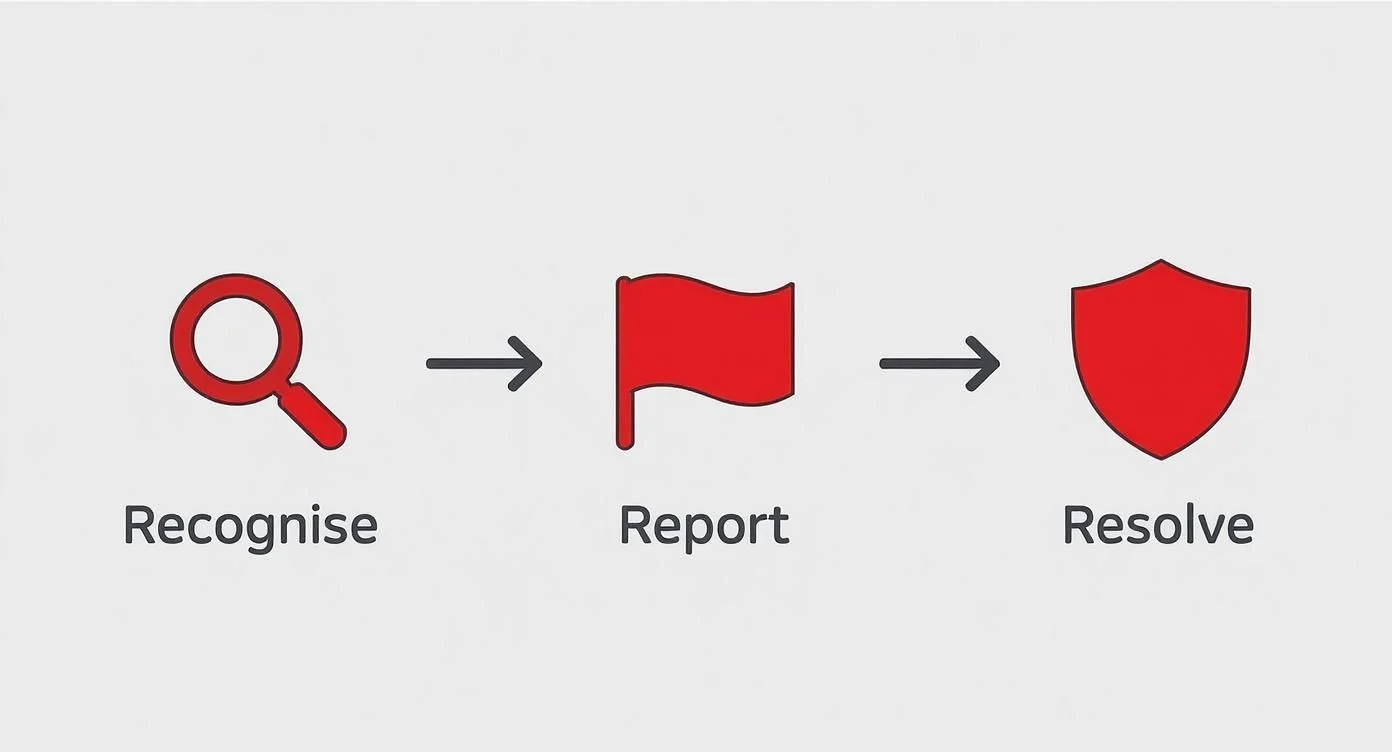
Training your team to follow this straightforward procedure can dramatically reduce the time between a threat being detected and it being neutralised.
Common Questions People Ask
How do I make the training relevant?
Tailor the content to your team’s specific roles. The threats your finance department faces are different from those targeting your sales team. Using role-based scenarios makes the training more engaging and immediately applicable to their daily work.
What if my team finds the training boring?
Avoid dull, text-heavy presentations at all costs. Use a mix of formats like interactive quizzes, videos, and real-life examples to keep the content fresh and interesting. Gamification elements, like leaderboards for phishing simulation performance, can also give engagement a real boost. For mobile workforces, effective training can be reinforced with strong security policies, which you can learn about in our article on Intune Mobile Device Management.
How Tbourke Solutions Can Help
At Tbourke Solutions, we specialise in creating cybersecurity awareness training programs that actually stick. We work with you to develop a continuous, engaging learning plan tailored to the specific needs of your business. From managed phishing simulations to role-based content, we help you build a security culture that lasts.
Our options are designed to make robust security simple and effective. To start turning your team into your strongest defence, visit our contact page and submit a query.
Strengthen Your Defences with Tbourke Solutions
Moving from theory to action is where the real work begins, and it helps to have a dedicated partner. Tbourke Solutions specialises in creating and managing practical cybersecurity awareness training programs built for the unique challenges Australian businesses face.
We steer clear of generic, one-size-fits-all modules that just tick a box. Instead, we focus on continuous, engaging education that actually makes an impact.
Our whole approach is about turning your team into a proactive line of defence. We deliver managed phishing simulations, create learning paths based on different job roles, and provide clear reporting that shows you the real-world improvement in your team’s security habits. The end goal is to build a resilient security culture, making solid protection accessible so you can focus on your business with confidence.
Common Questions We Hear
Business owners often have a few practical questions when they’re thinking about a managed training program. Here are some of the most common ones we get.
- How much time will this take away from my team? We design our training to be efficient. Most modules are short, bite-sized lessons that only take a few minutes a month. This keeps disruption to a minimum while making sure the lessons stick.
- Can we customise the training for our industry? Absolutely. Relevance is the key to getting people engaged. We adapt our programs to reflect the specific threats and compliance rules your industry deals with, whether you’re in healthcare, finance, or construction.
- What kind of results can we expect to see? Our clients see a measurable drop in clicks on simulated phishing links. More importantly, they see a big jump in the number of employees actively reporting suspicious emails, which is a sign of a much stronger security posture.
Our job is to make security less mysterious and deliver clear, tangible results.
Our Managed Cybersecurity Services
At Tbourke Solutions, we offer a complete suite of services designed to fortify your business against today’s threats. Our cybersecurity awareness training is a critical piece of a much broader security strategy we can help you build.
We work with you to weave awareness training into a layered defence. This ensures your people and your technology are working together to protect your organisation, creating a security-first mindset that becomes part of your company culture.
From the first assessment to ongoing management, we handle the complexities so you can have peace of mind. To see how our other security offerings can protect your assets, you can learn more about our full range of cybersecurity services.
Ready to Build Your Human Firewall?
Turning your employees into a confident, security-conscious team is one of the smartest investments you can make in your business’s safety. We’re here to guide you every step of the way with expert support and proven methods that work.
Take the first step towards a stronger, more secure future for your business. Tbourke Solutions offers tailored cybersecurity awareness training programs that are engaging, effective, and built for Australian businesses. We provide everything from foundational training for new hires to continuous phishing simulations and role-based learning modules.
Ready to empower your team and secure your business? Reach out via our contact page to learn about our customised options. You can submit a query at http://tbourke-solutions.com.au/contact and we’ll help you build your strongest line of defence.
Got Questions About Cybersecurity Training?
Jumping into cybersecurity awareness training always brings up a few practical questions. As a business owner or manager, you want to know what you’re really signing up for—the cost, the time, and whether it actually works—before you commit. Getting straight answers is the first step to clearing any hurdles and building a much safer, more resilient organisation.
Here are the most common questions we hear from Australian businesses, with no-nonsense answers to help you make the right call.
How Often Should We Be Doing This Training?
Cybersecurity awareness training isn’t a one-and-done event; it’s an ongoing habit. Think of it like the safety drills you run at work—consistency is what makes the difference. Threats change so fast these days that a single “tick-the-box” session once a year just doesn’t cut it anymore.
For the best results, we always recommend a layered approach:
- Day-One Foundations: Get every new hire started with a solid, comprehensive training session to set a strong security baseline from the get-go.
- Ongoing Micro-Learning: Keep security top of mind with monthly or quarterly bite-sized modules. Think short videos or quick quizzes that don’t pull people away from their work for hours.
- Regular Phishing Drills: Run consistent, simulated phishing attacks to test your team’s threat-spotting skills in a safe space and keep them sharp.
This continuous cycle ensures your team’s knowledge stays fresh and helps build a security-first mindset into your company’s DNA.
Is This Really Necessary for My Small Business?
Absolutely. In fact, you could argue it’s even more critical for smaller businesses. Cybercriminals often see small and medium businesses (SMBs) as easy targets, assuming they have weaker security and fewer resources to fight back.
A single data breach can be financially crippling for a small business. It can lead to serious downtime, wreck your reputation, and even bring on regulatory fines. Cybersecurity awareness training is one of the most cost-effective security moves you can make because it tackles the #1 attack vector: human error. It’s a defence that scales with you, making it essential for businesses of any size.
How Can We Tell if the Training is Actually Working?
A good training program has to deliver results you can see. A vague feeling of being “more secure” isn’t enough—you need real data to show the investment is paying off.
Here are the key metrics to watch:
- Phishing Simulation Click-Rates: You should see a steady drop in the percentage of employees clicking on simulated phishing links over time.
- Reporting Rates: Look for an increase in the number of staff who actively report suspicious emails to your IT team or provider. This is a great sign.
- Assessment Scores: Better scores on knowledge quizzes and tests show that your team truly understands security policies and how to spot threats.
At Tbourke Solutions, we give you clear, detailed reports that track these numbers. This way, you can see the tangible improvement in your team’s security habits and prove a clear return on your investment.
What’s the Single Most Important Topic to Cover?
While a great program touches on everything from password hygiene to physical security, the one area you absolutely must nail is phishing and social engineering.
The vast majority of successful cyber attacks start with a dodgy email, a sneaky text message, or a manipulative phone call. If you can train your staff to consistently spot and report phishing attempts, you shut down the main way attackers get in. Mastering this one skill gives you the biggest security bang for your buck and dramatically lowers your organisation’s overall risk.
Partnering with an expert can make all the difference when it comes to building a strong security culture. Tbourke Solutions specialises in creating and managing ongoing cybersecurity awareness training programs designed for the unique challenges Australian businesses face. We help turn your team from a potential vulnerability into your most proactive and confident line of defence.
Ready to empower your team and secure your business? Reach out via our contact page to learn about our customised options.
Share This Story, Choose Your Platform!