
At 4:45 pm, your agent is trying to send a contract, the buyer is waiting, the vendor is calling for an update, and the office Wi-Fi decides that now is the time to crawl. Or the virtual tour stutters halfway through a remote inspection and the client starts wondering whether your agency is as disorganised behind the scenes as the call looks on screen. In Sydenham, that kind of tech failure isn’t a small annoyance. It costs trust.
Real estate runs on timing. Miss the moment and you don’t always get a second shot. That’s why Real Estate Managed IT Services in Sydenham matters more than most agency owners realise. Good IT support isn’t just someone you ring when Outlook breaks. It’s the difference between an office that keeps moving and one that stalls every time a laptop, router, cloud app, or phone system has a bad day.
Your Guide to IT Stability in Sydenham’s Property Market
Sydenham has a median age of 37 and an average household size of 2.8, which reflects a local market where responsive, tech-enabled service matters for agencies competing for listings and buyers alike, as noted in this Sydenham property market overview. In practical terms, local agents need systems that work on the road, in the office, and during after-hours follow-up. A dropped call or a locked file can derail a deal faster than most principals expect.
A lot of agencies still treat IT like plumbing. If something leaks, call someone. That approach falls apart in real estate because your tech stack is tied directly to sales, leasing, trust accounting workflows, document handling, inspections, and client communication. If the system goes down during a busy listing period, the office doesn’t just slow down. It looks unreliable.
TLDR
Managed IT services help Sydenham real estate agencies stay operational, secure client data, and support mobile agents without relying on ad-hoc fixes.
The right setup covers proactive support, cloud access, cybersecurity, backups, and practical advice suited to real estate workflows.
That matters in a competitive suburb where speed, responsiveness, and trust directly affect listings and client retention.
If your office is still reacting to outages instead of preventing them, it’s time to move to specialist support.
Real estate is also connected to a broader local service ecosystem. If you’re coordinating property handovers, tradies, and tenant moves, small process improvements add up. Even something like having a dependable resource for end of lease cleaning Sydenham can reduce friction around settlement and rental turnover. The same principle applies to IT. The agencies that run clean, predictable systems tend to look sharper everywhere else too.
Good IT in real estate should feel boring. Contracts send, calls connect, CRM data syncs, and nobody has to think about the machinery underneath.
Core IT Challenges for Sydenham Real Estate Agencies
Most Sydenham agencies don’t struggle because they lack software. They struggle because the software, devices, internet, phones, and staff habits aren’t working as one system.

An office might have a CRM, cloud email, digital signatures, shared drives, mobile phones, and trust-related files spread across devices. On paper, that looks modern. In reality, many agencies are still depending on patchwork setups. A laptop bought from retail, a Wi-Fi network configured once and forgotten, personal phones accessing work email, and no clear backup plan. It works until it doesn’t.
Where the pressure shows up first
The first weak point is usually mobility. Agents are moving between appraisals, open homes, vendor calls, and after-hours follow-up. If remote access is clunky, people start creating workarounds. They download files locally, forward documents to personal accounts, save photos on unmanaged phones, or use consumer apps because the office system is too slow.
The second weak point is data handling. Real estate offices manage IDs, contracts, financial details, tenancy records, maintenance requests, and private client communication. That kind of data deserves stronger controls than “everyone knows the shared password”.
The third is continuity during disruption. Infrastructure and urban change can affect surrounding business activity in ways many agencies underestimate. A business impact assessment for the Sydenham to Bankstown corridor found 70.9% operational impact in secondary effects for real estate-related services, which is a useful reminder that agencies need resilient systems when external conditions shift, according to the Sydenham to Bankstown business impact assessment.
What breaks in practice
Here’s what I see go wrong in real offices:
- Shared mailboxes become bottlenecks when nobody owns folder structure, permissions, or archiving.
- Reception takes the hit when phones, calendars, and contact records don’t line up.
- Inspection photos and videos sprawl everywhere across OneDrive folders, desktops, phones, and USB drives.
- Password habits drift until ex-staff still have access somewhere they shouldn’t.
- One device failure becomes an office problem because there’s no tested fallback.
That’s why generic support often misses the mark. A provider can fix a printer and still fail your agency if they don’t understand transaction pressure, client expectations, and document risk. If your concern is cyber exposure, this guide on how to protect against cyber attacks is a useful starting point, but real estate needs those controls applied to actual day-to-day workflows, not just as a checklist.
Practical rule: If staff are inventing their own ways to access files, message clients, or share documents, your IT environment is already out of control. It just hasn’t failed loudly yet.
Why ad-hoc fixes stop working
A one-person agency can sometimes get away with informal systems for a while. Once you have property managers, sales agents, admin staff, and external contractors touching the same information, informal becomes risky. Every shortcut creates another place for data to leak, another delay point, or another failure that lands on the principal’s desk.
That’s the local reality. In a market where clients compare agencies quickly, small IT problems become reputation problems.
When to Get Professional IT Help
Monday, 8:47 am. Reception cannot open the shared mailbox. A sales agent is tethering off a phone because the office connection keeps dropping. Property management is chasing a lease document that was saved to the wrong laptop on Friday. In a Sydenham agency, that kind of morning costs listings, delays approvals, and puts staff into workarounds that create bigger problems later.
Professional IT help should start before a failure day like that becomes normal. If your agency is relying on ad hoc fixes while juggling hybrid work, cloud systems, mobile devices, and compliance obligations, the risk is already there. The question is whether you want to address it in a controlled way or during a live problem.
The warning signs that matter
The clearest trigger is repeated interruption to revenue work. If agents lose access to contracts before an appraisal, if phones or email wobble during an inspection run, or if remote staff cannot connect cleanly from home after the recent local NBN upgrades, your setup is no longer keeping pace with how the business operates.
Another sign is uncertainty around access and records. Real estate offices carry trust-sensitive information, identity documents, financial records, and communication trails that can fall under AUSTRAC obligations depending on the work being done. If nobody can quickly answer who has access, where files live, how data is backed up, or how ex-staff are removed from every system, you need proper oversight.
Growth also exposes weak foundations. A second office, another property manager, more contractors, or new tools such as Property inspection software solutions can improve operations, but only if the underlying environment is stable. Otherwise each new system adds another login, another sync issue, and another support gap.
What agencies get wrong
The common mistake is treating each symptom as a separate purchase. Another app for file sharing. Another phone plan. Another antivirus subscription. Another person to ring after hours. That approach works like patching a leaking roof with different materials every month. Water still gets in, and now nobody is sure what was done last time.
Managed support starts with standards. Devices are set up the same way. Access is controlled the same way. Backups are checked. Security alerts are reviewed. Internet and remote access are tested against real working conditions, including staff switching between the office, home, and the road. That is the difference between occasional help and actual operational support.
If your agency is showing those patterns, this guide on signs your business has outgrown ad-hoc IT support will help you gauge how far the problem has spread.
If IT only gets attention after an outage, the business is choosing disruption as its maintenance plan.
Deconstructing Managed IT Services for Real Estate
A lot of people hear “managed IT services” and picture a vague support package with a helpdesk number attached. In a real estate office, it should be much more concrete than that. It should map directly to how your agency works.
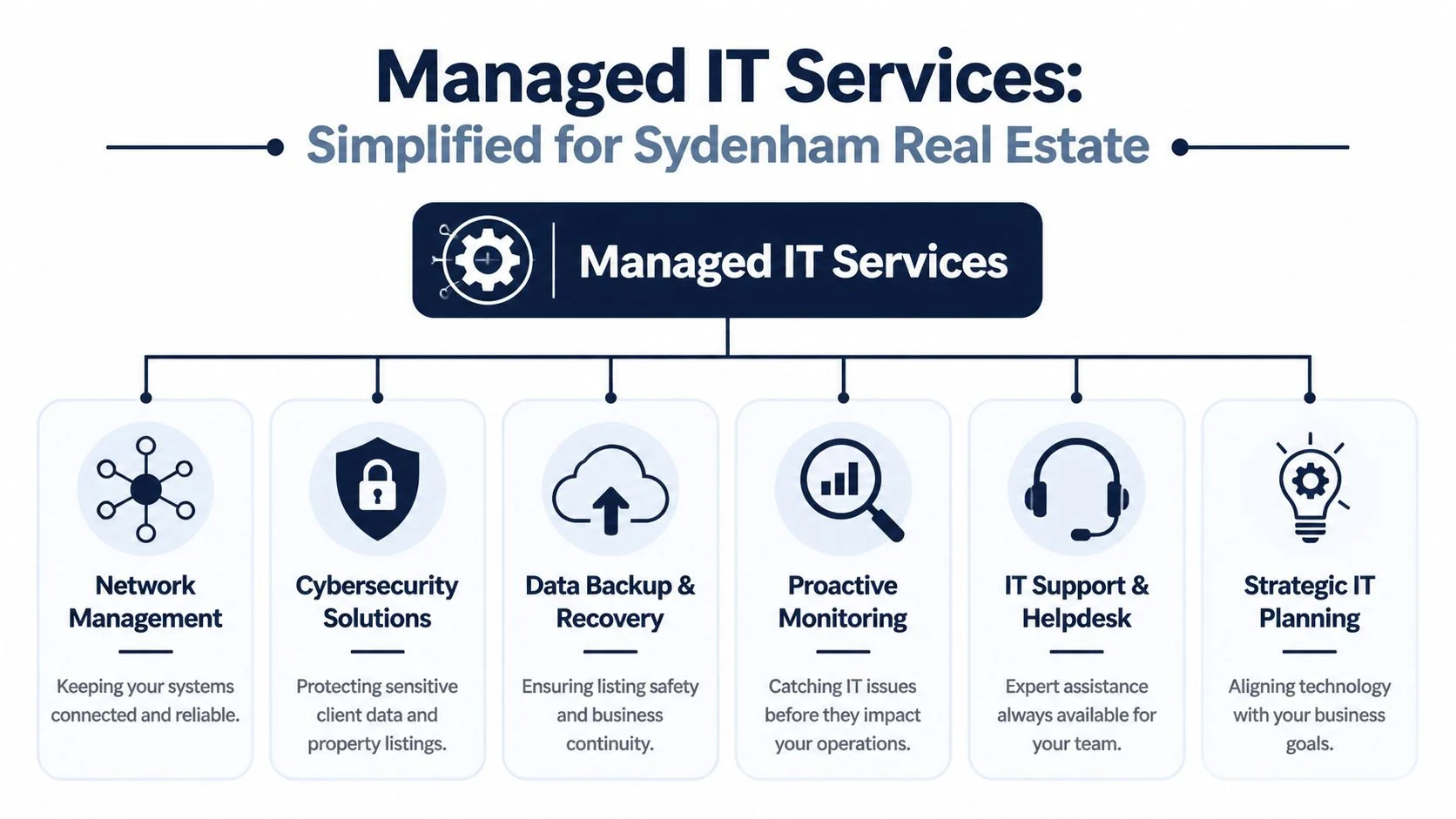
Monitoring before failure
The simplest analogy is this. Reactive IT is a locksmith. Managed IT is a security guard walking the perimeter every night.
Proactive monitoring means someone is watching the health of your environment before staff start reporting problems. That includes internet stability, device health, cloud service alerts, storage issues, failed backups, and suspicious login behaviour. In a property office, this matters because your busiest periods don’t leave room for diagnostics. You need problems identified before they turn into stopped auctions, missed callbacks, or delayed lease processing.
Helpdesk that understands agency work
A proper IT support and helpdesk function is not just about resetting passwords. It’s about understanding the pressure behind the request.
If reception can’t search the right mailbox, that affects response times. If an agent can’t sync photos from a phone before a listing goes live, that affects marketing. If a property manager can’t open a routine inspection report while on the road, that affects service delivery. Support has to fix the technical issue and understand why the timing matters.
Cloud access and line-of-business software
Real estate teams need access from the office, the car, home, and on-site inspections. That’s where cloud solutions earn their keep. Documents, calendars, CRM access, task tracking, and communication tools need to work across devices without encouraging staff to create unsafe shortcuts.
For agencies using specialised software, uptime matters. According to this overview of real estate and property management IT services, specialised managed IT services can deliver 99.9% uptime for property management software such as Yardi Voyager and MRI Software, and reduce recovery time from hours to under 15 minutes through automated failover to cloud backups. That’s not just a technical benchmark. It means your office can keep moving when a local machine, connection, or server component fails.
Backup and disaster recovery
A backup that has never been tested is just a hopeful theory.
In practice, data backup and disaster recovery should cover contracts, listing assets, email, shared files, key line-of-business platforms, and the ability to restore operations quickly. The point isn’t merely to save copies. The point is to know what gets restored first and how staff keep working while that happens.
A good recovery plan answers three questions fast. What failed, what’s still safe, and how do staff keep serving clients today?
Strategic advice, not just support tickets
The strongest managed providers don’t just fix faults. They provide IT planning. That means reviewing whether your agency should standardise devices, tighten access controls, improve document workflows, refresh Wi-Fi, or migrate systems more cleanly.
If you’re comparing service models, this breakdown of what are MSPs gives a good general explanation. For real estate, its core value is in applying that model to listing campaigns, inspections, leasing workflows, and sales admin, not just office computers.
What works well in real estate
Some tools outside the core IT stack also benefit from a cleaner setup. For example, agencies working with consultants or reports tied to inspections may find value in dedicated Property inspection software solutions when they want clearer field reporting and document consistency. The broader point is that specialised apps only help when your underlying access, permissions, storage, and support are stable.
What doesn’t work is trying to run a mobile real estate business on unmanaged devices, inconsistent file naming, and cloud access that nobody has reviewed in years. That isn’t lean. It’s fragile.
Key Benefits of Managed IT for Agency Growth
The biggest mistake principals make is viewing managed IT as a cost centre. In real estate, the better lens is operational advantage. Stable systems give your team more usable selling time, cleaner admin flow, and fewer embarrassing service failures.
Productivity that agents actually feel
Agents don’t care about infrastructure in the abstract. They care whether calls connect, documents open, calendars sync, and listing assets are where they expect them to be.
When those basics are stable, the whole office moves faster. Admin spends less time chasing missing information. Property managers don’t double-handle routine reports. Sales staff stop wasting energy on login friction, patchy remote access, or device oddities. That regained time goes back into calls, follow-up, appraisals, and client care.
Hybrid work that isn’t held together with luck
A modern agency doesn’t live at one desk. It works from open homes, cars, cafés, home offices, and vendor meetings. That’s no longer a special setup. It’s normal.
According to this article on IT services for the real estate industry, 73% of Victorian real estate businesses operate in a hybrid model, and Melbourne’s outer west has seen a 14% increase in NBN enterprise fibre upgrades supporting low-latency VoIP and VDI for mobile agents. For Sydenham agencies, that means there’s a practical opportunity to build a setup that supports voice calls, remote desktops, cloud files, and mobile work without constant compromise.
Better client experience
Clients don’t see your firewall or backup dashboard. They see outcomes.
They notice whether contracts arrive cleanly, whether updates are prompt, whether inspections run smoothly, whether documents are easy to access, and whether their private information feels handled professionally. Strong IT improves those moments because staff are less distracted by tool failure and more able to respond with confidence.
Agencies rarely lose trust because of one dramatic system failure. More often, they lose it through repeated small frictions that make clients wonder what else is disorganised.
Easier scaling
Growth exposes weak systems fast. One extra staff member might seem manageable. Three new starters, shared inbox changes, more devices, another office location, and more cloud apps can tip a shaky setup into chaos.
Managed IT gives you standard ways to onboard staff, secure access, support remote work, manage shared resources, and review future needs. If you want a broader business case for that shift, this summary of the benefits of managed IT services is useful context.
A short comparison
| Agency setup | What usually happens |
|---|---|
| Ad-hoc support | Problems get fixed late, staff invent workarounds, and nobody owns the bigger picture |
| Managed support | Systems are reviewed regularly, common faults are reduced, and growth is easier to absorb |
The agencies that grow cleanly are usually not the ones with the fanciest software. They’re the ones with consistent foundations.
Advanced Cybersecurity for Protecting Your Listings and Clients
Real estate is attractive to attackers because the data is valuable and the timing is sensitive. Agencies handle IDs, financial details, tenancy records, signed contracts, and fast-moving transactions where one convincing email can do real damage.

Zero-trust in plain English
Zero-trust architecture means the system doesn’t automatically trust a user or device just because they’re inside the business. Every access request gets checked.
That sounds strict, but it’s practical. In a real estate office, staff work from multiple devices and locations. People log in from home, from inspections, and from shared spaces. Zero-trust treats every login like the front door of a property. You still let the right person in, but you check who they are before handing over the keys.
Why MDR matters
Basic antivirus isn’t enough for an agency handling sensitive documents and high-pressure transactions. You also need visibility into suspicious behaviour.
According to this piece on real estate IT services, a zero-trust architecture combined with managed detection and response, or MDR, can reduce data breach risks by 65% and cut mean time to detect threats to under 5 minutes, which matters when 28% of Australian real estate SMEs reported cyber incidents. In simple terms, MDR means there are tools and people watching for unusual activity and responding quickly before a bad login, malicious attachment, or compromised device turns into a full-blown office issue.
The controls that make the difference
The strongest setups usually include a combination of measures, not one silver bullet:
- Multi-factor authentication adds another proof point before access is granted.
- Device management sets rules for laptops and phones used for work.
- Email filtering and user protection reduce the chance of staff acting on fake invoices or malicious links.
- Access reviews make sure old accounts, excessive permissions, and shared credentials don’t linger.
- Logging and alerting create a record of what’s happening so suspicious activity can be investigated properly.
A lot of agencies also underestimate document handling risk. If you’re looking at broader best practice around optimizing document flow in real estate syndication, the useful takeaway is that document movement needs structure, permissions, and traceability. That principle applies just as much to contracts, ID packs, lease files, and disclosure materials in a local agency.
Compliance and daily behaviour
Security isn’t just a software stack. It’s staff behaviour plus systems that make the right action easier.
That includes controlling who can download what, separating personal and business storage, standardising how sensitive files are shared, and preparing for breach response obligations under Australian requirements. For agencies looking at baseline controls, the ACSC Essential 8 guide is a practical reference point.
Security should reduce risky behaviour, not rely on staff being perfect under pressure.
What doesn’t work is telling a busy property manager to “be careful” while leaving them with broad access, weak file-sharing habits, and no clear reporting path when something looks off. Real protection comes from systems that assume mistakes will happen and contain the damage when they do.
Choosing Your Sydenham IT Partner and The Onboarding Process
Choosing an IT provider for a real estate agency is less like buying software and more like choosing a building manager. You need someone who keeps the place running, spots issues early, understands the tenants, and doesn’t disappear when something urgent happens.
What to look for in a provider
Local context matters. A provider near Sydenham is more likely to understand how smaller Melbourne west agencies operate. That includes mixed device environments, hybrid work, reception-heavy communication, after-hours pressure, and that a principal often ends up carrying technology decisions they never wanted.
Industry fit matters too. Ask whether they understand:
- Sales and property management workflows
- Cloud platforms your team already uses
- Mobile access requirements for agents
- Access control for shared mailboxes and files
- Backup expectations for critical business data
Transparent pricing also matters. If support terms are vague, invoices become a surprise. You want clear scope, clear response expectations, and a plain explanation of what’s included.
Questions worth asking
Before signing anything, ask practical questions:
- How do you handle onboarding without disrupting the office?
- What do you monitor proactively versus waiting for us to report?
- How do you secure staff devices used outside the office?
- What happens if a machine fails on a busy day?
- How do you document our setup so we’re not dependent on one technician?
The answers tell you more than a feature list. Good providers speak in workflows, risk, priorities, and accountability. Weak ones stay abstract.
If a provider can’t explain your backup and recovery process in plain English, they probably can’t execute it cleanly when the pressure is on.
What onboarding should look like
A smooth onboarding process is usually phased. Not flashy. Just organised.
Discovery comes first. That means reviewing devices, users, shared mailboxes, Wi-Fi, internet services, cloud apps, file storage, backups, and security gaps.
Planning comes next. Priorities are set around risk and business impact. For example, shared access cleanup and backup checks may come before replacing devices.
Implementation should be staged. You don’t rip out the whole environment at once. You standardise critical systems, secure access, improve visibility, and document the setup while keeping the office running.
Ongoing support is where the value settles in. Tickets get handled, but the bigger gain is that someone is reviewing the environment before the same old problems repeat.
What a clean switch feels like
A good transition shouldn’t feel dramatic to your staff. They should notice that logins are clearer, support is easier to reach, shared systems make more sense, and recurring faults start disappearing. The best onboarding projects are the ones where the office feels calmer a few weeks later because less energy is leaking into preventable tech issues.
Your Next Steps with Tbourke Solutions and FAQs
A Sydenham sales office can look fine from the outside right up until a busy Saturday exposes the cracks. An agent is trying to pull listing photos from the cloud in a driveway. Property management is chasing documents from the office. The principal is asking whether staff access, client records, and trust-related systems are locked down properly. If the answer depends on guesswork, the setup needs attention.
Tbourke Solutions works from nearby Hillside, which matters more than many agencies expect. A local provider is more likely to understand how western suburbs agencies operate. Fast mobile work, shared mailboxes, inspection-heavy days, and pressure around document handling all shape the type of support a real estate office needs. Generic IT support often treats an agency like any other small business. That usually misses the key pressure points.

For Sydenham agencies, the job is not just keeping laptops running. It is keeping sales, leasing, and property management moving without exposing the business to preventable risk. That includes access control around client information, practical support for AUSTRAC-related record handling, and making proper use of local NBN improvements so hybrid work is reliable, not just available on paper.
Ways Tbourke Solutions can help
An agency in Sydenham will usually need a mix of day-to-day support and cleanup work that has been put off for too long. Common areas include:
- Managed IT support for staff devices, Microsoft 365, shared email, user accounts, and recurring support issues
- Cybersecurity controls such as MFA, endpoint protection, monitoring, access reviews, and response planning
- Hybrid work setup so agents can work from open homes, home, or the road without exposing files and logins
- Network and Wi-Fi reviews where poor office coverage, unstable internet, or phone problems are slowing the team down
- IT planning for office moves, onboarding, offboarding, system tidy-ups, and standardising years of patchwork decisions
The best next step is usually a proper review of what you already have. In real estate, replacing everything at once is rarely the smart move. Cleaning up permissions, securing mobile access, checking backups, and fixing weak Wi-Fi often delivers more value, faster.
Frequently Asked Questions
| Question | Answer |
|---|---|
| Do small real estate agencies really need managed IT? | Yes. Smaller offices feel outages and security mistakes faster because one failed login, one mailbox issue, or one internet problem can slow the whole team. |
| Will switching IT providers disrupt our office? | It should be controlled and staged. Good onboarding keeps the office working while the provider documents systems, fixes obvious risks, and straightens out access. |
| Can managed IT help with remote and hybrid work? | Yes. The useful part is not just remote access. It is secure remote access that works consistently on office, home, and mobile connections. |
| What if we already use cloud software? | Cloud apps do not manage device health, user permissions, recovery planning, or security settings for you. Those still need active oversight. |
| Can support be tailored to property management and sales teams? | It should be. Sales teams need speed and mobility. Property managers usually need tighter process control, better documentation, and fewer access gaps. |
| Do we need to replace everything we already use? | Usually no. Most agencies get better results by standardising and securing the current setup before making major platform changes. |
| How do we start the conversation? | Start with a clear discussion about what keeps breaking, what staff are working around, how remote access is handled, and where compliance or security feels unclear. That gives both sides something concrete to assess. |
If your agency is dealing with recurring downtime, patchy remote access, unclear permissions, or support that only reacts after the damage is done, get the environment reviewed properly. Fix the foundations before the next campaign, rent roll issue, or compliance check puts the weak spots on display.
If you want practical help with Real Estate Managed IT Services in Sydenham, Tbourke Solutions provides local support from nearby Hillside across managed IT, cloud systems, cybersecurity, consultancy, and network infrastructure.
Share This Story, Choose Your Platform!