The core difference is simple: a Managed Service Provider (MSP) looks after your IT operations, making sure your technology just works. In contrast, a Managed Security Service Provider (MSSP) is a dedicated cybersecurity specialist, focused purely on protecting your digital assets from every angle.
The right choice comes down to what you need most: rock-solid operational stability, a powerful cyber defence, or a smart blend of both.
TLDR: What You Need to Know in a Nutshell
A Managed Service Provider (MSP) is your outsourced IT department, focused on keeping your systems running smoothly through services like help desk support, network management, and data backups. A Managed Security Service Provider (MSSP) is your dedicated cybersecurity guard, providing 24/7 threat monitoring, incident response, and vulnerability management to defend against digital threats. While many MSPs now offer advanced security, the right choice depends on your specific business needs, risk profile, and compliance requirements.

Unpacking the MSP vs MSSP Question
In the world of IT outsourcing, the acronyms MSP and MSSP get thrown around a lot, sometimes even used interchangeably. It’s a common point of confusion for business owners, but their roles are fundamentally different.
Think of an MSP as your organisation’s GP for technology. They handle the day-to-day health of your entire IT setup, everything from network management and cloud services to help desk support and data backups. Their primary goal is to keep things running smoothly, focusing on availability and performance.
An MSSP, on the other hand, is more like a security specialist, a cybersecurity cardiologist, if you will. Their entire mission is to monitor, detect, and respond to cyber threats, 24/7. They are the guardians of your digital world, obsessed with protecting you from data breaches, ransomware, and other attacks. Their main goal is protection and resilience.
At a Glance: Key Distinctions
This table breaks down the fundamental differences between an MSP and an MSSP.
| Criterion | Managed Service Provider (MSP) | Managed Security Service Provider (MSSP) |
|---|---|---|
| Primary Goal | Maximise IT uptime and operational efficiency. | Minimise cybersecurity risk and respond to threats. |
| Core Services | Network management, help desk, software patching, cloud administration. | 24/7 security monitoring, threat detection, incident response, vulnerability scanning. |
| Key Tools | Remote Monitoring & Management (RMM), Professional Services Automation (PSA). | Security Information & Event Management (SIEM), Security Orchestration (SOAR). |
| Focus | Proactive maintenance and reactive support for IT health. | Proactive defence and real-time response to security incidents. |
| Team Expertise | IT generalists and network engineers. | Security analysts, ethical hackers, and threat intelligence experts. |
What Does a Managed Service Provider Actually Do?
Think of a Managed Service Provider (MSP) as your dedicated, outsourced IT department. Their entire job is to take complete ownership of your technology, making sure everything runs smoothly so your team can focus on their actual work without fighting with tech problems. They’re the mechanics and engineers keeping your business’s engine tuned and running at full tilt.
The core of an MSP’s value is proactive management. Instead of waiting for a server to crash or a laptop to fail, they are constantly monitoring your network, devices, and systems to spot trouble before it causes a costly outage. This flips the old “break-fix” model on its head, turning your IT from an unpredictable expense into a stable, strategic part of your business. To get a handle on what this looks like in practice, this overview of What Is an MSP is a great starting point, even if it’s focused on a specific industry like healthcare.
Core Functions of an MSP
An MSP’s responsibilities are broad, covering just about everything your business needs to operate from a tech perspective. The ultimate goal is to deliver a seamless technology experience for both your staff and your customers.
Here’s what they typically handle day-to-day:
- Proactive Network Monitoring: Keeping a constant watch over your network to ensure it’s fast, reliable, and secure, preventing slowdowns before they happen.
- Responsive Help Desk Support: A dedicated support team for your employees to call when they run into any IT issue, from a software glitch to a printer that won’t cooperate.
- Device and Software Management: Taking care of all software updates, security patches, and device configurations to keep everything current and secure.
- Cloud Infrastructure Administration: Managing your cloud platforms like Microsoft 365 or Google Workspace, making sure your data is accessible, backed up, and correctly configured.
- Data Backup and Disaster Recovery: Setting up rock-solid backup systems to protect your business data and creating a clear plan to get you back up and running fast if disaster strikes.
When you see that 83% of businesses using an MSP now list cybersecurity as a top priority, it’s clear the role has evolved. A good MSP provides a stable foundation, which is the perfect starting point for adding more specialised security layers.
An effective MSP doesn’t just fix problems; they prevent them. Their value is measured not just in resolved support tickets, but in the hours of downtime your business never experiences.
Ultimately, an MSP brings predictability to your operations. You get predictable IT performance and, just as importantly, a predictable monthly cost. This lets you budget effectively and avoid the nasty financial surprises that come with reactive IT support.
For a deeper dive into their role, our guide on what MSPs are and what they do is a great resource. An MSP is the foundation for a stable and efficient IT environment, paving the way for more specialised security layers.
Understanding the Specialised Role of an MSSP
While a Managed Service Provider (MSP) is your IT generalist, keeping the engine of your business running smoothly, a Managed Security Service Provider (MSSP) is a specialist operative with a single, critical mission: defending your digital assets. Think of them less as the mechanic and more as the dedicated, round-the-clock security detail for your entire technology environment.
Their job isn’t about performance or uptime; it’s purely about protection. An MSSP operates on the front lines of cyber defence, bringing the advanced tools, expert personnel, and constant vigilance needed to guard against an ever-growing landscape of digital threats.

The Core of an MSSP: A Security Operations Centre
At the heart of any genuine MSSP is the Security Operations Centre (SOC). This isn’t just a help desk with some security software; it’s a command centre staffed 24/7 by security analysts, threat hunters, and incident responders. Their entire purpose is to continuously monitor your network, endpoints, and cloud services for any sign of malicious activity.
To do this, the SOC relies on powerful technologies, most notably a Security Information and Event Management (SIEM) system. A SIEM platform acts like a central nervous system for your security, collecting and analysing log data from every corner of your IT infrastructure. It pieces together billions of individual events to spot patterns that could signal a sophisticated cyber attack in progress, something a standard firewall or antivirus would completely miss.
Proactive Defence and Rapid Response
An MSSP’s approach is fundamentally proactive. They don’t just sit and wait for a breach to happen. Instead, they actively hunt for threats and vulnerabilities lurking within your environment.
Key proactive services include:
- Continuous Vulnerability Scanning: Regularly probing your systems to find and prioritise security weaknesses before attackers can exploit them.
- Proactive Threat Hunting: Using threat intelligence and advanced analytics to actively search for hidden adversaries who may have bypassed initial defences.
- Incident Response Planning: Developing and testing a clear, actionable plan to contain a breach, eradicate the threat, and recover systems with minimal disruption.
This proactive stance is a defining difference when comparing MSP vs MSSP. While an MSP patches systems to prevent known issues, an MSSP is out there hunting for the unknown.
Meeting Australian Compliance Mandates
For Australian businesses, this level of security is more than just good practice; it’s often a legal requirement. As the Australian managed services sector grows, so does the regulatory scrutiny. MSSPs provide the specialised tools and constant monitoring needed for compliance with regulations like the Notifiable Data Breaches (NDB) scheme.
The true value of an MSSP isn’t just in the technology they deploy, but in the human expertise that interprets the data. They provide the context, analysis, and decisive action needed to turn security alerts into meaningful protection.
Ultimately, an MSSP delivers a defence-in-depth strategy. For organisations handling sensitive data or operating in high-risk industries, understanding our managed cybersecurity services can clarify how this specialised protection works.
When to Get Help
Feeling swamped by all the technical jargon? Unsure if your biggest risk is a server crashing or a data breach? If you’re struggling to get a clear picture of your IT operations and security weaknesses, that’s the perfect signal to bring in an expert. Don’t wait for a system failure or a security scare to make the decision for you. Taking a proactive approach is always the most effective and cost-efficient way to build a resilient technology foundation. Reach out via our contact page to discuss your needs.
Diving Deeper: A Side-by-Side Comparison
At a glance, Managed Service Providers (MSPs) and Managed Security Service Providers (MSSPs) can look similar. They both help you manage your technology, right? Yes, but their core missions are worlds apart. Getting this distinction right is the key to making a smart investment for your business.
Think of it like this: an MSP is the facilities manager who keeps the lights on, the plumbing working, and the building running smoothly day-to-day. An MSSP is the specialised security firm that installs the alarms, monitors the cameras, and responds if someone tries to break in. One handles operational health; the other handles active threats.
Let’s break down exactly where their responsibilities diverge.
Primary Objective and Scope of Work
An MSP’s entire world revolves around operational efficiency and uptime. Their job is to keep your IT infrastructure, networks, servers, and computers, humming along without a hitch. Their scope is incredibly broad, covering everything from fixing a printer jam and setting up a new user to managing your cloud services.
An MSSP, on the other hand, has a laser-focused objective: cyber defence and risk mitigation. Their scope is deep but narrow, dedicated solely to protecting your digital assets. They live and breathe threat monitoring, incident response, and managing sophisticated security tools. They aren’t the ones you call for a password reset or a software install; they’re the ones who spot a threat and shut it down before it causes damage.
Here’s a look at how these two providers stack up across the most important criteria.
MSP vs MSSP Core Differences at a Glance
This table cuts straight to the chase, highlighting the fundamental differences in focus and function between an MSP and an MSSP.
| Criterion | Managed Service Provider (MSP) | Managed Security Service Provider (MSSP) |
|---|---|---|
| Primary Goal | Maximise IT uptime and operational efficiency. | Minimise cyber risk and respond to threats. |
| Core Focus | Broad IT management (networks, servers, support). | Narrow and deep security management. |
| Key Metrics | System availability, ticket resolution times. | Threat detection rates, incident response times. |
| Main Tools | RMM (Remote Monitoring & Management), PSA (Professional Services Automation). | SIEM (Security Information & Event Management), SOAR (Security Orchestration, Automation, & Response). |
| Team Skills | IT generalists, network engineers, system administrators. | Security analysts, ethical hackers, incident responders. |
| Reporting | Operational health reports, performance metrics. | Threat analysis, compliance reports, vulnerability assessments. |
Ultimately, this comparison shows that you’re not choosing between two similar services. You’re deciding which distinct function, operations or security, is your immediate priority.
Core Tools and Technologies
The software each provider uses tells a clear story about their priorities. An MSP’s toolkit is all about performance, management, and organisation.
- Remote Monitoring and Management (RMM): This is the MSP’s command centre. It allows them to see the health of all your devices, push out software patches, and automate routine maintenance without ever stepping into your office.
- Professional Services Automation (PSA): This is the business brain of the operation. It handles help desk tickets, manages projects, and takes care of billing, keeping the MSP’s workflow efficient.
An MSSP operates in a completely different world, using a suite of highly specialised platforms built to hunt for and neutralise threats.
- Security Information and Event Management (SIEM): This powerful technology is like a central intelligence hub. It pulls in log data from every corner of your network and uses advanced analytics to spot suspicious activity that would otherwise be invisible.
- Security Orchestration, Automation, and Response (SOAR): These platforms act as a force multiplier for security teams. They automate the initial steps of an incident response, allowing human analysts to focus their skills on the most critical parts of an attack.
The difference is clear: an RMM tool tells an MSP if a server is running slow, while a SIEM tool tells an MSSP if a malicious actor is trying to access that server.
Team Expertise and Skill Sets
The people behind the service are just as different as the tools they use. MSPs hire IT generalists, network engineers, and system administrators. These are the versatile problem-solvers who have a broad knowledge base, enabling them to tackle the diverse challenges of keeping a business’s IT running.
MSSP teams are built from a different mould entirely. They are staffed with cybersecurity specialists, security analysts who watch for threats 24/7, ethical hackers who probe for weaknesses, and incident responders who are trained to contain a breach under pressure. Their expertise isn’t wide; it’s incredibly deep, focused on the ever-changing tactics of cybercriminals.
This distinction in skill sets is crucial as businesses lean more heavily on outside experts. Understanding the value each brings is a key part of exploring the benefits of managed IT services.
How to Decide Between an MSP, an MSSP, or Both
Choosing between a Managed Service Provider (MSP), a Managed Security Service Provider (MSSP), or bringing both on board can feel complicated. But really, it all comes down to one simple question: What is your primary business need right now?
The right answer depends entirely on your specific circumstances, your industry, your day-to-day operations, and how much risk you’re willing to tolerate. For some Australian businesses, a modern, security-savvy MSP is the perfect all-in-one solution. For others, especially those in finance or healthcare, the specialised vigilance of a dedicated MSSP is completely non-negotiable.
The flowchart below breaks this down, offering a clear path based on whether your core goal is operational stability or hardened security.
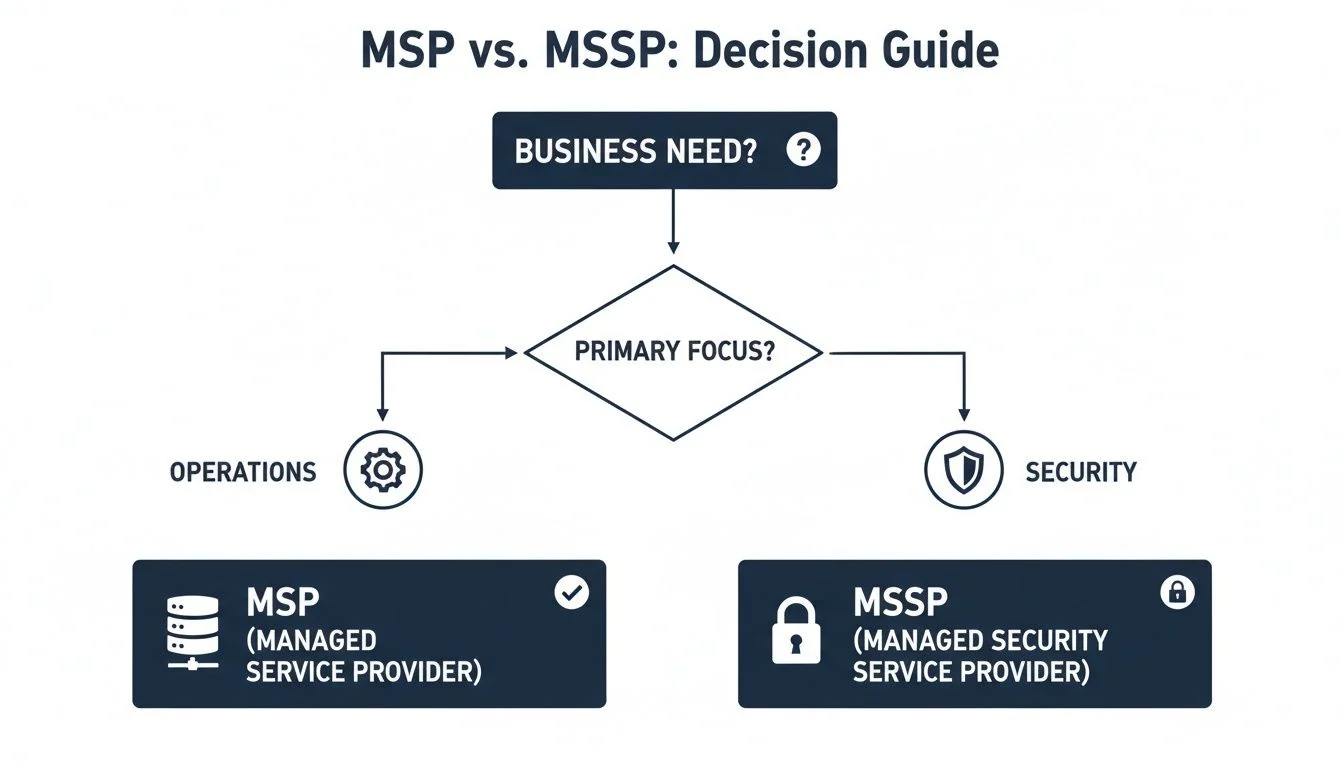
As the decision tree shows, if smooth IT operations are your main headache, an MSP is your starting point. If cyber defence is what keeps you up at night, then an MSSP is the clear choice.
When an MSP Is the Right Fit
For a huge number of small to medium businesses (SMBs) in Australia, a modern, security-conscious MSP is easily the most practical and cost-effective option. This is especially true if your biggest challenges are about keeping the lights on day-to-day, rather than fighting off advanced cyber threats.
An MSP is likely your ideal partner in these situations:
- You’re a Startup or Small Business: Your main priority is just getting your core technology to work reliably. You need help desk support, network management, and maybe some help with the cloud, but you aren’t handling huge volumes of sensitive data.
- You Have No Internal IT Team: An MSP can step in and act as your complete outsourced IT department. You get the broad expertise needed to keep the business running smoothly without the significant cost of hiring a full-time internal team.
- Your Biggest Pain Point Is Productivity: Downtime, slow systems, and staff struggling with technology are your main frustrations. An MSP’s core focus on operational health directly solves these problems.
When You Need a Dedicated MSSP
The need for an MSSP is dictated by risk and regulation, not just the size of your business. A small financial advisory firm, for example, has a far greater need for specialised security than a large manufacturing company might.
You should be looking seriously at an MSSP if:
- You Handle Sensitive Data: If your business stores or processes financial records, personal health information (PHI), or other confidential data, you simply require a more advanced level of protection.
- You Must Meet Strict Compliance Standards: Industries like healthcare, finance, and government contracting are bound by strict regulatory requirements. An MSSP is specifically geared to help you navigate and meet these obligations.
- You Are a High-Value Target: If your business operates in an industry that’s frequently targeted by cyber attacks, like e-commerce or legal services, then a dedicated security partner isn’t a luxury, it’s essential.
The Best of Both Worlds: An Integrated Approach
For most growing Australian SMEs, the best path forward is often an integrated one. This means partnering with a single provider that delivers both comprehensive IT management and robust cybersecurity services under one roof. This model neatly sidesteps the complexity and potential communication gaps that can pop up when trying to manage two separate vendors.
An integrated provider understands that strong security is built on a foundation of well-managed IT. They ensure your systems are not only running efficiently but are also hardened against threats from day one.
This unified approach brings some major advantages. You get a single point of contact, a cohesive strategy where IT and security decisions are perfectly aligned, and often, much better value for your investment. To see how this works in practice, you can explore the services offered by Managed Security Service Providers. It’s a balanced and highly effective strategy for achieving both operational excellence and a strong defensive posture.
How Tbourke Solutions Delivers an Integrated Solution
Trying to choose between an MSP and an MSSP can feel like a false choice. Should you prioritise smooth IT operations or hardened cyber defence? At Tbourke Solutions, we believe you shouldn’t have to pick one. We have built our services on the principle that for Melbourne’s small businesses, schools, and aged care, great IT management and strong security are two sides of the same coin.
With over 20 years of hands-on experience, we provide a unified approach that delivers the best of both worlds. We blend the proactive, day-to-day IT support of a traditional MSP with the vigilant, security-first mindset of an MSSP. This means you get one trusted local partner who understands your entire technology environment, from the ground up, ensuring your operational needs and security requirements are always perfectly aligned.

A Single Partner for Complete Peace of Mind
Juggling separate providers for IT and security creates communication gaps, finger-pointing, and conflicting priorities. An MSP might roll out a change that accidentally opens a security hole, while an MSSP’s strict controls could grind your daily workflow to a halt. Our integrated model eliminates that friction completely. We handle everything, from help desk support and cloud management to 24/7 security monitoring and threat response, all guided by a single, cohesive strategy. It’s not just more efficient; it’s fundamentally more secure.
With Tbourke Solutions, you get a holistic strategy from a single, trusted local provider. We ensure your operational needs and security requirements are always perfectly aligned, giving you a powerful advantage.
We are all about building transparent, lasting partnerships with our clients. We take the time to actually understand what you need, whether you’re a growing SME, a school protecting student data, or a sole trader just wanting reliable tech support. You can see how our philosophy translates into real-world benefits by reading about how managed IT reduces downtime and security risk. Your business’s future depends on technology that is both productive and protected. Stop trying to decide between an MSP vs an MSSP and secure your operations with a partner who delivers both.
Ready for a personalised IT and security assessment? Reach out through our contact page to start the conversation today.
Frequently Asked Questions
Navigating the choice between an MSP and an MSSP can bring up many questions. Here are clear, straightforward answers to the most common queries we encounter from business owners.
Can my MSP handle all my cybersecurity needs?
It depends on the MSP and your specific risk profile. Many modern MSPs, like Tbourke Solutions, have integrated strong cybersecurity practices into their core offerings. For most small to medium-sized businesses, this provides a robust and cost-effective level of protection. However, if your business operates in a high-risk industry like finance or healthcare, or is subject to strict compliance regulations, the specialised, 24/7 threat hunting and incident response capabilities of a dedicated MSSP might be essential.
Is it more expensive to hire both an MSP and an MSSP?
Yes, in most cases, hiring two separate vendors is more expensive and complex. You will be managing two contracts, two relationships, and trying to align two different teams, which can lead to communication gaps and security blind spots. An integrated provider that offers both expert IT management and robust cybersecurity services typically delivers better value and a more cohesive, secure strategy.
When does a business truly need a dedicated MSSP?
The need for a dedicated MSSP is driven by risk and regulation, not business size. A small financial advisory firm has a greater need for specialised security than a large manufacturing company might. You should seriously consider a dedicated MSSP if your business:
- Handles large volumes of sensitive data (financial records, health information, etc.).
- Must comply with strict industry regulations (e.g., APRA, NDB scheme).
- Is a high-value target for sophisticated cyber attacks.
At Tbourke Solutions, we simplify this choice by offering a fully integrated service. You get the operational excellence of a top-tier MSP and the vigilant protection of an MSSP from a single, trusted local partner.
Secure your business’s future with a holistic IT and security assessment. To submit a query and get started, reach out to us via our contact page.
Share This Story, Choose Your Platform!