In the transport game, IT services are not just about fancy software; they are the specialised tech that helps logistics and transport companies manage their fleets, sharpen up operations, and seriously improve safety. It is about moving your business from clunky, paper based processes to smart, data driven systems that deliver real cost savings and better reliability.
TL;DR
This guide explores how essential IT services for transportation, such as fleet management, cloud solutions, and cybersecurity, can revolutionise your logistics operations. We cover the core technologies that reduce operational costs, boost fleet efficiency, and enhance road safety. You will learn how to choose the right IT partner and see a measurable return on investment, ensuring your business stays competitive and secure.
The Engine Room of Modern Transport IT Services
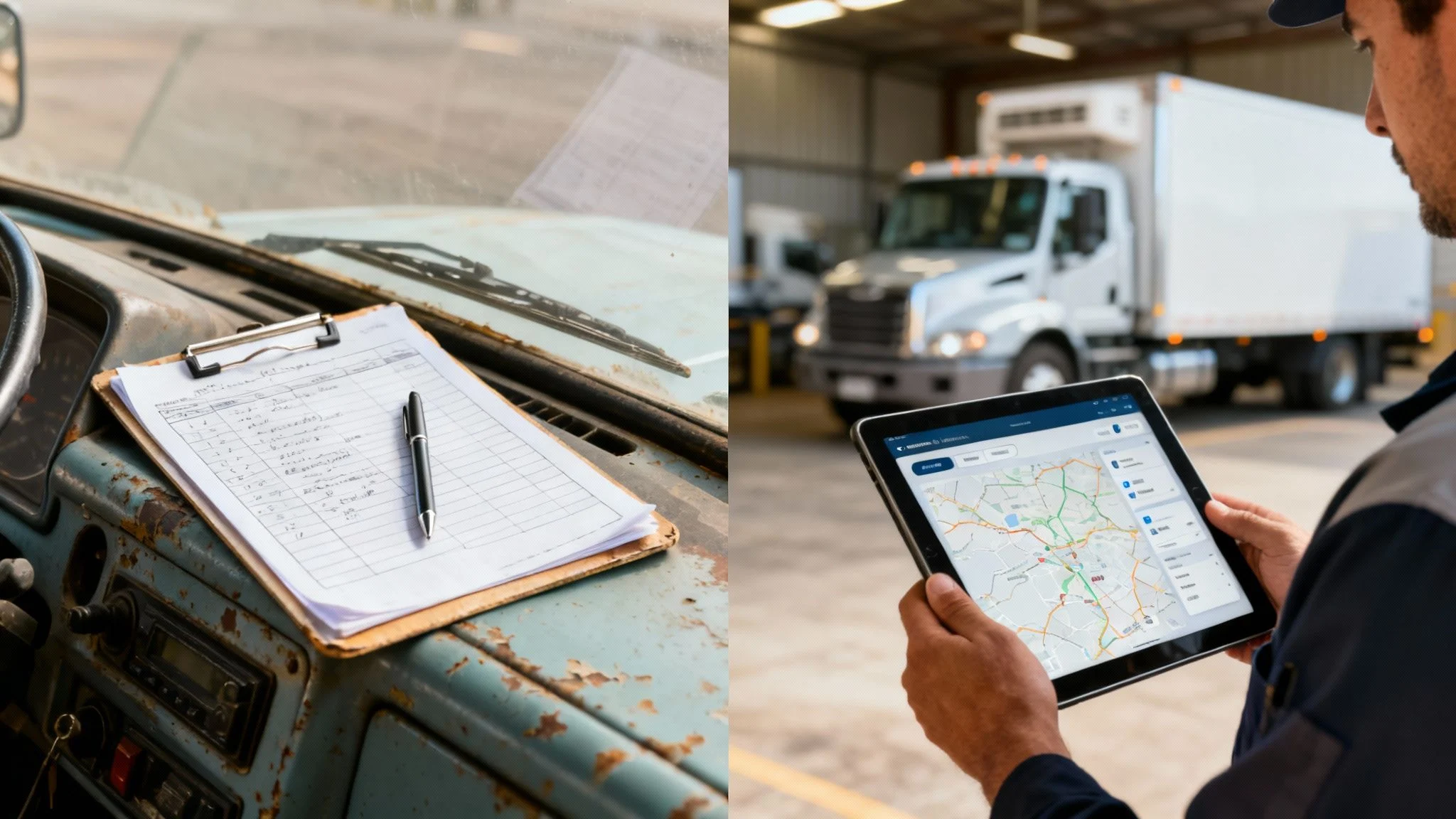
Picture two Aussie transport companies. One is wrestling with a chaotic mix of spreadsheets, constant phone calls, and paper run sheets. They cannot easily track their drivers, surprise maintenance issues blow the budget, and compliance paperwork is a black hole of wasted time.
The other company? They run everything through a central digital system. Dispatch, tracking, maintenance alerts, and compliance are all seamlessly connected. It is not hard to see who has the competitive edge. This is the difference that strategic IT services for transportation makes.
What This Guide Covers
Think of this article as your roadmap to understanding how IT can modernise your transport business. We will break down how technologies like fleet management, cloud solutions, and cybersecurity can dramatically improve your efficiency, cut operational costs, and boost safety on the road.
You will learn how to pick the right IT solutions, create a sensible implementation plan, and measure the actual return on your investment. It is all about giving Australian transport operators practical steps to modernise and get ahead.
Core Technologies Powering Australian Fleets
To really get what IT services can do for a transport business, we need to lift the bonnet and look at the specific tech that is driving things forward. These are not just fancy buzzwords; they are powerful tools that, when used right, become the central nervous system of a modern logistics operation. They connect your vehicles, your team, and your clients in a way that paper logs and phone calls never could.
The momentum here is huge. The Australian Intelligent Transport System (ITS) market was valued at USD 1,324.2 million in 2023 and is set to grow significantly. This is not surprising, given the urgent need to sort out traffic congestion and make our roads safer.
Let’s break down the core components that form the foundation of a digitally powered fleet.
Fleet Management and Telematics Systems
Think of fleet telematics as giving your vehicles a voice. These systems are not just a dot on a map—they combine GPS tracking with onboard diagnostics to send a constant stream of live data right back to your office. It is a clear window into the health and real time performance of your entire operation.
With this tech, you can see exactly where every truck is, how fast it is going, and even keep an eye on driver habits like harsh braking or speeding. This kind of visibility is a game changer for everything from tweaking delivery routes on the fly to giving customers an accurate ETA. Even better, remote diagnostics can flag a potential engine fault before it becomes a costly breakdown on a remote highway, turning reactive repairs into proactive maintenance.
The Internet of Things in Logistics
The Internet of Things, or IoT, pushes telematics even further. It is about placing smart sensors not just on the truck, but on the cargo and its components as well.
Picture a refrigerated truck carrying temperature sensitive goods. IoT sensors can constantly monitor the cargo’s temperature and humidity, firing off an instant alert if conditions slip outside the safe zone. This is not just good for preventing spoilage; it is essential for compliance.
But it goes much further:
- Tyre Pressure Monitors: These sensors can spot a slow leak long before a driver would, helping to prevent dangerous blowouts and improving fuel efficiency.
- Fuel Level Sensors: Get precise fuel consumption data and help stamp out potential theft or misuse.
- Door Sensors: Get a notification the moment a cargo door opens, adding a crucial layer of security to your deliveries.
IoT turns your physical assets into intelligent, data producing team members. Your fleet starts telling you what it needs—from fuel and maintenance to security checks—before a person even has to ask.
Cloud Computing for Seamless Operations
If telematics and IoT are the senses of your operation, then cloud computing is the brain. It acts as a central, secure, and accessible hub for all the data your fleet is generating.
Instead of being chained to a single computer in the depot, your team can access dispatch schedules, compliance records, and logistics data from anywhere with an internet connection. This flexibility is massive for a business that is always on the move. A dispatcher working from home can have the exact same tools as one in the main office.
Plus, cloud platforms ensure your critical data is backed up and safe from local disasters like hardware failure, fires, or floods. Your business can keep running, no matter what happens at your physical site.
Software Integration and Process Automation
The real magic happens when all these technologies talk to each other. Software integration is what connects your different systems—your accounting software, dispatch platform, telematics, and customer database (CRM)—so they can share data automatically. This gets rid of soul crushing manual data entry and slashes the risk of human error.
For example, when a job is marked ‘complete’ in your telematics system, it can automatically trigger an invoice in your accounting software. This kind of seamless workflow frees up your admin staff to focus on things that actually grow the business.
As your network of connected systems grows, solutions like SD-WAN become critical for making sure everything communicates reliably. You can learn more about managing these connections in our guide to SD-WAN. It is all about building a single, unified workflow that powers your entire business from end to end.
How IT Delivers a Measurable Return on Investment
Pouring money into new technology can feel like a massive expense, but for any modern transport operator, it is one of the surest ways to unlock serious savings and boost profitability. The real magic of IT services in transportation is not just about fancy gadgets; it is about turning raw data into direct, measurable wins for your operations and your bottom line.
It is a shift in mindset—from seeing tech as a cost to seeing it as an investment. Every dollar you spend on the right tools should find its way back to you, whether through lower running costs, better use of your vehicles, or smoother day to day workflows. The trick is knowing exactly where to look for those returns.
The growth in this space is undeniable. The forecast for Australia’s Intelligent Transport System (ITS) market shows just how quickly the industry is adopting this technology.
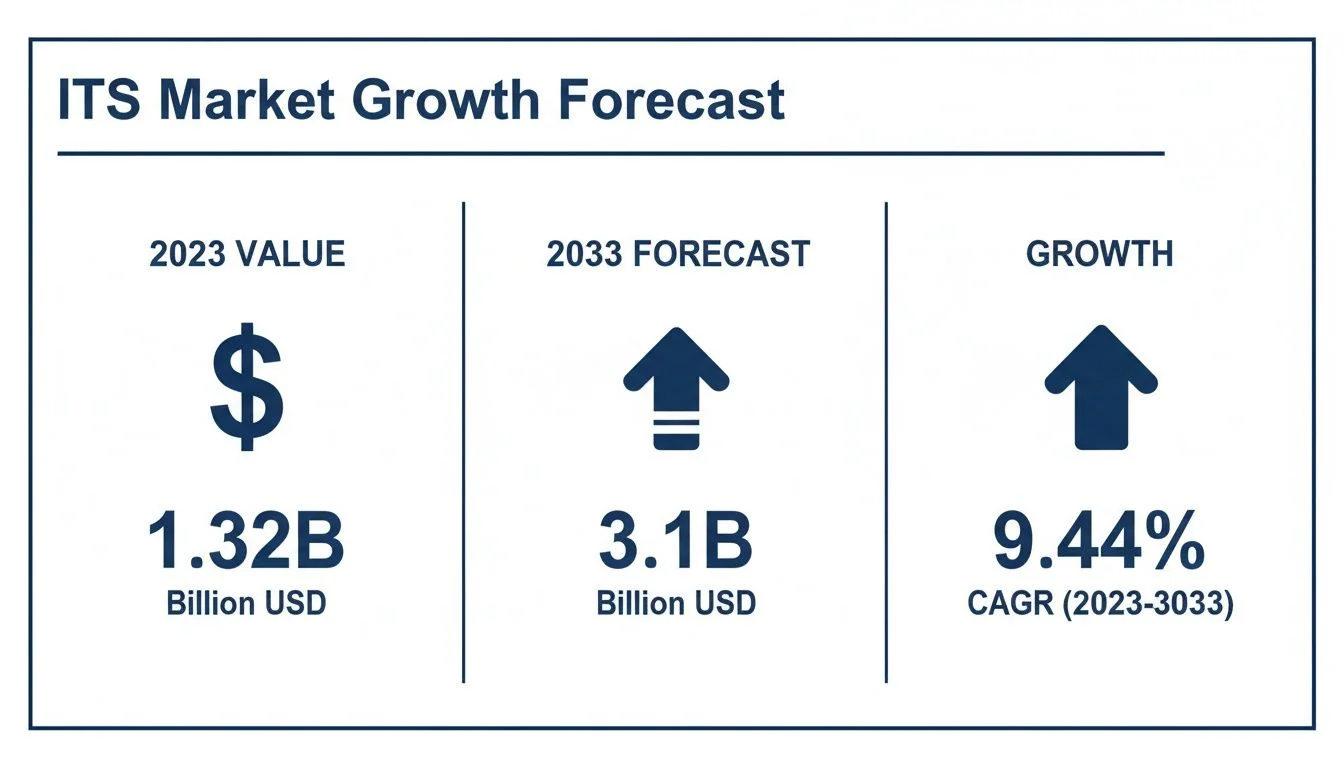
With the market tipped to more than double by 2033, it is clear that operators are seeing tangible results and voting with their wallets.
Slashing Your Operational Costs
The quickest and most obvious return on investment comes from chipping away at your daily running costs. Fuel and maintenance are the two biggest cash drains for any fleet, and this is where a smart IT setup makes a huge difference.
- Fuel Efficiency: Route optimisation software is not just a fancy map. It uses live traffic data and smart algorithms to calculate the most efficient route for every single trip, dodging congestion and cutting out wasted kilometres. That alone can lead to massive fuel savings across your entire fleet.
- Predictive Maintenance: Instead of waiting for a truck to break down on the side of the road, IoT sensors can monitor everything from engine health to tyre pressure in real time. This lets you schedule maintenance before something goes wrong, avoiding expensive emergency repairs and the profit killing downtime that comes with them.
- Reduced Admin Burden: Think about all the hours spent on compliance paperwork, invoicing, and payroll. Automating these tasks frees your office staff from endless data entry, allowing them to focus on things that actually grow the business, like looking after customers.
In Australia, AI powered predictive maintenance is already a game changer. Local transport companies are now using it to predict vehicle issues with an incredible 92% accuracy rate. This has slashed vehicle downtime by up to 30% for some of the country’s biggest fleets, while dynamic rerouting has cut fuel use by as much as 18%.
Boosting Asset Utilisation and Productivity
Getting the absolute most out of every vehicle and every team member is crucial. Better visibility and smarter scheduling translate directly into more jobs done and more revenue in the bank.
A centralised dispatch system linked to your vehicle telematics gives you a bird’s eye view of your whole fleet. You can instantly assign the closest truck to a new job, cutting down on “deadhead” miles and giving your clients much faster response times. To really dig into how this works, checking out the key benefits of a Transportation Management System (TMS) gives some fantastic insights into these productivity gains.
By moving to cloud based systems, your entire team—dispatchers, drivers, and admin staff—can access the info they need, wherever they are. This makes your whole operation more agile and ready to adapt when plans change.
For small businesses, the cloud is especially powerful. You can ditch the expensive on site servers while getting top tier security and reliability. We have put together a detailed guide on the benefits of Azure cloud for small business that breaks this down further. It is all about making sure your critical data is always safe, accessible, and properly backed up.
The table below breaks down the kind of practical returns you can expect from investing in specific IT services.
Expected ROI from Key IT Services
| IT Service Implementation | Area of Impact | Potential Metric Improvement |
|---|---|---|
| Fleet Management & Telematics | Fuel Consumption & Maintenance | 10-18% reduction in fuel costs; 20-30% decrease in unexpected downtime. |
| Cloud Computing & SaaS | Admin & Operational Overhead | 15-25% reduction in manual admin tasks; Improved data access & security. |
| IoT & Predictive Maintenance | Asset Longevity & Repair Costs | Up to 30% reduction in vehicle downtime; 10-20% lower maintenance spend. |
| Software Integration (TMS/ERP) | Scheduling & Route Efficiency | 5-15% increase in jobs per day; significant reduction in empty miles. |
These are not just abstract numbers; they represent real savings and efficiencies that go straight to your profit margins.
Navigating Cybersecurity and Data Compliance Challenges
The more connected your transport business gets, the bigger a target it becomes for cyber threats. Let’s be blunt: a single successful attack is not just an IT headache. It can bring your entire operation to a grinding halt.
Imagine ransomware locking up your dispatch system, stopping every truck in its tracks. Or a data breach exposing sensitive client shipping details. This is why getting serious about cybersecurity is completely non negotiable.
The risks are not generic; they are specific and severe for the transport industry. Your fleet is a collection of moving data points, and every bit of information—from driver logs to cargo manifests—is valuable. Protecting it is not just good practice; it is a critical function that safeguards your reputation and your bottom line.

This shift to digital is happening at a massive scale. Australia’s IT services market, which is tied directly to the transport sector’s modernisation, is predicted to jump from USD 32.26 billion in 2025 to a staggering USD 77.77 billion by 2030. That growth is fuelled by businesses like yours adopting cloud services and better security, showing just how vital this has become.
The Essential Eight: A Practical Defence
For Australian businesses, the Australian Cyber Security Centre (ACSC) gives us a clear playbook called the Essential Eight. Think of it as a practical, prioritised checklist—a set of smart moves to protect your systems from the most common cyber threats.
It is not about building an impenetrable digital fortress. It is about making your business a much harder, less attractive target so attackers move on to easier prey.
The framework focuses on three key areas:
- Preventing malware from getting in and running by controlling which applications can be used and patching them quickly.
- Limiting the damage if an incident does occur by restricting powerful admin privileges and securing user applications.
- Recovering your data and getting back online through a robust, regularly tested backup plan.
Implementing these strategies is a core part of any competent IT service offering for a transport company. To get a better handle on the specifics, you can learn more about how the ACSC Essential Eight framework works in our detailed guide.
An IT partner that does not speak fluently about the Essential Eight is not equipped to protect a modern transport business. It is the baseline standard for effective cybersecurity in Australia.
Demystifying Data Compliance
On top of direct cyber threats, you also need to navigate a complex web of data compliance rules. For transport companies, this usually boils down to a few key areas.
Data Sovereignty is a big one. This principle means certain types of data must be stored on servers physically located within Australia. If your cloud provider stores your client information or financial records overseas, you could be breaking the law without even realising it.
Chain of Responsibility (CoR) laws also have a digital angle. You have to prove you have taken reasonable steps to manage safety, which now includes securely managing and storing digital records like driver fatigue logs, maintenance reports, and mass declarations.
Keeping up with these rules can feel daunting. For those looking at a comprehensive strategy, exploring compliance automation tools for SOC 2, ISO 27001 & NIS 2 can seriously simplify the process, helping you manage multiple standards at once.
The key takeaway? Choose an IT partner who already understands these industry specific obligations. It is crucial.
Your Roadmap to a Successful IT Rollout
Bringing new technology into a transport business can feel like a huge job, but it does not have to be a headache. The trick is to treat it like any other business upgrade—think of it less like a complex tech project and more like adding a new, more efficient truck to your fleet.
A clear, step by step plan is your best friend here. It ensures you are not just buying shiny new gadgets but investing in tools that solve real problems. A good plan gets your team on board, avoids disrupting your daily runs, and makes sure you see a genuine return on your investment.
Step 1: Pinpoint Your Pain Points
Before you even think about solutions, you need to get brutally honest about what is holding your business back. Where are the real bottlenecks?
- Is your dispatch process a mess of paperwork and phone calls, leading to costly errors?
- Are you constantly blindsided by vehicle breakdowns that take trucks off the road?
- How many hours are wasted every week on manual compliance and invoicing?
- Is your fuel bill creeping up without a clear reason why?
This is not about tech; it is about business. Nailing down these issues is the most critical step. It guarantees you invest in technology that fixes what’s actually broken, rather than just chasing the latest trend.
Step 2: Set Clear Goals and a Realistic Budget
Once you know the problems, you can set sharp, measurable goals. Vague ambitions like “we want to be more efficient” do not cut it. Instead, aim for specifics.
For example, a solid goal sounds like: “reduce fuel consumption by 10% within six months” or “cut our invoicing admin time by five hours per week.”
With clear targets, you can build a sensible budget. See this as an investment, not an expense. The right IT services for transportation should pay for themselves through savings, efficiency gains, and better service. A quick consultation can help you figure out the potential ROI and set a budget that makes perfect business sense.
Think of your IT budget as a core part of your operational strategy. The goal is not just to spend money on tech; it is to allocate resources that will directly boost your bottom line and make your customers happier.
Step 3: Choose the Right IT Partner
Finding a vendor is not just about getting the cheapest quote. You need a partner who genuinely gets the transport industry in Australia—the long hours, the tight margins, and the compliance headaches. Do they have a track record with businesses like yours? Do they offer support that understands your operation does not just run from 9-to-5?
This is where you need to ask the tough questions. Dig into their expertise on cybersecurity (especially the Essential Eight framework), data sovereignty, and their ability to integrate new systems with the software you already use.
For a deeper look at what separates a great IT partner from a mediocre one, our guide on business IT consulting services is a great place to start.
The Vendor Selection Checklist for Transport IT Services
Choosing an IT provider can feel overwhelming. This checklist is designed to help you cut through the noise and evaluate potential partners based on what truly matters for a transport and logistics business.
| Evaluation Criteria | Key Questions to Ask | Importance |
|---|---|---|
| Industry Experience | Have you worked with other transport or logistics companies? Can you provide case studies or references? | High |
| Technical Expertise | How do you handle cybersecurity for a 24/7 operation? What is your experience with telematics and fleet software integration? | High |
| Local Support & Availability | Is your support team based in Australia? What are your support hours and guaranteed response times? | High |
| Scalability | Can your solutions grow with our fleet? What does the process look like if we add five new vehicles next year? | Medium |
| Compliance & Data Security | How do you ensure our data stays in Australia and meets local privacy laws? Are you familiar with NHVR requirements? | High |
| Training & Onboarding | What does your training process for our drivers and office staff look like? Is it included or an extra cost? | Medium |
| Pricing & Contracts | Is your pricing transparent? Are there hidden fees? What are the contract terms and exit clauses? | Low |
By using this checklist, you can compare providers apples to apples and find a partner who will be a genuine asset to your business, not just another supplier.
Step 4: Do Not Boil the Ocean—Plan a Phased Rollout
Trying to change everything at once is a surefire way to cause chaos and turn your team against the new tech. A smart implementation is done in stages.
Start with the one area that will deliver the biggest and fastest win, based on the problems you identified in Step 1. Maybe that means rolling out a new telematics system on just a handful of vehicles to begin with. Or perhaps you start by automating a single, time consuming admin task like proof of delivery processing.
This phased approach keeps disruption to a minimum. It gives your team time to learn and adapt, and it lets you work out any kinks on a small scale before you commit to a fleet wide rollout.
Step 5: Focus on People—Training and Ongoing Support
Let’s be honest: the fanciest technology in the world is completely useless if your team does not know how—or does not want—to use it properly. Good, practical training is not an afterthought; it should be baked into your plan from day one.
Make sure your IT partner provides hands on training and is committed to offering ongoing support after you go live. Things change, software gets updated, and your business will evolve. A strong support relationship ensures your technology keeps working for you long after the initial installation is complete.
Answering Your Top Questions About Transport IT
Even with the best plan, taking on new tech always brings up a few questions. We get it. Here are some of the most common things we hear from transport and logistics owners across Australia when they are looking at specialist IT.
Let’s cut through the jargon and get straight to the practical answers.
How Much Should a Small Transport Business Budget for IT?
There is no magic number here, because costs are usually tied to how many users or vehicles you have. The better way to think about it is not as a cost, but as an investment that pays you back.
While some businesses set aside around 3-5% of revenue for their tech, the real story is in the return on that investment. When you start adding up the money you save from less vehicle downtime, better fuel economy, and fewer hours spent on admin, the monthly fee for a managed IT service often pays for itself a few times over. A good provider will sit down with you and map out a business case based on your own numbers.
Can We Use These Technologies in Remote Areas with Poor Internet?
Absolutely. This is a classic Aussie problem, and modern IT services for transportation are built for it. A good IT partner will not just slap in a single solution; they will build a hybrid strategy to keep you connected.
This usually looks something like this:
- A Mix of Cellular and Satellite: Your systems will automatically switch between multiple networks to grab the best signal available, wherever the truck is.
- Offline Data Storage: Telematics units can keep recording data even when there’s no signal. The moment the vehicle gets back in range, it syncs everything up to the cloud automatically.
- Tough as Nails Hardware: We are talking about devices built to handle the rough roads, dust, and patchy connectivity you find on regional and remote runs.
The whole point is to have a system that reliably captures every bit of data, no matter how far off the beaten track your fleet goes.
Do We Need to Replace All Our Existing Systems?
Not at all. A “rip and replace” approach is almost never the right move. The first job of a good IT partner is to look at what you are already using and figure out how to make it all work together, smarter.
The goal is to get your different systems—like your accounting software, dispatch platform, and telematics—talking to each other. When they communicate, your team no longer has to waste time manually punching the same data into three different places. That saves a ton of time and kills a lot of mistakes. We focus on phasing in improvements that build on what you have already invested in.
The best IT strategy improves what you already have before it asks you to replace it. It is about making your current tools work better together, not just throwing them out.
How Tbourke Solutions Can Power Your Fleet
At Tbourke Solutions, we specialise in providing robust and reliable IT support built for small to medium sized businesses in the transport sector. We understand that your operations are 24/7, and our solutions are designed to keep up. Our focus is on turning technology from a recurring problem into a genuine competitive advantage for your fleet.
Here is how we can help:
- Managed IT Services: Think of us as your dedicated IT team, always on the job. We proactively monitor and maintain your systems to prevent downtime before it can pull a truck off the road. You can learn more about the benefits of managed IT services and how they deliver value.
- Cloud Solutions: We provide secure, Australian based cloud services, giving your team access to critical data from the office, the road, or anywhere in between.
- Cybersecurity: We protect your sensitive fleet, client, and financial data from ever present threats by implementing security measures aligned with the Essential Eight framework.
- Connectivity: From depots to remote regional runs, we design and support robust networks built to keep your operations online and your data flowing.
Ready to get your technology working as hard as you do? Let’s have a practical, no nonsense chat about what your operation needs to thrive.
You can get in touch by visiting our contact page and submitting a query. Let’s start mapping out the road ahead for your business.
Share This Story, Choose Your Platform!