
Effective IT budget planning isn’t just about crunching numbers or tracking expenses; it’s about making smart, forward-thinking decisions that directly fuel your business’s growth and efficiency. It’s the roadmap that connects your technology spending to your most important goals.
TLDR: Your Quick Guide to Smart IT Budgeting
This guide shows you how to transform your IT budget from a simple expense list into a strategic tool for business growth. We’ll walk you through auditing your current spending, aligning technology investments with your core business goals, and planning for future needs. You’ll learn how to build a practical, forward-looking budget that boosts efficiency, strengthens security, and gives you a competitive edge, with tips on how an IT partner can simplify the entire process.
Why Your IT Budget Is a Strategic Asset, Not Just an Expense Sheet
Welcome to your no-nonsense guide for creating an IT budget that actually works. We’re talking about a plan that does more than just keep the lights on; it actively drives your business forward.
Forget the intimidating spreadsheets and the frantic, reactive spending that happens when a server suddenly dies. We’ll show you how to build a practical, forward-looking financial plan for your technology. This is designed specifically for the real-world needs of Australian small to medium businesses, schools, and even tech-savvy families in suburbs like Hillside and across Melbourne.
This guide breaks down everything from nailing down your core costs and linking tech spending to your actual business goals, to justifying every dollar and planning for the unexpected.

We want to reframe IT budgeting from a painful administrative chore into a powerful strategic tool for:
- Boosting efficiency across your entire organisation.
- Strengthening your defences against ever-present cyber threats.
- Giving you a real competitive edge in your market.
A well-built budget transforms your technology from a cost centre into a genuine value driver. It gives you a clear roadmap, making sure every dollar is invested in tech that helps you hit your targets. This is the difference between simply paying bills and proactively using technology to innovate, scale, and stay ahead of the curve.
For many businesses, just getting a handle on what can be managed externally is the first big step. Exploring the benefits of managed IT services can reveal how a partner can streamline this whole process for you.
By the end of this guide, you’ll have the confidence and the practical tools to build an IT budget that works for you, not against you.
Trying to get a grip on your IT budget can feel like wrestling with a beast. It’s one of those jobs that’s easy to push to the side, but getting it wrong can seriously stunt your growth or leave you scrambling when unexpected costs pop up.
This isn’t just about creating another spreadsheet of expenses. It’s about building a strategic plan that turns your technology from a simple cost centre into a genuine business asset.
We’re going to walk you through the entire process, step-by-step. You’ll learn how to properly audit all your tech costs, from the obvious hardware and software bills to those sneaky cloud subscriptions and ongoing support fees. We’ll also cover smart ways to forecast expenses, manage them effectively, and justify the numbers to anyone holding the purse strings.
Think of this as your practical guide to building a forward-looking financial plan. And, if it all still feels a bit much, we’ll show you how bringing in a local expert like Tbourke Solutions can simplify everything and help you get real value from your tech spend.
Decoding Your Current Technology Spending
Before you can plan where you’re going, you need a painfully honest look at where you are right now. Effective IT budgeting always starts with a deep dive into your current technology spending. This isn’t just about giving your invoices a quick glance; it’s about rolling up your sleeves and auditing every subscription, contract, and piece of gear to get a crystal-clear financial picture.
Honestly, most businesses we work with are shocked by what they uncover. Forgotten software subscriptions, stacks of underused licenses, and services that do the same job are classic culprits that quietly drain your bank account without adding any real value. A proper audit is your chance to find and cut this waste straight away.
Getting a Grip on Your Core Cost Categories
To make sense of it all, you need to bring some order to the chaos. That means categorising every single IT-related expense. This simple act of sorting reveals spending patterns you’d otherwise completely miss and helps you see the bigger picture.
Most of your costs will fall into a few key buckets. Think hardware, software, cloud services, internet, and support.
For instance, a small professional services firm in Hillside might discover they’re paying for Dropbox in one department and Google Drive in another, all while their Microsoft 365 plan includes a hefty amount of OneDrive storage they aren’t even using. Just by consolidating onto one platform, they can slash costs and make life simpler for everyone.
The real goal of an audit isn’t just to tally up the numbers. It’s to challenge the value of every single line item and ask, “Is this still the best tool for the job, and are we getting our money’s worth?”
This critical review is the bedrock of any smart IT budget.
The All-Important Split: CapEx vs OpEx
As you sort through your spending, one of the most important distinctions to make is between Capital Expenditure (CapEx) and Operational Expenditure (OpEx). This isn’t just boring accounting talk; it’s a strategic decision that shapes your cash flow, financial planning, and even your tax obligations.
- CapEx (Capital Expenditure): These are your big, one-off purchases for physical assets that you’ll use for years. We’re talking about buying a new server, refreshing the office laptops, or purchasing old-school perpetual software licenses. These assets are typically depreciated over time.
- OpEx (Operational Expenditure): This bucket covers all the recurring, day-to-day costs that keep your tech running. Think monthly software subscriptions (like Xero or Adobe), cloud hosting fees from AWS or Azure, your internet bill, and IT support contracts. These are treated as ongoing running costs.
Getting this right is crucial for building a flexible and modern budget. For example, instead of a massive upfront cost for a new server (CapEx), switching to a monthly cloud hosting plan (OpEx) frees up a huge chunk of cash that you can put towards other business priorities.
Many businesses struggle with figuring out which services to manage themselves versus which to pay for on a recurring basis. For a much deeper look at this, our guide on what IT services can be outsourced is a great resource for making those big strategic calls.
When looking at these costs, especially software, you have to be relentless about finding efficiencies. For example, adopting proven strategies to reduce software development costs can make a massive difference to your bottom line.
By meticulously tracking and categorising every dollar, you build the solid foundation you need to create a smart, forward-looking IT budget that actually drives your business forward.
A Practical Breakdown of Your IT Costs
To help you get started, we’ve put together a table outlining the most common IT cost categories. Use this as a checklist to audit your own spending and make sure nothing gets missed. It’s a simple way to see exactly where your money is going.
Essential IT Budget Cost Categories
A breakdown of common IT expenses to help you audit and categorise your technology spending effectively.
| Category | Description | Expense Type (CapEx/OpEx) | Example |
|---|---|---|---|
| Hardware | Physical equipment like computers, servers, printers, and networking gear. | Primarily CapEx, but can be OpEx if leased. | New Dell laptops for the sales team; a network switch. |
| Software | Applications and programs used by your business. Includes one-time purchases and recurring subscriptions. | CapEx (perpetual licenses) or OpEx (subscriptions/SaaS). | Microsoft 365 subscription; Adobe Creative Cloud; a Xero license. |
| Cloud Services | Infrastructure (IaaS), platforms (PaaS), and software (SaaS) hosted by a third-party provider. | OpEx | Amazon Web Services (AWS) hosting; Google Workspace; Salesforce. |
| Network & Connectivity | Services that connect your business to the internet and link your internal systems. | OpEx | NBN business internet plan; VPN services; domain name registration. |
| IT Support & Labour | Costs associated with maintaining, managing, and supporting your technology. | OpEx | Monthly managed IT services contract; salaries for in-house IT staff. |
| Cybersecurity | Tools and services dedicated to protecting your data, network, and devices from threats. | OpEx | Antivirus software; firewall subscriptions; security awareness training. |
| Training & Development | Costs for upskilling your team on new software, systems, or security practices. | OpEx | A training course on Microsoft Excel; cybersecurity awareness session. |
Taking the time to sort your expenses into a structure like this doesn’t just organise your finances; it gives you the power to make much smarter decisions about your technology investments in the future.
Building Your Strategic IT Budget Framework
Now that you’ve audited what you’re currently spending, it’s time to shift gears from looking backward to planning forward. Building a strategic IT budget framework isn’t just about listing expenses; it’s about tying every single dollar you spend on technology to a specific business outcome. This is how you make sure your IT investments are actively pushing your organisation towards its most important goals.
Your IT budget should always be in lockstep with your overall strategic plan for your small business. For example, if a key objective for the year is to boost online sales by 20%, your IT budget has to reflect that. That might mean putting money aside for e-commerce platform upgrades, stronger cybersecurity to protect customer data, or new digital marketing tools. A budget that doesn’t support your core goals is just a shopping list.
This process is simpler than it sounds. It’s about auditing, categorising, and then analysing your spending to build a smart framework for the future.
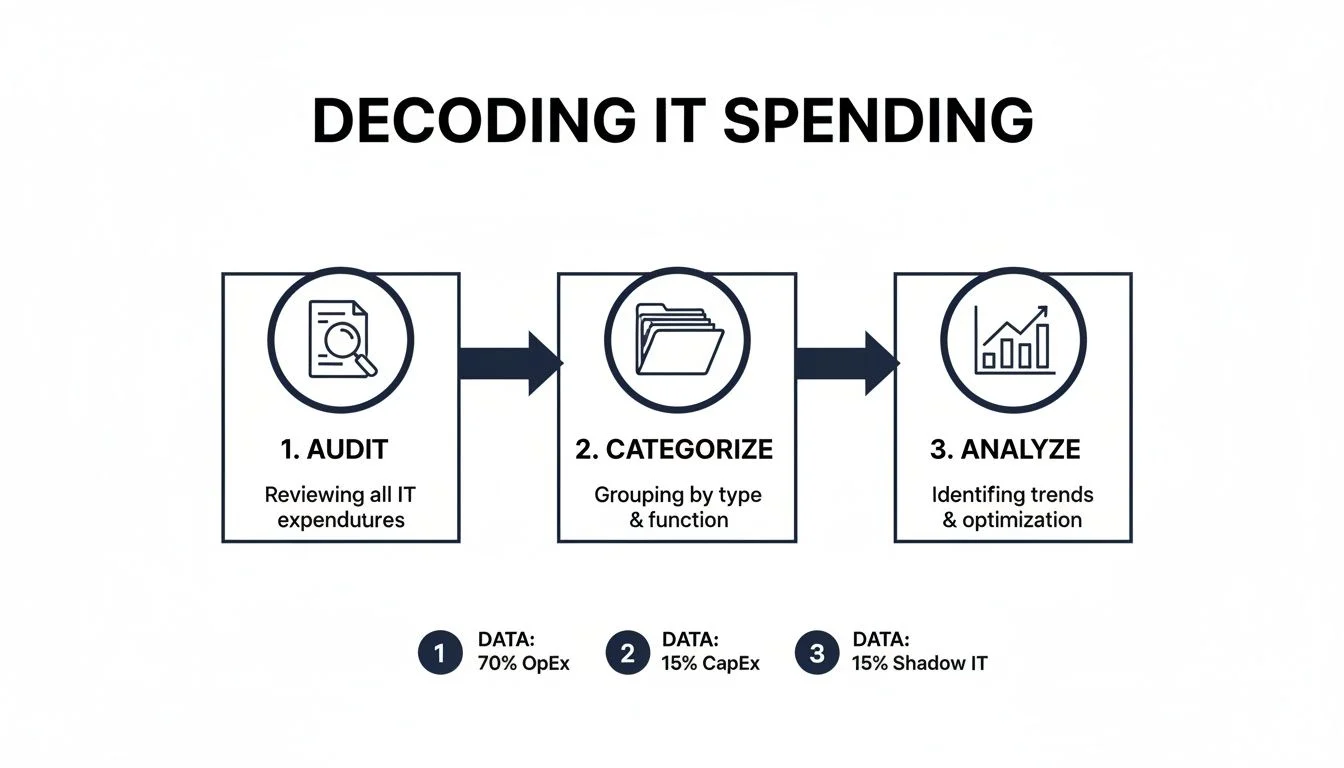
This visual really drives home the point: a solid budget starts with understanding the past so you can strategically plan for what’s ahead.
Realistic Forecasting For Future Needs
Good forecasting is part art, part science. You need to look at historical spending, anticipate how your business will grow, and keep an eye on what’s happening in the market. A growing school in Melbourne, for instance, has to plan for more students, which directly translates to needing more software licences, better network capacity, and additional devices.
This forward-thinking approach is becoming absolutely critical for Australian SMBs. National tech spending is on a steep upward curve, changing how every organisation approaches its IT budget planning. Forecasts show that IT spending in Australia is set to hit around A$146.9 billion in 2025 and climb to A$172.3 billion by 2026. This isn’t just a small bump; it signals a major shift where budgets must now prioritise software, cloud services, and expert support over just the occasional hardware refresh.
A budget without a contingency fund is a disaster waiting to happen. The question isn’t if something will go wrong, but when.
This is where building resilience into your budget becomes non-negotiable.
Building in a Financial Safety Net
Unexpected events are a guarantee in the world of technology. A critical server could die, a new cyber threat might demand an immediate software rollout, or a key vendor could suddenly hike their prices. Without a contingency fund, these curveballs can derail your entire financial plan, forcing you to pull money from other vital areas of the business.
A smart, resilient budget plans for these unknowns. A good rule of thumb is to set aside 5% to 10% of your total IT budget as a dedicated contingency fund. This isn’t “spare” cash; it’s a strategic buffer that gives you the agility to handle emergencies without crippling your core operations. It’s the foresight that protects your cash flow and keeps the business running when the unexpected inevitably happens.
By linking your budget to clear business goals, forecasting realistically, and building in a safety net, you transform your budget from a static document into a powerful tool for sustainable growth. In our experience, knowing your options with IT outsourcing vendors is a massive help here, as it clarifies how you can best allocate resources for ongoing support and management.
Future-Proofing Your IT Investment Strategy
A static budget is an old-school budget. If you want to get real value from your IT spend, your plan needs to be agile and forward-looking, ready to adapt to what’s next rather than just reacting to what’s already happened.
Think of your IT budget less as a fixed annual document and more as a living strategy. It should evolve right alongside your business and the fast-moving tech world. The real magic happens when you shift from a reactive to a proactive mindset. Instead of scrambling when a new cyber threat pops up or a competitor rolls out new tech, a future-proofed budget sees these things coming. It sets aside resources strategically to keep you ahead of the curve, turning potential headaches into genuine opportunities for growth.
Tapping into National Technology Priorities
You’re not building your budget in a bubble. Here in Australia, national trends and government policies are powerfully shaping the technology choices for businesses, schools, and even households. The growing focus on AI, cybersecurity, and digital skills isn’t just talk; it’s backed by serious investment that creates both opportunities and expectations for organisations like yours.
Public policy is a big clue for your long-term IT planning. The Australian Government’s recent Federal Budgets have signalled billions flowing into digital capability, which directly impacts your tech choices. With a planned government investment of around A$15.1 billion in 2025–26 for science, research, and innovation, there’s a clear push towards AI, stronger cybersecurity, and cloud initiatives to improve data sovereignty.
For a business in Melbourne or a school in Hillside, this means your budget should be proactively earmarking funds for these areas over the next few years. You can get a deeper dive into this from this analysis of the Federal Budget’s impact on technology investment.
Don’t Forget Your People and Processes
Technology is only ever as good as the people who use it. Funnelling money into employee training for new software and security awareness isn’t a cost; it’s a direct investment in your team’s productivity and your business’s resilience. The Federal Budget even encourages this, offering incentives for businesses that upskill their staff in high-demand areas like AI and cloud technologies.
A well-trained team is your first and best line of defence against cyber threats and your greatest asset in getting a real return on your software investments. Carving out 2-5% of your IT budget for training is a smart, financially sound decision.
Just as important is how you handle your vendors and contracts. Don’t just tick and flick renewal terms as they come in. Proactive vendor management means getting on the front foot:
- Reviewing contracts regularly to make sure the terms still actually meet your needs.
- Negotiating better pricing or improved service levels when it’s time to renew.
- Consolidating software licences to get rid of redundant tools and cut your overall costs.
Setting a Regular Review Cadence
A future-proofed budget needs constant attention. The old ‘set it and forget it’ approach just doesn’t cut it anymore. You need to establish a regular review cadence, quarterly check-ins are a great place to start, to keep your budget aligned with the real-world needs of your business.
These reviews are your chance to see how you’re tracking, adjust your forecasts, and shuffle funds around as your priorities change. This agility is what ensures your IT spending stays strategic, efficient, and fully supportive of where your organisation is headed. This is especially true if you’re considering a move to the cloud, where the benefits of Azure Cloud for small business can dramatically shift your spending model from large upfront costs (CapEx) to more flexible operational spending (OpEx).
How An IT Partner Simplifies Your Budget Planning
Trying to manage an IT budget without a dedicated tech team can feel like you’re navigating a maze blindfolded. You know you need to spend money on technology, but figuring out where, when, and how much is a constant challenge.
This is where bringing in a Managed Service Provider (MSP) like Tbourke Solutions can make a world of difference. An expert IT partner helps you move away from a reactive mess of unexpected bills and towards a stable, strategic investment in your business’s future.

It’s all about adding predictability and expert guidance. Instead of just fixing things when they break, you get a proactive strategy and access to years of experience without the hefty cost of hiring an entire in-house IT department.
Achieving Cost Predictability and Transparency
A huge headache in IT budgeting is the constant stream of unexpected costs, a server dies, a major software licence comes up for renewal, or a security issue needs urgent attention. Working with Tbourke Solutions helps smooth out these bumps.
We solve this with transparent, fixed-fee pricing for our managed IT support, cybersecurity, and cloud solutions. Our pricing model is straightforward with no hidden surprises, which makes your financial planning so much simpler. You get a predictable monthly operational expense, allowing for far more accurate budgeting and forecasting.
Partnering with an MSP means you’re no longer just paying to fix things when they break. You’re investing in a stable, secure, and efficient technology environment that helps your business thrive.
If you’re still getting your head around what an MSP does day-to-day, our guide on what MSPs are can shed some light on how we deliver that value.
Common IT Budget Planning FAQs
Even with a solid plan, a few questions always pop up when you’re wrestling with an IT budget. Here are our answers to the questions we hear most often.
How much should a small business spend on IT?
There’s no single magic number, but a common benchmark is 3% to 6% of total revenue. However, this can be misleading. A new tech company’s needs are vastly different from a local trade business. A better approach is to build your budget from the ground up based on your specific operational needs and growth goals for the year. An IT partner can help you analyse these factors to arrive at a realistic figure that truly supports your objectives.
What’s the biggest mistake businesses make with IT budgeting?
The most common and costly mistake is being purely reactive. Many businesses only budget for visible costs like new laptops and software subscriptions, completely forgetting crucial expenses like replacing ageing hardware before it fails, investing in robust cybersecurity, or planning for disaster recovery. This leads to expensive emergencies and panic-driven spending. A strategic budget is proactive, anticipating future needs and setting aside funds for preventative measures, saving you significant money and stress down the line.
How can I justify a bigger IT budget to management?
To get buy-in, you must frame the conversation around business value, not technology. Instead of saying, “We need a new firewall,” explain it as, “This investment significantly reduces our financial risk from a data breach and protects client trust.” Connect every dollar to a clear business outcome and use data to show the return on investment (ROI). Show how the spending boosts efficiency, lowers operational risk, or drives revenue growth. When you translate technical needs into tangible business benefits, the value becomes undeniable.
Let Tbourke Solutions Streamline Your IT Budget
Navigating the complexities of IT budget planning can be a major challenge, but you don’t have to figure it all out alone. At Tbourke Solutions, we provide the strategic guidance and transparent managed IT services you need to build a technology budget that genuinely drives business growth.
Whether you need a full vCIO to align your tech with your goals or a predictable managed services plan to eliminate surprise costs, we have options to suit your needs. We’re here to help you make smart, proactive decisions that turn your technology into a powerful asset.
Ready to stop guessing and start planning? Reach out to our team by submitting a query on our contact page today.
Share This Story, Choose Your Platform!