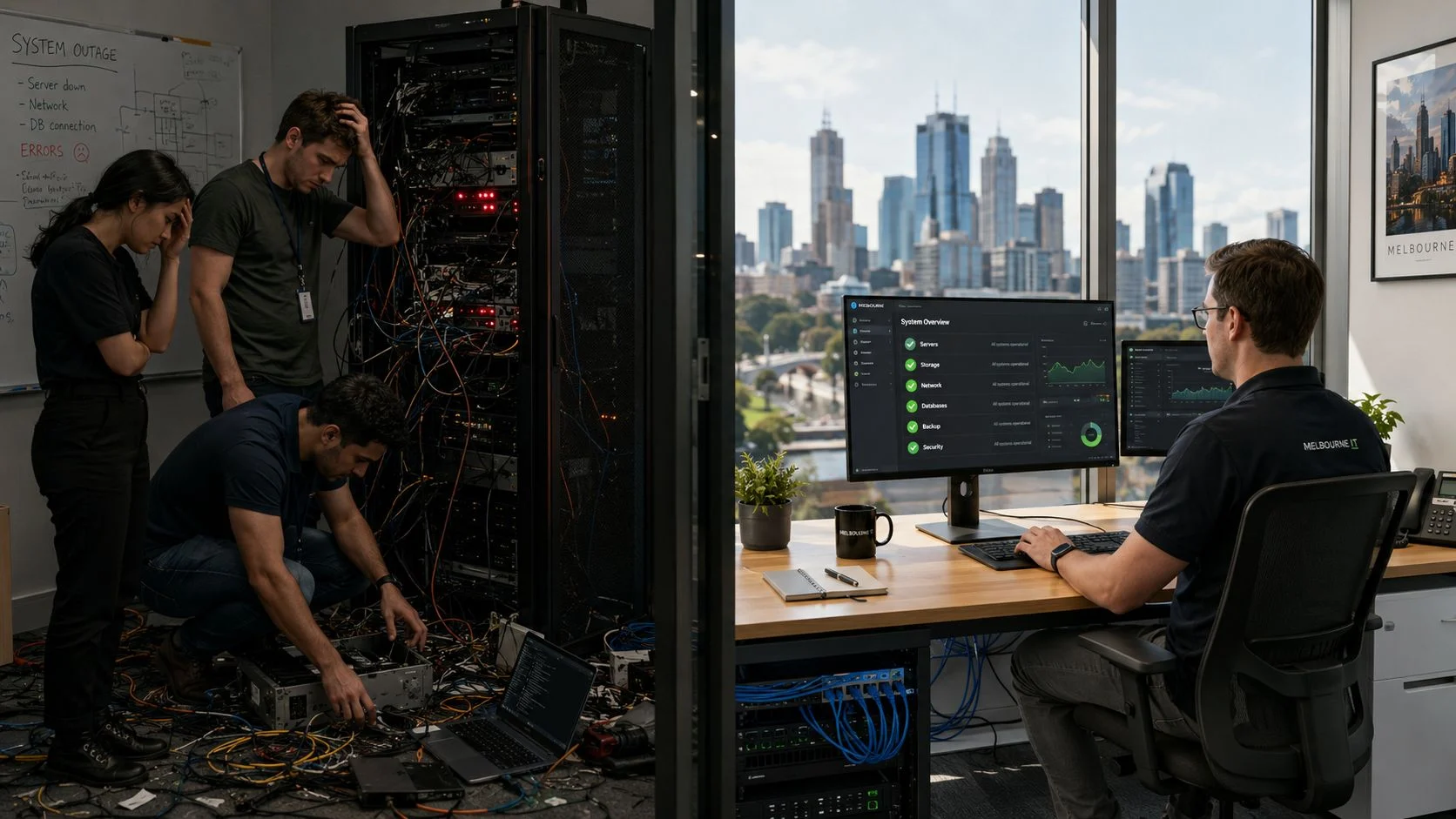
For a long time, IT risk was seen as a technical problem, something best left in the server room. For many small to medium-sized Melbourne businesses (SMBs), the strategy was simple: fix things when they break.
That reactive mindset is no longer enough. Today, IT risk has moved out of the server room and into the boardroom. It’s a central business vulnerability that directly hits your profitability, reputation, and, frankly, your ability to survive.
TL;DR: Your Quick Summary
A modern Managed Service Provider (MSP) takes ownership of your IT risk by acting as a proactive security partner, not just a reactive break-fix service. This involves conducting in-depth risk assessments, establishing clear contracts and a shared responsibility model, and executing daily tasks like continuous monitoring and patch management. Ultimately, this strategic partnership protects your assets, ensures operational continuity, and turns your IT from a liability into a resilient business advantage.
Why IT Risk Is Now a Core Business Responsibility
The role of a Managed Service Provider (MSP) has fundamentally changed. It’s no longer just about keeping the lights on. A modern MSP takes ownership of your IT risk by becoming a proactive security partner, moving far beyond simple break-fix support.
They do this with a combination of comprehensive risk assessments, clear service level agreements (SLAs), continuous system monitoring, and solid processes for everything from patching and backups to incident response. This strategic shift turns IT from a reactive cost centre into a core function that actively protects your business operations and assets.

The New Landscape of Business Threats
The threats hitting local businesses are more frequent and damaging than ever. It’s not just big corporations in the news; SMBs are prime targets because they’re often seen as having weaker defences. This reality has forced a major rethink in security investment.
The Australian cybersecurity market is now worth around USD 7.6 billion, with some companies ramping up their security spending by as much as 80% after seeing high-profile breaches. It’s no surprise that Managed Security Services (MSS) have become the go-to solution, as businesses look to outsource this complex need to specialists. You can read more about the drivers behind this market growth on Channel Insider.
This shift means managing IT risk is now a non-negotiable part of good business governance. The fallout from a breach goes way beyond just technical downtime. We’re talking about:
- Financial Loss: The direct costs of data recovery, regulatory fines, and potential legal action can be crippling.
- Reputational Damage: Losing customer trust is a huge blow, and winning it back is incredibly difficult.
- Operational Disruption: A breach can bring your entire operation to a halt, making it impossible to serve clients, process orders, or do business at all.
A modern MSP gets this. Their job has evolved from just maintaining systems to actively identifying, assessing, and shutting down the threats that could derail your entire business. They’re a strategic partner, working to keep you secure and resilient in the face of constant challenges. This guide will walk you through the practical strategies MSPs use to take genuine ownership of your IT risk.
What Does Good MSP Risk Ownership Actually Look Like?
If you’re a busy decision-maker, you just want the bottom line. It’s simple: a capable MSP doesn’t just fix things when they break; they take full ownership of your business’s IT risk. This isn’t a vague promise, it’s a proactive, multi-layered strategy that starts long before any alarms go off.
It all begins with a deep-dive risk assessment to map out your specific vulnerabilities. From there, that foundation is locked in with crystal-clear contracts and a shared responsibility model, so everyone knows exactly who does what.
Of course, the real work is in the day-to-day. Ownership means continuous monitoring and having a structured incident response plan ready to go. If you’re new to this world, understanding what MSPs are and the role they play is the perfect starting point.
Ultimately, this partnership is what protects your assets, keeps your operations running smoothly, and helps you navigate Australia’s tricky regulatory landscape. And as you go, it’s vital to know how to know if your Managed Service Provider is doing a good job, that’s how you ensure genuine accountability and keep your risk management effective.
Right then, let’s get down to business. Taking ownership of IT risk isn’t about ticking a box after you install a new firewall. That’s just the start. For a Managed Service Provider (MSP), genuine ownership begins with building a solid, proactive framework, one that’s designed to see trouble coming, not just clean up the mess afterwards.
This isn’t a quick technical scan. It’s a deep dive into your entire operation. Why? Because IT risk isn’t just about servers and software. It’s about how that technology underpins your people, your processes, and your business goals. We need to look at everything from your day-to-day operations and the sensitivity of your data to any specific regulatory duties you might have. This initial assessment is the foundation for every single security decision we make down the track.

To get a clear picture of what we’re protecting, we break the initial assessment down into a few key areas. Each step builds on the last, giving us a comprehensive understanding of your unique risk profile before we even touch a single setting.
Key Components of an Initial IT Risk Assessment
| Assessment Component | Objective | Example Action |
|---|---|---|
| Asset Identification | To create a comprehensive inventory of everything valuable that needs protecting. | Cataloguing all physical hardware (servers, laptops), intangible data (client lists, IP), and even business-critical software subscriptions. |
| Vulnerability Analysis | To identify the specific weaknesses that could be exploited by an attacker. | Running technical scans for unpatched software while also reviewing staff security training procedures to find human-factor gaps. |
| Impact Assessment | To understand the real-world business cost if a vulnerability is exploited. | Calculating the potential financial loss per hour of downtime for a critical server or the cost of regulatory fines for a data breach. |
| Framework Adoption | To structure the security strategy using a proven, industry-recognised model. | Aligning security controls and priorities with a framework like the ACSC’s Essential Eight, scaled to fit an SMB budget and complexity. |
This structured approach ensures we’re not just guessing. We’re making informed, strategic decisions based on a clear understanding of what matters most to your business and where the real dangers lie.
Asset Identification: What You Need to Protect
First things first: you can’t protect what you don’t know you have. The initial job is to identify and catalogue every single critical asset in your business. And this goes way beyond just making a list of servers and laptops.
An asset is anything that holds value for your organisation. That includes:
- Tangible Assets: The physical kit like servers, workstations, network switches, and company mobile phones.
- Intangible Assets: This is the big one. We’re talking customer databases, financial records, intellectual property, and sensitive employee details.
- Reputation and Trust: Your good name. A data breach can shatter the trust you’ve built with customers, and that’s often harder to recover than any lost data.
By mapping all this out, an MSP gets a crystal-clear picture of what makes your business tick. It allows us to prioritise our efforts and make sure the “crown jewels” are properly locked down.
Vulnerability Analysis: How It Can Be Compromised
Once we know what we’re protecting, the next question is how it could be compromised. This is where vulnerability analysis comes in. An MSP will examine your systems, your processes, and even your physical security to find weak points an attacker might go after.
This is much more than just running an automated software scan. A proper analysis looks at multiple layers:
- Technical Vulnerabilities: Things like out-of-date software, poorly configured firewalls, weak password policies, and insecure Wi-Fi networks.
- Procedural Vulnerabilities: The gaps in your processes. Maybe there’s no formal security training for new hires, no incident response plan, or sloppy data handling practices.
- Human Vulnerabilities: Let’s be honest, this is often the weakest link. We’re talking about the risk of an employee clicking on a phishing email or accidentally leaking sensitive information.
Taking this holistic view means we can address both the tech weaknesses and the human ones, creating a much tougher defence overall.
“A risk assessment is like a health check-up for your business’s technology. You don’t just check for one problem; you look at the entire system to understand where the real risks lie and how to treat them before they become critical.”
Impact Assessment: The Real-World Cost of a Breach
Okay, so we’ve found a vulnerability. That’s only half the battle. The most important step is figuring out what would actually happen if that weakness was exploited. A good MSP helps you translate the technical jargon into cold, hard business consequences.
The impact assessment answers the crucial question: “So what?”
- What’s the financial cost of every hour your main server is down?
- If your customer data gets stolen, what are the potential regulatory fines?
- How would a ransomware attack cripple your ability to serve your clients?
Understanding this potential impact is everything. It helps justify spending money on security by showing the clear, tangible value in preventing a specific disaster. This is the step that connects a technical weakness directly to your bottom line.
Adopting Proven Security Frameworks
To pull all this together, smart MSPs don’t try to reinvent the wheel. We adapt established security frameworks to fit the specific needs, and budget, of a small or medium-sized business. Here in Australia, a perfect example is the Australian Cyber Security Centre’s (ACSC) Essential Eight.
This framework provides a straightforward, prioritised list of strategies to fend off the most common cyber threats. While it was originally designed for government departments, a skilled MSP knows how to scale these principles down for a smaller business environment. To get a better handle on this, you can check out our detailed guide on the ACSC Essential Eight and see how it can be put to work protecting your organisation.
The end result of this entire process is a custom-built risk profile that acts as our strategic roadmap for every security task that follows.
Defining Roles Through Clear Contracts and Agreements
Having a solid risk framework is a great start, but without clear boundaries, it’s just a recipe for disaster. When something goes wrong, and eventually, it will, the last thing you need is a finger-pointing match over who was supposed to do what. This is where the contracts and commercial agreements you have with your Managed Service Provider (MSP) become absolutely critical.
These documents aren’t just legal red tape. They are the operational blueprints that define your entire relationship. They make sure you and your MSP are perfectly aligned on expectations, responsibilities, and what success actually looks like. A well-written agreement is the foundation of a partnership where everyone knows their role inside and out.
Modern Service Level Agreements
Gone are the days when a Service Level Agreement (SLA) was a simple promise of 99.9% network uptime. While keeping the lights on is still important, modern SLAs for security-conscious MSPs go much, much deeper. They now spell out specific, measurable actions tied directly to managing risk.
A modern SLA needs to clearly define:
- Incident Response Times: How fast will the MSP acknowledge a critical security alert? How quickly will they start working to fix it? This needs to be measured in minutes or hours, not days.
- Patching Cadence: The agreement must outline a clear schedule for applying security patches to your critical systems, with different timelines for different severity levels.
- Backup and Recovery Objectives: Key metrics like Recovery Time Objective (RTO) and Recovery Point Objective (RPO) have to be explicitly stated. This way, you know exactly how fast you can get back online and how much data you might lose in a worst-case scenario.
Getting this granular transforms the SLA from a passive guarantee into an active, ongoing commitment to protecting your business.
The Shared Responsibility Model Explained
One of the most important concepts a good MSP will introduce is the Shared Responsibility Model. It’s a simple but powerful idea: cybersecurity is a partnership, not a complete handover. This model draws a clear line in the sand, separating the tasks the MSP manages from those that remain your responsibility as the client.
The Shared Responsibility Model is crucial because it kills ambiguity. It makes sure critical security tasks, like training your staff not to click on dodgy links, don’t fall through the cracks because everyone assumed someone else was handling it.
For instance, an MSP typically takes ownership of things like:
- Managing and monitoring the firewall.
- Applying security patches to servers and operating systems.
- Backing up your business data according to the SLA.
- Responding to and containing security incidents.
At the same time, you (the client) retain ownership of:
- Enforcing strong password policies among your team.
- Training staff to spot and report phishing attempts.
- Approving user access to sensitive company data.
- Making the final call on strategic security investments.
This division of labour is vital. It’s how you build a robust security posture where technology and people are working in sync.
When to Get Help
If your current IT arrangement is missing this level of contractual clarity, that’s a massive red flag. If you don’t have a formal SLA that specifies security response times, or if the lines of responsibility are blurry, you’re carrying a lot of unnecessary risk. It’s time to find a partner who makes clear, documented ownership a priority. Feel free to reach out via our contact page to chat about how a properly structured agreement can strengthen your security.
Navigating Cyber Insurance and Liability
The roles laid out in your MSP agreement have a direct knock-on effect on another critical area: cyber insurance. In Australia, the regulatory landscape has become much tougher, with frameworks like the ACSC Essential Eight and the Notifiable Data Breaches scheme carrying serious penalties. As a result, cyber insurance is no longer a “nice-to-have,” but insurers have tightened their requirements significantly. For a deeper dive into this, you can find insights into the top challenges for Australian MSPs on Support Hub 360.
Before an underwriter will even give you a quote, they’ll want to scrutinise your security controls and processes. A detailed SLA and a Shared Responsibility Model are powerful evidence that you’re proactively managing your risk. This documentation can honestly be the difference between securing affordable coverage and being denied outright. As you define these roles, it’s worth exploring how to manage vendor compliance and security effectively, especially with partners like MSPs, using tools like third-party risk management software.
Ultimately, clear contracts do more than just manage liability. They build trust and transparency, forming the bedrock of a successful partnership. By explicitly defining every role and responsibility, an MSP demonstrates true ownership of your business’s IT risk, ensuring everyone is pulling in the same direction: keeping you secure and operational.
Bringing Risk Management to Life with Daily Action
Strategy is one thing, but the real work of owning IT risk happens every single day. A solid plan is your roadmap, but it’s the consistent, disciplined execution of daily, weekly, and monthly tasks that truly keeps a business safe. A great Managed Service Provider (MSP) doesn’t just install security software and disappear; they are actively in the trenches, managing a continuous cycle of monitoring, maintenance, and response.
This constant operational rhythm is the core of how we take ownership of your IT risk. It’s a hands-on commitment to all the small but critical actions that stop minor glitches from snowballing into major security disasters. These day-to-day activities are the true backbone of a resilient and secure IT environment.
The chart below shows how a strong risk partnership is built. It all starts with a clear Service Level Agreement (SLA), defined roles, and the right insurance coverage working in harmony.
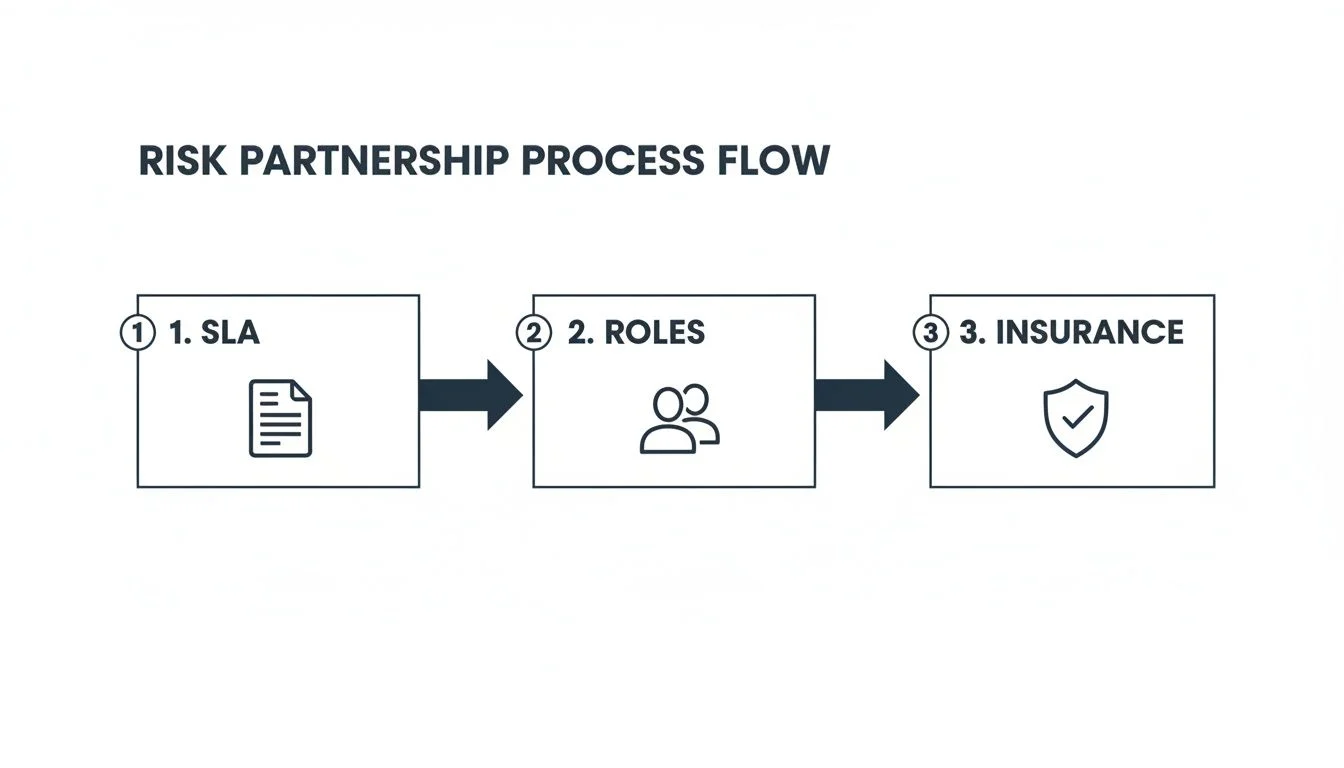
This shows that effective day-to-day risk management can only happen once a clear, documented partnership is in place.
Continuous Monitoring with RMM Tools
Proactive risk management is impossible without visibility. We use Remote Monitoring and Management (RMM) tools to keep a constant, watchful eye over your entire IT network. Think of it as a 24/7 digital security guard that never sleeps, blinks, or takes a coffee break.
This technology is our eyes and ears, allowing us to:
- Track System Health: We monitor things like CPU load, memory usage, and disk space to spot signs of hardware failure before it brings your business to a halt.
- Detect Anomalies: We can spot unusual network traffic or unauthorised login attempts that could be the first sign of a cyber attack in progress.
- Automate Routine Checks: Key services like antivirus software and backups are checked automatically, ensuring they are always running correctly without needing manual intervention.
This constant oversight means we can often find and fix potential problems before you or your team even realise anything is wrong.
A Disciplined Patch Management Program
Software vulnerabilities are the front door for most cybercriminals. Every single day, new security flaws are found in the software you use, Microsoft Windows, web browsers, you name it. A disciplined patch management program is the process of consistently applying updates to slam these doors shut.
It’s a shocking but true statistic: a recent study found that 60% of data breaches were caused by unpatched vulnerabilities. This fact alone shows why a casual, “we’ll get to it eventually” approach to patching is a recipe for disaster.
A good MSP goes way beyond just turning on automatic updates. We manage a formalised program that includes testing patches before they’re deployed (to avoid breaking something important) and prioritising the most critical security updates for immediate application. For businesses running on Microsoft, leveraging a managed service for this is a game-changer. Solutions like Windows Autopatch can automate and secure this absolutely critical task.
Resilient Data Backup and Disaster Recovery
Even with the best defences in the world, things can still go wrong. A hard drive can fail, a fire can break out, or a ransomware attack can succeed. This is where a robust Backup and Disaster Recovery (BDR) strategy becomes your ultimate safety net.
Taking real ownership here means much more than just running a backup every night. It’s a comprehensive process:
- Frequent Backups: Data is backed up regularly throughout the day to ensure that if the worst happens, you lose as little data as possible.
- Offsite and Immutable Copies: We store backup copies in a separate, secure location where they can’t be touched, altered, or deleted by a ransomware attack.
- Regular Testing: We periodically test the backups by actually trying to restore data from them. This is non-negotiable. A backup that has never been tested is just a hopeful wish, not a reliable plan.
A Formal Incident Response Plan
When a security incident hits, panic and chaos only make a bad situation worse. A professional MSP owns the risk by having a formal Incident Response (IR) plan rehearsed and ready to go at a moment’s notice. This isn’t a vague idea; it’s a documented, step-by-step playbook designed to control the situation and minimise the damage.
A proper IR plan follows a clear structure:
- Detection and Analysis: Identifying that an incident has occurred and quickly figuring out its scope and severity.
- Containment: The immediate priority is to isolate the affected systems to stop the threat from spreading across the rest of the network.
- Eradication: Once contained, the threat is completely removed from the environment.
- Recovery: We restore the affected systems and data from clean backups to get the business back up and running.
- Post-Incident Review: After the dust settles, we analyse what went wrong, how the plan worked, and what can be improved to prevent it from happening again.
This structured approach shows that true risk ownership isn’t a one-off project. It’s the sum of all these daily, disciplined processes that transforms your IT from a potential liability into a secure, resilient business asset.
Common Questions About MSPs and IT Risk
Stepping into a partnership with a Managed Service Provider (MSP) can feel like a big move, and it naturally brings up a lot of questions. We get it. Below, we’ve answered some of the most common queries we hear from Australian businesses looking to get a proper handle on their technology and security.
Does Hiring an MSP Mean I Can Forget About IT Risk?
Not quite. What it really does is create a powerful partnership based on a shared responsibility model. This is probably the most important concept to grasp when you’re working with an MSP.
While we take the lead on the technical heavy lifting, like managing security tools, round-the-clock monitoring, and jumping on incidents, your business still owns key internal responsibilities. Things like setting acceptable use policies for your team, making sure everyone gets trained on how to spot a dodgy phishing email, and ultimately signing off on strategic tech investments.
A good MSP will make this crystal clear from day one, clearly documenting who does what so there’s no confusion. It’s a team effort, and when everyone knows their role, the business is far more secure.
What’s the First Thing an MSP Actually Does?
The very first, non-negotiable step is a comprehensive risk assessment. We can’t protect what we don’t fully understand.
This initial deep dive involves auditing your entire IT setup. We’re talking everything from your servers and software to how you store data and who has access to what. The goal here is to pinpoint your most critical business assets, uncover any existing weak spots, and figure out the real-world business impact if a particular cyber threat hit you.
Think of this assessment as the strategic blueprint that shapes every security decision we make for your organisation from that point forward.
How Much Is This Going to Cost?
The honest answer is: it depends. The cost varies based on the size of your business, how complex your IT environment is, and the exact level of service you need. Most MSPs offer a few different tiers, from basic monitoring right through to a fully managed security package that covers absolutely everything.
Typically, you’ll pay a fixed monthly fee, which is great for making your technology costs predictable. While it’s certainly an investment, it’s almost always a smarter financial move than hiring a dedicated in-house IT security expert.
More importantly, that predictable monthly fee is a drop in the ocean compared to the potential cost of a data breach. A single incident can spiral into devastating recovery bills, regulatory fines, serious reputational damage, and days or even weeks of business downtime.
How Do I Know the MSP Is Actually Doing a Good Job?
Transparency is everything. A professional MSP partnership is built on clear, consistent communication, and you should expect regular, easy-to-digest reports that prove they’re on top of your risk.
These reports should give you a clear snapshot of key metrics, such as:
- System Health: A quick overview of how your servers and network are performing.
- Security Posture: A summary of threats blocked, patches applied, and vulnerabilities fixed.
- Backup Status: Simple confirmation that your data backups are running successfully and have been tested.
But reports are only half the story. Your MSP should also be holding regular strategic review meetings with you. These aren’t just tech chats; they’re business conversations about your evolving risk profile, potential improvements, and making sure your IT strategy is still perfectly aligned with where your business is heading. This ongoing dialogue is the real proof that your MSP is truly taking ownership of your IT risk.
How Tbourke Solutions Takes Ownership of Your IT Risk
Taking ownership of your IT risk isn’t about buying a one-size-fits-all security package. It’s about having a partner who takes the time to understand the nuts and bolts of your business and builds a strategy from the ground up. With over 20 years of experience working with Melbourne-based SMBs, we’ve seen what happens when technology isn’t aligned with business goals. Our entire process starts with a detailed assessment, not a sales pitch, so every recommendation we make is purposeful and designed to protect what matters most to you.
Our Approach to Owning Your Risk
We don’t just fix things when they break; we become your strategic partner in security, giving you complete peace of mind so you can get back to business. Here’s how we can help:
- Fully Managed IT Services in Melbourne: We handle everything from the day-to-day monitoring and maintenance to long-term strategic planning. You can finally stop worrying about the tech and focus on your customers.
- Targeted Cybersecurity Solutions: Our expertise is focused squarely on protecting you from modern, sophisticated threats. You can learn more about our specific cybersecurity services and how they apply to businesses like yours.
- Strategic IT Consultancy: We provide the practical guidance you need to make smart, future-proof technology investments, ensuring your IT budget is an investment, not just a cost.
Our commitment is to a completely transparent partnership. We make sure you always have a clear picture of your risk posture and the steps we’re actively taking to keep your business safe. If you’re ready to move from a reactive, break-fix mindset to a proactive security strategy, we’re here to help. Reach out and submit a query through our contact page to start the conversation.[/fusion_text][/fusion_builder_column][/fusion_builder_row][/fusion_builder_container]
Share This Story, Choose Your Platform!