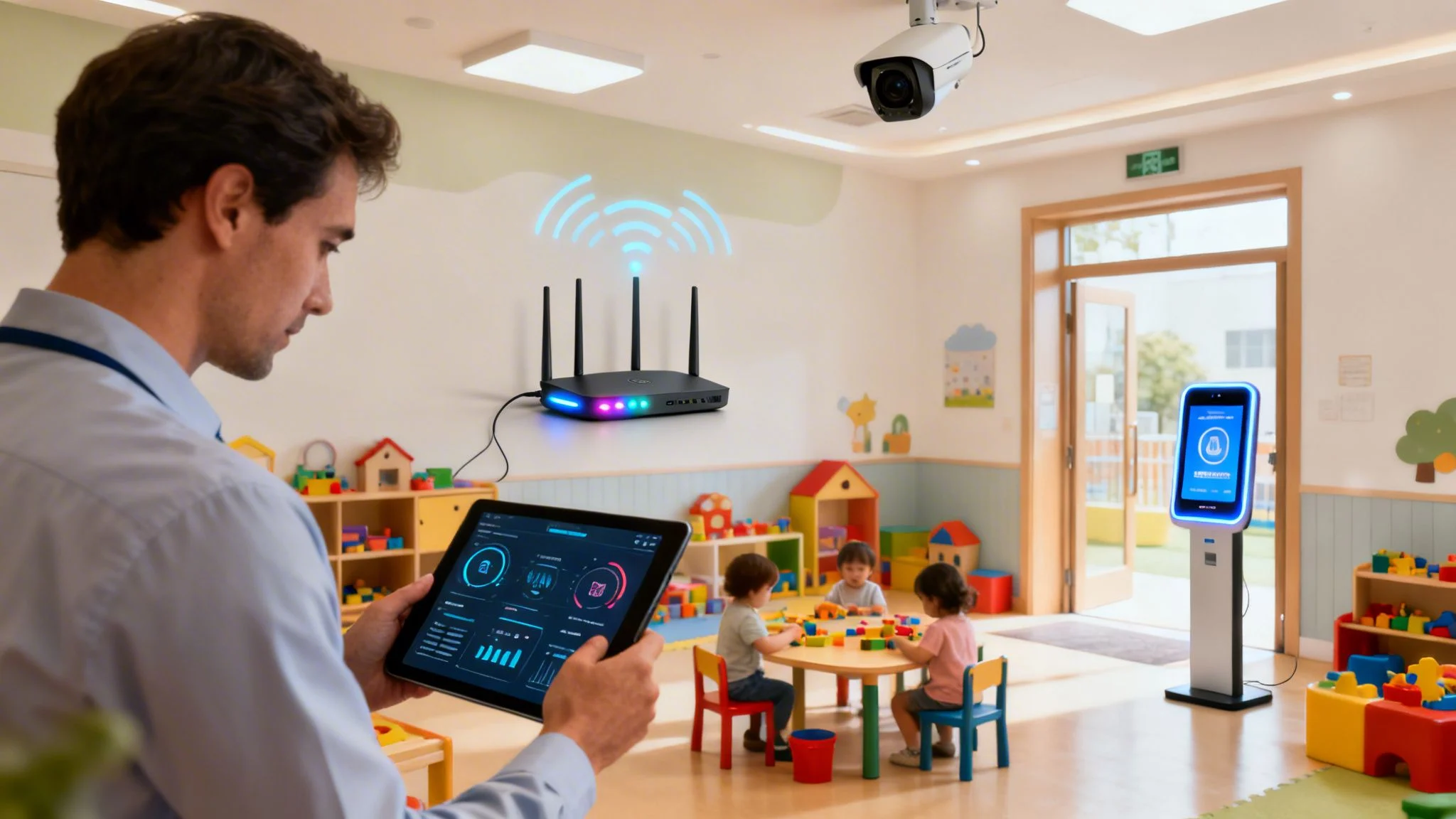
When your IT goes down, it’s not just an inconvenience—it’s a direct hit to your childcare centre’s operations, finances, and reputation. A system failure can instantly derail everything from parent communication and billing to critical compliance tasks, leading to very real financial losses from staff downtime and even regulatory penalties.
Worse still, it chips away at the hard-earned trust you’ve built with parents and your community.
TL;DR: Your Quick Guide to IT Downtime Risks
IT downtime in a childcare centre is a critical business threat, not just a technical glitch. System failures can halt essential operations like digital check-ins, subsidy processing, and parent communication, leading to immediate financial losses and compliance risks. More importantly, every minute of downtime erodes the trust you’ve built with families. This article breaks down the tangible costs and hidden damages of IT failure and provides actionable strategies to build a more resilient and reliable centre.
The Hidden Threat Disrupting Australian Childcare Centres
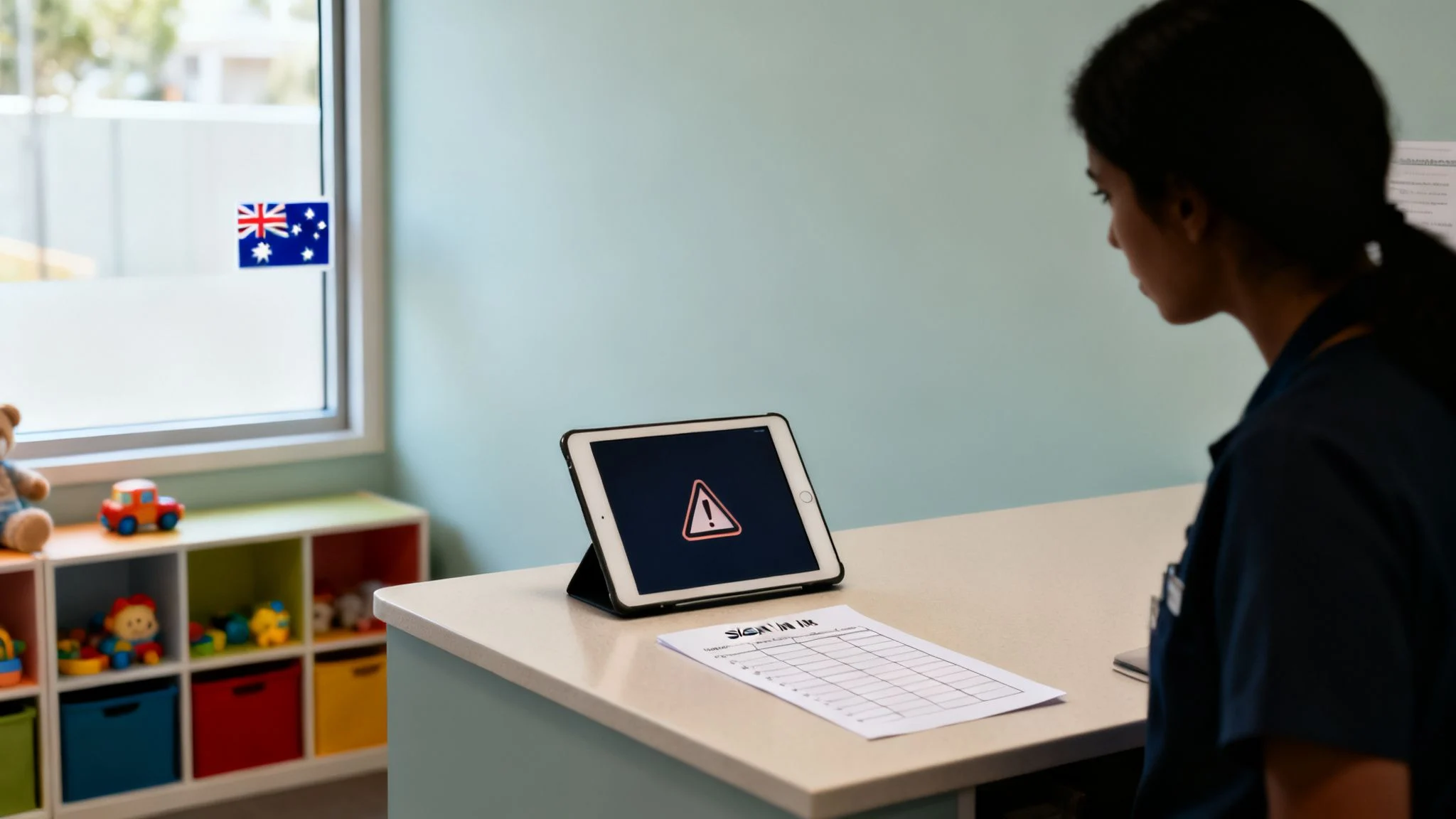
In a modern Australian childcare centre, technology isn’t just a helpful tool; it’s the central nervous system of your entire operation. It’s what you rely on for digital sign-ins, managing attendance records, processing Child Care Subsidy (CCS) payments, and sending those vital real-time updates to parents.
So, when these systems fail, it’s far more than a minor hiccup. It’s a full-blown operational crisis.
An IT outage can paralyse your centre. Staff suddenly can’t pull up essential records, parents can’t be billed correctly, and new enrolments grind to a halt. This is more than a technical glitch—it’s a significant business risk with consequences that can ripple out for weeks or even months.
Understanding the True Impact
This guide is for childcare operators who need to get to grips with the real-world risks and costs of IT downtime. We’ll cut through the technical jargon to give you a clear, straightforward look at what’s really at stake.
You’ll see how a simple system failure can quickly turn into:
- Tangible Financial Losses: We’re talking about paying staff who can’t do their jobs, shelling out for emergency IT support, and losing revenue because you can’t process new enrolments.
- Intangible Reputational Damage: This is the erosion of parent trust when communication breaks down or their personal data seems at risk. It’s hard to measure but even harder to win back.
- Compliance and Safety Risks: The scariest part—what happens if you can’t access a child’s medical records or emergency contacts during a critical incident?
For Australian centres, it’s vital to understand these challenges within our local context, and that includes looking at specialised services tailored for daycare and childcare providers that can help keep things running smoothly.
By the end of this article, you’ll have a solid grasp of these threats and, more importantly, a set of actionable strategies to build a more resilient and trusted centre. To see how professional support can safeguard your operations, you can explore our specialised IT services for the education sector.
Here’s the rewritten section, designed to sound like an experienced human expert and match the provided examples.
The Real Cost of an IT Outage: A Quick Guide
If you’re a busy childcare director, here’s what you really need to know. When your IT goes down, it’s not just a minor inconvenience—it’s a critical threat that can completely paralyse your centre.
Suddenly, digital check-ins stop working, you can’t process crucial subsidy claims, and sending updates to anxious parents becomes impossible. The immediate hit is financial, with staff unable to do their jobs and the risk of compliance breaches looming.
But the damage runs deeper than that. Every minute your systems are offline, you’re chipping away at the trust you’ve worked so hard to build with parents and the community. Proactive IT isn’t just another expense; it’s a fundamental investment in your centre’s stability, protecting you from the very real childcare IT downtime risks and costs. It’s about safeguarding your business and, most importantly, the families who rely on you every single day.
The True Cost of an Outage: What Your Centre Can Lose
When your centre’s IT systems go dark, the impact is immediate and it ripples through every part of your operation. It’s not just a matter of rebooting a computer; for a modern childcare centre, it’s a complete operational shutdown.
The initial chaos of screens going blank quickly gives way to tangible financial bleeding. But just as damaging are the subtle, long-term consequences that can erode the very foundation of your business. To grasp the full picture, we need to look beyond the obvious inconvenience and separate the immediate, out-of-pocket expenses from the hidden damages.
This infographic breaks down the core impacts of downtime into three critical areas that every childcare director needs to understand.
As it shows, a single technical failure can paralyse your day-to-day operations, trigger direct financial loss, and severely damage the trust you’ve worked so hard to build with families.
To better understand these two sides of the downtime coin, let’s compare the immediate financial hits with the lingering, indirect costs.
Direct vs Indirect Costs of IT Downtime in Childcare
| Cost Category | Direct Financial Costs (Immediate Impact) | Indirect Costs (Long-Term Impact) |
|---|---|---|
| Revenue & Operations | Inability to process new enrolments or bill for current services, leading to lost or delayed income. | Damage to your centre’s reputation, making it harder to attract new families in the future. |
| Staffing & Productivity | Paying wages to staff who can’t perform their duties (e.g., update records, communicate with parents). | Lower staff morale due to constant tech frustrations, leading to burnout and higher employee turnover. |
| Repairs & Recovery | Emergency call-out fees for IT technicians, which are significantly higher than planned maintenance costs. | Costs associated with recruiting and training new staff to replace those who leave due to a stressful work environment. |
| Compliance & Legal | Immediate fines or penalties for being unable to produce required documentation for regulatory bodies. | Legal liability if a system outage prevents access to a child’s critical medical information during an emergency. |
| Parent Relations | Potential need to offer discounts or credits to families impacted by service disruptions. | Erosion of parent trust due to communication breakdowns and concerns over data security. |
While the direct costs hit your bank account straight away, it’s often the indirect costs that cause the most lasting harm to your centre’s health and viability.
Quantifying the Direct Financial Hits
The most immediate costs are the ones that show up on your balance sheet. These are the direct, out-of-pocket expenses that start piling up the moment your systems fail.
Think about it in concrete terms. When your management software is offline, your team can’t process new enrolments or bill for existing ones. This isn’t just delayed income; it’s potentially lost revenue, especially if a prospective parent moves on to another centre that can process their application on the spot.
Then there are the staffing costs. You’re still paying wages to educators and admin staff who are effectively sidelined, unable to update attendance, log observations, or communicate with parents through official channels. All that unproductive time is a direct financial drain.
Finally, you have the emergency repair fees. Calling in an IT technician for an urgent, unscheduled fix is always far more expensive than planned maintenance. These reactive costs can be substantial, often running into thousands of dollars for a single incident.
The Australian childcare industry’s growing reliance on digital tools makes this financial risk even more acute. A server crash during peak hours could cost a mid-sized facility $1,000 to $3,000 per incident in recovery fees and lost revenue alone. Considering that historical telco outages have cost small businesses an average of $8,500 daily, the exposure for childcare centres is significant. You can learn more about the financial trends impacting the childcare sector.
The Hidden Costs That Linger
While direct financial costs are painful, it’s the indirect or “hidden” costs that can cause far more lasting harm. These damages are harder to put a number on, but they can fundamentally weaken your business from the inside out.
The most significant indirect cost is the erosion of parent trust. When your communication systems fail, parents are left in the dark. They can’t get updates on their child, can’t check sign-in records, and start to worry about the security of their personal and payment information.
Trust is the currency of childcare. Every minute of downtime is a withdrawal from that account. Once depleted, it is incredibly difficult to earn back.
This breakdown in trust quickly leads to reputational damage that can spread like wildfire through the local community, both by word-of-mouth and in online reviews. A reputation for being unreliable is incredibly difficult to shake and can deter new enrolments for years to come.
Furthermore, compliance failures present a major risk. If you can’t access or produce required documentation for licensing bodies or CCS reporting because of a system outage, you could face hefty fines or other penalties. The inability to access a child’s medical records or emergency contacts during an incident is a terrifying liability.
Finally, consider the toll on your team. Constant IT issues are frustrating and stressful for your staff. It makes their jobs harder, tanks their efficiency, and can easily lead to burnout and higher staff turnover—which brings its own set of costs related to recruitment and training.
Common Causes of IT Downtime in Childcare Settings
To stop IT downtime, you first need to understand why it happens. It’s rarely a single, dramatic event like a lightning strike. More often than not, downtime is caused by a few common culprits that, with a bit of foresight, are surprisingly manageable.
For non-technical centre directors, these issues can feel like a mystery. But they really just boil down to a few core weak points where a small failure can snowball, bringing your entire centre to a standstill and piling on the risks and costs.
Hardware Failures: The Ageing Equipment Problem
The most straightforward cause of downtime is often the physical gear your centre runs on. We’re talking about the server humming away in the back office, the computer at the front desk, or the network router that links everything together. Just like any machine, they have a use-by date.
An ageing server is the classic example. After five or six years, its internal parts start getting tired and become much more likely to fail. One morning, its hard drive might just give up without any warning, taking all your enrolment data, financial records, and parent contact lists with it.
A server failure isn’t just a computer problem; it’s an operational standstill. When it goes down, your ability to manage your centre goes down with it.
Relying on old hardware is a gamble many centres take without realising the odds. In fact, research shows that running key applications on servers older than five years can increase unplanned downtime incidents by over 200%. For a childcare centre, that’s a risk that directly impacts child safety and your compliance obligations.
Software Glitches and Update Issues
Software is the engine that powers your day-to-day operations, from your Childcare Management System (CMS) to your accounting programs. But this software can also be a major point of failure, especially when it’s not looked after properly.
A buggy software update is a frequent trigger. Your CMS provider might release a new version with exciting features, but a hidden flaw could cause the whole system to crash over and over or, worse, corrupt your data. On the flip side, if your computer operating systems aren’t kept up-to-date, they can become incompatible with newer software, leading to constant crashes and instability.
Cybersecurity Threats: A Growing Danger
Cybersecurity isn’t just a worry for big banks anymore. Childcare centres are now prime targets for cybercriminals because of the highly sensitive data you hold on children and their families. A successful attack is one of the most disruptive and frightening causes of downtime.
Think about this all-too-common scenario:
- A staff member gets an email that looks like it’s from a parent, asking them to check an attached “invoice.”
- They click the attachment, and without them knowing, it unleashes ransomware onto your network.
- Within minutes, every file on your server is locked and inaccessible. Your check-in kiosks go offline, you can’t access medical records, and a threatening ransom demand appears on your screen.
This isn’t just a story to scare you; it happens to small businesses across Australia every single day. Protecting against these kinds of threats means having multiple layers of defence.
Human Error: The Accidental Disruption
Finally, we get to one of the most common—and frustrating—causes of IT downtime: simple human error. These aren’t malicious acts, just unintentional mistakes made by well-meaning staff who might not be aware of the consequences of their actions.
It could be as simple as an employee accidentally deleting a critical folder holding all your upcoming enrolment forms. It could be someone spilling a coffee on the main reception computer or unplugging the wrong cable while trying to tidy up the office. These small accidents can have massive ripple effects, bringing key administrative functions to a grinding halt.
When To Get Help
If you’re constantly battling slow computers, frequent software crashes, or have absolutely no idea what to do if your main server fails, it’s time to call in the professionals. Waiting for a major outage is a gamble that can cost your centre dearly in lost revenue, wasted staff time, and shattered parent trust. A proactive IT partner can assess your weak points and build a stable foundation for your daily operations. To find out how we can help, please reach out via our contact page.
Building a Resilient Childcare Centre

Knowing what causes downtime is one thing, but actually doing something about it is what protects your centre. Moving from awareness to action is the key. Building a truly resilient operation means putting practical strategies in place to slash your risks and bounce back fast when things inevitably go wrong.
This isn’t about throwing money at expensive, complicated technology. It’s about creating a strong framework built on proactive support, solid security, and smart planning. Let’s break down the pillars that will fortify your centre against the significant childcare IT downtime risks and costs.
Embrace Proactive Managed IT Services
The old “break-fix” model of IT support—where you only call for help when something is already broken—is a recipe for disaster in a modern childcare centre. A proactive Managed IT Service Provider (MSP) flips this outdated approach on its head. Instead of waiting for a crisis, an MSP partner constantly monitors your systems to stop problems before they even start.
This approach involves:
- 24/7 System Monitoring: Your servers, network, and computers are watched around the clock for early warning signs, like a failing hard drive or strange network activity.
- Preventative Maintenance: Regular software updates, security patches, and system health checks are handled for you, keeping everything stable and secure.
- Expert Support on Standby: When you do have a question or an issue, you have a dedicated team of experts who already know your setup inside and out.
In Australia’s childcare sector, which is projected to hit $22.3 billion in revenue by 2025, any amount of downtime is a serious financial threat. Experts estimate that for a typical Melbourne centre, downtime costs anywhere from $500 to $2,000 per hour. This really puts the value of proactive IT support into perspective.
Implement Robust Cybersecurity Measures
Cybersecurity is not an optional extra anymore. You hold sensitive family and financial data, and protecting it from digital threats is a fundamental responsibility. A strong defence is built in layers, and it all starts with your team.
Your staff are your first line of defence against cyber threats. Empowering them with knowledge is one of the most effective security investments you can make.
Effective cybersecurity is a mix of the right tech and the right training:
- Essential Security Software: This includes business-grade antivirus, anti-malware software, and a firewall to block unauthorised access to your network.
- Email Filtering: Smart systems can scan incoming emails to identify and block phishing scams and dangerous attachments before they ever reach your staff’s inboxes.
- Regular Staff Training: Teach your team how to spot suspicious emails, why strong, unique passwords matter, and the golden rule of never sharing login details.
Develop a Comprehensive Backup and Disaster Recovery Plan
No matter how strong your defences are, you have to plan for the worst-case scenario. A solid Backup and Disaster Recovery (BDR) plan is your ultimate safety net, ensuring you can restore your data and get back online quickly after an incident.
A cornerstone of a resilient centre is strategic foresight; comprehensive business continuity planning is what guides your preparation for any disruption. A good BDR strategy isn’t just about having a copy of your files; it’s a detailed, tested playbook for recovery. It clearly defines who does what, how data is restored, and how you’ll communicate with parents and staff during an outage.
An effective plan includes:
- Automated, Regular Backups: Your critical data should be backed up automatically at least once a day to a secure, off-site location like the cloud.
- Multiple Backup Copies: The “3-2-1 rule” is the industry best practice: keep three copies of your data on two different types of media, with one copy stored safely off-site.
- Regular Testing: A backup is useless if you can’t restore from it. Your IT provider should regularly test the restoration process to guarantee your data is recoverable when it counts.
By investing in these key strategies, you turn IT from a source of anxiety into a pillar of strength for your centre. If you’d like to see what a professional plan looks like, check out our guide on disaster recovery plan examples.
How Tbourke Solutions Protects Your Childcare Centre
Knowing the risks and costs of IT downtime is one thing, but having a dedicated partner to stop it from happening in the first place is something else entirely. At Tbourke Solutions, we specialise in supporting small to medium businesses in the education and childcare sectors. We offer far more than just quick technical fixes—we provide the operational stability you need to focus on what truly matters: the children in your care.
With over two decades of experience serving the Melbourne area from our base in Hillside, we act as a true IT partner. We get that your centre’s needs are unique, requiring a mix of robust technology and a genuine understanding of the daily pressures you face.
Our Support for Your Centre
We build resilience directly into your operations through a set of specialised services designed to tackle the most common causes of downtime head-on. Our goal is to give you peace of mind, knowing your technology is reliable, secure, and fully supported.
Our core offerings include:
- Proactive Managed IT Services: We don’t wait for things to break. Our team constantly monitors your systems to find and fix issues before they can disrupt your centre, shifting your IT from a reactive headache to a preventative asset.
- Robust Cybersecurity: We implement layered security solutions, including advanced firewalls and email filtering, to shield your sensitive family and financial data from ever-present digital threats like ransomware and phishing attacks.
- Reliable Cloud Solutions & Backup: Our cloud services give you secure, flexible access to your critical data from anywhere. Combined with our comprehensive Backup and Disaster Recovery plans, we ensure you can keep operating even if something happens at your physical premises.
We believe in clear, straightforward pricing with no hidden surprises. Our goal is to give you a predictable IT budget so you can invest in your centre’s future, not just react to its problems.
By partnering with us, you gain an expert team committed to keeping your centre secure, efficient, and always online. You can learn more about how managed IT services reduce downtime and security risks in our detailed article.
Ready to secure your centre’s operations and protect your reputation? Reach out for a chat by visiting our contact page. Let’s build a more resilient future for your centre, together.
Frequently Asked Questions About Childcare IT Downtime
Navigating the world of IT can feel complex, and it’s only natural for questions to pop up. To help, we’ve answered some of the queries we hear most often from childcare operators, giving you clear, practical information to help you make the best decisions for your centre.
Is professional IT support really affordable for small centres?
This is a big concern for many. The best way to look at it is as an investment rather than an expense. The cost of a single major downtime incident—combining lost revenue, staff wages for unproductive hours, and emergency repair fees—can easily exceed the cost of an entire year’s managed IT service plan. At Tbourke Solutions, we offer straightforward pricing and plans designed specifically for small to medium businesses, helping you prevent expensive disasters before they happen.
What is the single most important IT security measure for a childcare centre?
If we had to pick just one, it would be a comprehensive data backup and disaster recovery plan. This is your ultimate safety net. Even with the best security, things can still go wrong. A reliable, regularly tested backup ensures that if your data is ever compromised by ransomware, corrupted by a software glitch, or lost in a hardware failure, you can get back up and running quickly with minimal data loss. It protects your most valuable digital assets: your financial records, enrolment details, and critical compliance data.
How can we make our staff more aware of cybersecurity risks?
Staff training is absolutely essential. Simple human error remains one of the leading causes of security breaches and costly downtime. Turning your team into your first line of defence is a game-changer. This doesn’t have to be complicated. It’s about running simple, regular sessions on how to spot a suspicious phishing email, why using strong and unique passwords matters, and reinforcing the golden rule of never sharing login details. You can learn more about building a security-savvy team in our guide on security awareness and training.
Protecting your centre from the significant childcare it downtime risks and costs isn’t something you should have to do alone. At Tbourke Solutions, we specialise in providing reliable, secure, and affordable IT support that’s built for the unique needs of childcare centres across Melbourne.
Don’t wait for a crisis to show you where the weak spots are. Secure your operations, protect your data, and safeguard your reputation by partnering with a trusted IT expert. To talk about how we can help, please reach out and submit a query on our contact page.
Share This Story, Choose Your Platform!