IT services for manufacturing are not just about fixing printers or managing servers. Think of it as specialised tech support built for the tough, fast paced world of a factory floor, connecting the operational machinery (OT) with the business side of things (IT). This kind of support is what keeps production lines running, industrial systems secure, and data flowing smoothly from the factory floor to the front office. A standard IT provider simply does not have the experience to handle the high stakes, real time demands of a modern production facility.
TLDR
This guide explains why specialised IT services are essential for modern manufacturing operations. We break down how connecting your factory floor technology (OT) with your business systems (IT) boosts efficiency, strengthens security, and prevents costly downtime. You will learn the core services involved, the tangible benefits for your bottom line, and what to look for in an expert IT partner.
Why Modern Manufacturing Runs on Specialised IT
The Real Cost of a Disconnected Factory Floor
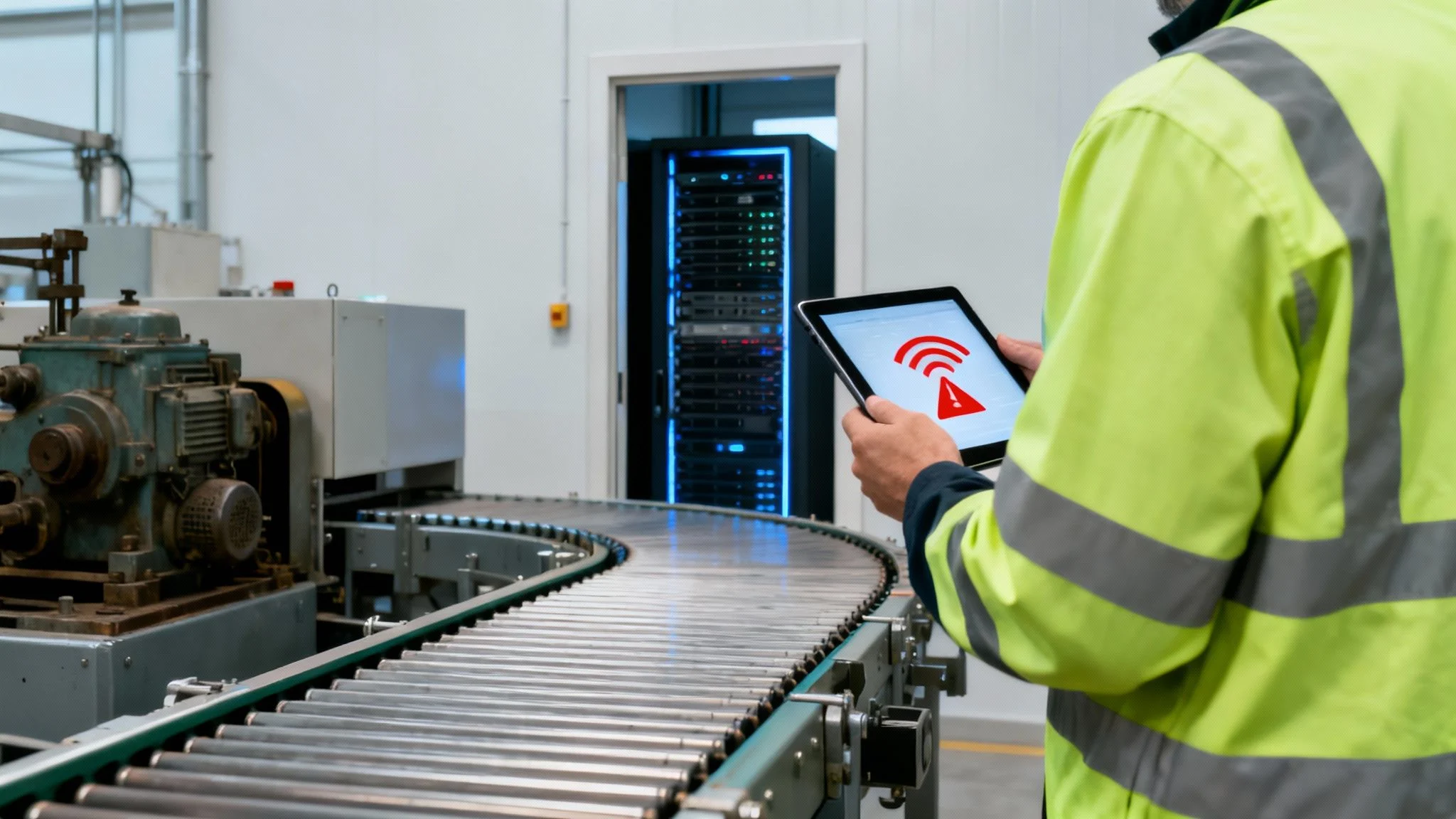
Imagine this: it’s the middle of a shift at a busy SME here in Melbourne, and production suddenly grinds to a halt. The conveyor belt stops moving, CNC machines fall silent, and your team is left standing around, waiting. The cause is not a broken part; it is an invisible IT glitch. A network bottleneck is stopping a legacy machine from sending crucial data to your central Manufacturing Execution System (MES).
This is not some rare, hypothetical scenario. For many Australian manufacturers, it is a recurring nightmare that exposes a critical weakness. Your average IT support team, who are pros at managing office software and email, are often completely out of their depth when it comes to the complex dance between Information Technology (IT) and Operational Technology (OT).
The factory floor is a high stakes environment where downtime is not just an inconvenience, it is measured in lost revenue every single minute. Generic IT solutions just do not grasp this urgency or the unique needs of industrial gear.
Bridging the Great IT and OT Divide
At the heart of the challenge for manufacturers is the collision of two very different worlds:
- Information Technology (IT): This is the world you are probably familiar with. It covers your servers, emails, business software like your ERP, and cybersecurity for the office network.
- Operational Technology (OT): This is the hardware and software that directly controls the physical equipment on your factory floor. Think industrial control systems (ICS), SCADA systems, and programmable logic controllers (PLCs).
When these two worlds are not properly connected and secured, you end up with data silos, glaring security holes, and operational headaches. For example, a cyberattack that hits your office IT network could easily jump over to the OT network if they are not separated correctly, triggering a full scale production shutdown. Understanding how to shield both is vital, which is why a solid grasp of network segmentation is fundamental for any manufacturing business.
This is exactly where specialised IT services for manufacturing come in. They are designed to bridge that gap, creating a single, secure, and efficient tech ecosystem. It’s about making sure the data from your assembly line directly informs the business decisions being made in the front office, turning your facility into a truly smart factory.
A Quick Guide to Manufacturing IT
If you’re a busy decision maker, here’s the bottom line: specialised IT for manufacturing is all about bridging the gap between your factory floor and your front office. It connects your heavy machinery, what we call Operational Technology (OT), with the business software that runs everything else (your IT).
Getting this connection right is a game changer. It directly boosts your production efficiency and, just as importantly, strengthens your defences against cyber threats that could shut down your entire plant. When these two worlds talk to each other properly, you gain a serious competitive edge.
Ultimately, working with an IT specialist who actually gets the noisy, demanding environment of a factory floor means your technology starts working for you, not against you. It lets you focus on what you do best: making great products. A dedicated IT strategy is not a luxury anymore; it is a core part of being a resilient, modern industrial business.
The Core IT Services Powering Your Factory
Think of your manufacturing operation like a high performance vehicle. For it to run at peak efficiency, you need the engine, transmission, and electrical systems all working in perfect harmony. In the same way, your factory needs specific IT services firing on all cylinders. These are not just optional extras; they are the core components that prevent breakdowns, boost speed, and put you in the driver’s seat.
Let’s move past the dry, technical jargon and take a look under the bonnet of a modern manufacturing IT strategy. Each of these services is a direct solution to a real world problem that costs time, money, and headaches on the factory floor.
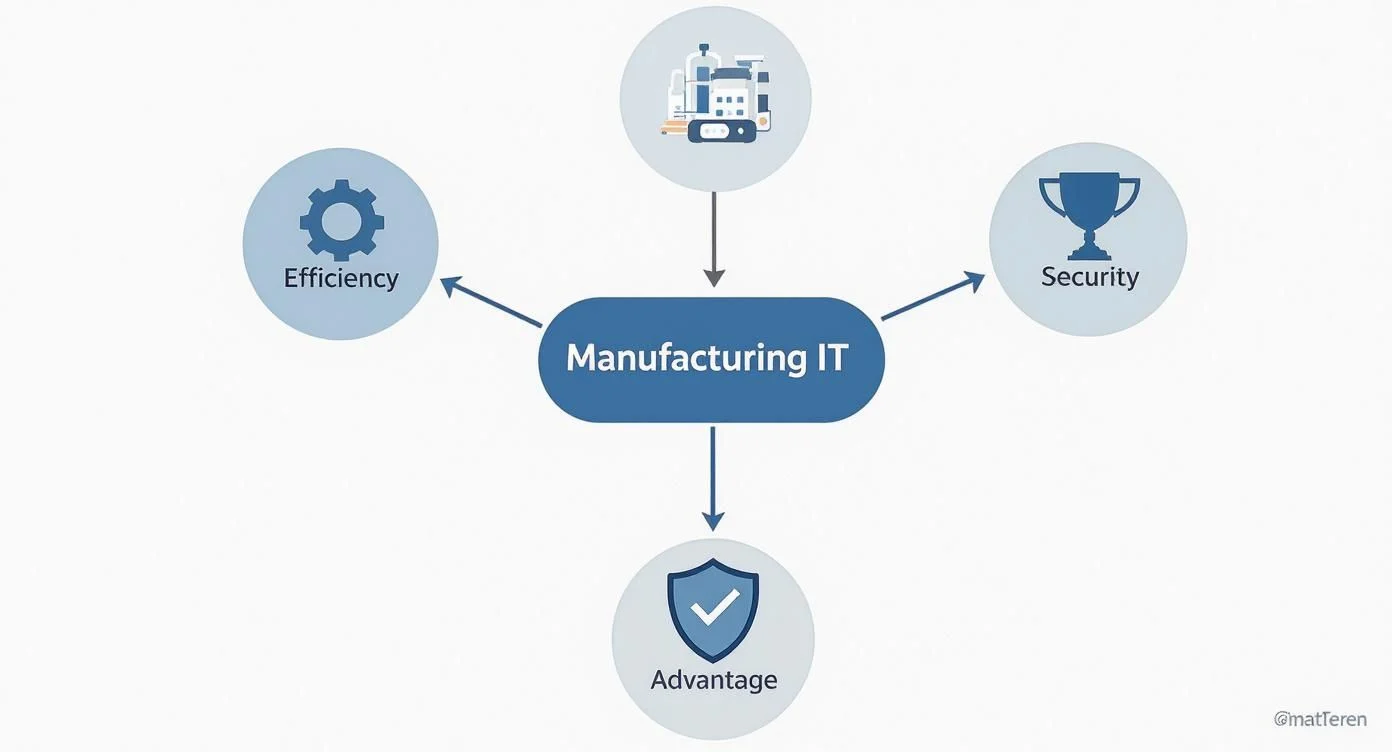
As you can see, a solid IT strategy is not just about plugging in new tech. It’s about achieving critical business outcomes: better efficiency, stronger security, and a real competitive edge.
To make this crystal clear, the table below connects each key IT service to its direct impact on your production goals.
Connecting IT Services to Your Production Goals
| IT Service Component | Primary Function | Impact on Manufacturing Operations |
|---|---|---|
| Industrial Networking | Creates a robust, high speed communication backbone for the factory floor. | Prevents data bottlenecks, ensuring real time machine communication and control. |
| MES/SCADA Integration | Unifies production monitoring (SCADA) with workflow management (MES). | Provides a complete, live view of the production line, enabling proactive quality control. |
| OT/IT Convergence | Securely links factory floor systems (OT) with business software (IT). | Enables accurate, real time inventory tracking and data driven business forecasting. |
| Cybersecurity | Protects the entire network, from machinery to business systems, from threats. | Prevents costly downtime from cyber attacks and protects sensitive intellectual property. |
| Managed Services | Provides proactive monitoring, maintenance, and support for all IT systems. | Minimises unexpected breakdowns and frees up your team to focus on production. |
| Cloud & Backup | Offers scalable data storage, processing power, and disaster recovery. | Ensures business continuity and provides access to powerful analytics tools. |
These services are not just abstract concepts; they are practical tools that deliver tangible results every single day.
Industrial Networking: The Factory Superhighway
A standard office network is like a quiet suburban street, fine for predictable, light traffic. But your factory floor? That’s the city centre during peak hour, with a constant flood of data from CNC machines, sensors, robots, and monitoring systems. Trying to run that on an office grade network is a recipe for digital gridlock.
Industrial networking is the multi lane superhighway built specifically for this tough environment. It’s designed to make sure critical data from your machinery gets where it needs to go instantly, without lag.
- Robust Connectivity: Uses hardened switches and access points that can handle the dust, vibrations, and temperature swings common on a factory floor.
- Prioritised Traffic: Guarantees that urgent commands, like an emergency stop signal, always have a clear path, preventing catastrophic failures.
- Scalability: Lets you add new machines and sensors to the line without bogging down the entire network.
A well designed network is the foundation for everything else. It’s also crucial for connecting multiple sites, which is why understanding solutions discussed in our SD-WAN guide can be so valuable for growing businesses.
MES and SCADA Integration: The Central Nervous System
If the network is your superhighway, then your Manufacturing Execution System (MES) and Supervisory Control and Data Acquisition (SCADA) systems are the central nervous system. They collect, process, and act on all the data flowing through your factory.
- SCADA is like the eyes and ears, monitoring real time processes like machine speeds, pressure, and temperature.
- MES acts as the brain, using that data to manage workflows, track production progress, and ensure quality control.
When these systems are properly integrated, your managers get a complete, live view of the entire production line from a single dashboard. This means they can spot a potential bottleneck or a machine showing early signs of failure and act before it turns into a costly shutdown.
Without integration, you are flying blind. You have islands of data but no unified intelligence. Proper integration turns that raw data into actionable insights that drive smarter, faster decisions on the floor.
OT and IT Convergence: The Bridge to Business Intelligence
For decades, the factory floor (Operational Technology, or OT) and the front office (Information Technology, or IT) operated in completely separate worlds. The OT team cared about keeping machines running, while the IT team focused on business data and emails. In today’s world, that separation is a major liability.
OT/IT convergence is all about building a secure bridge between these two worlds. It allows crucial production data from your machines to flow seamlessly into your business software, like your Enterprise Resource Planning (ERP) system. This connection delivers powerful benefits:
- Accurate Inventory: Real time production counts from the floor automatically update stock levels in your ERP.
- Better Forecasting: Historical machine performance data helps you predict maintenance needs and true production capacity.
- Streamlined Orders: Sales orders entered into the ERP can be sent directly to the factory floor to schedule production runs.
This convergence is a cornerstone of modern manufacturing. Here in Australia, the reliance on such IT advancements is clear. Manufacturing R&D spending was about AU$5.047 billion in 2023-24, making up a huge 21% of all business R&D. A massive chunk of that investment is fuelling IT driven automation and system integration.
New technologies are constantly pushing this further. For example, exploring how Augmented Reality for Manufacturing helps to improve efficiency and safety on the production line is a great next step. By bridging the digital and physical worlds, AR provides workers with real time information and guidance, reducing errors and speeding up complex tasks.
The Real-World Benefits of Specialised IT
Investing in specialised IT services for your factory is not just about fixing computer problems, it is about making a real, measurable impact on your bottom line. When your technology is properly aligned with your production goals, it stops being a cost centre and starts becoming an engine for growth and efficiency.
Let’s move past the jargon and look at the concrete benefits a solid IT strategy brings to the factory floor. These advantages tackle the most common and costly challenges that Australian manufacturers face every single day.
Maximise Your Uptime and Production Output
Unplanned downtime is the enemy of profit in manufacturing. Every minute a machine sits idle, you are losing money and falling behind on orders. Specialised IT helps you shift from putting out fires to preventing them in the first place, keeping your production lines humming.
Think about a critical CNC machine that starts showing tiny signs of overheating, only detectable through its network data. A general IT provider would almost certainly miss it. A manufacturing IT specialist, however, uses proactive monitoring tools that would trigger an immediate alert.
This gives your maintenance team a heads up to schedule a quick, off peak service to replace a failing cooling fan, a minor fix that prevents a catastrophic motor failure. The result? A few minutes of planned maintenance instead of days of expensive, unscheduled downtime, saving you thousands.
Strengthen Your Data and Intellectual Property Security
In modern manufacturing, your most valuable assets are often digital. This is not just customer lists and financial records; it’s your priceless intellectual property, proprietary designs, chemical formulas, and unique production processes. A data breach can be devastating, leading to operational chaos and the loss of your competitive advantage.
Proper data security for manufacturing involves:
- Protecting OT Networks: Setting up firewalls and security rules specifically designed to shield your industrial control systems from cyber threats.
- Securing IP: Using advanced encryption and access controls to make sure your schematics and process data can only be seen by authorised staff.
- Ensuring Business Continuity: Building solid backup and recovery systems is non negotiable. You can see how a robust strategy protects your operations by looking at some disaster recovery plan examples.
Enable Smarter, Data-Driven Decision Making
Guesswork has no place in a modern factory. Success comes from making fast, accurate decisions based on real time information. When your operational technology (OT) and information technology (IT) systems are correctly integrated, you get a clear, single view of your entire operation.
With accurate, live data flowing from the factory floor to your business software, you can move from reactive problem solving to strategic, proactive management. This visibility is the key to unlocking new levels of efficiency and agility.
This constant flow of information empowers you to make smarter calls across the business. You can fine tune inventory based on actual production rates, forecast maintenance needs with much greater accuracy, and adjust schedules on the fly to meet changing customer demands.
Future-Proof Your Entire Operation
The manufacturing world does not stand still; new technologies and processes are always emerging. A rigid, outdated IT setup will hold you back, making it difficult and expensive to adapt. On the other hand, specialised IT services for manufacturing build a scalable and flexible foundation for your business.
This forward thinking approach means you can add a new production line, integrate smart sensors, or bring in automation without needing a complete system overhaul. This kind of investment is a big reason why Australia’s IT services revenue is projected to hit AU$57.17 billion in 2025 and climb to AU$70.26 billion by 2030, as manufacturers lean on expert support to stay competitive. It ensures your operations are not just efficient today, but ready for whatever comes next.
How to Choose the Right Manufacturing IT Partner
Picking an IT provider is a massive decision, one that directly impacts your factory’s uptime, security, and bottom line. The right partner becomes a true extension of your team, while the wrong one can be a source of constant headaches and serious risk. For manufacturers, the stakes are just so much higher. You have to look beyond the slick marketing and find a provider who genuinely gets the industrial world.
This choice has never been more critical. A recent report revealed that in 2025, over half (53%) of Australian manufacturing leaders named IT as their number one operational challenge. It even beat out cyber risks and inflation, which shows just how central technology now is to keeping production lines humming.
The key is finding a partner who understands that downtime is not just an inconvenience, it is measured in lost revenue per minute. They need to speak the language of both Information Technology (IT) and Operational Technology (OT).
Your Checklist for Vetting a Manufacturing IT Provider
Before you even think about signing a contract, you need to ask the right questions. The answers you get will tell you everything you need to know about whether they have the specialised skills for a factory floor. Vague, generic responses are a huge red flag.
Use this checklist to guide your conversations and find out what they’re really made of:
- Do you have real world experience with OT and industrial control systems? Ask them for specific examples of how they’ve supported SCADA, MES, or PLC environments. They should be able to talk confidently about securing and managing these systems, not just the PCs in the front office.
- What’s your specific cybersecurity plan for a factory? A solid answer here goes way beyond just antivirus software. Look for a deep understanding of network segmentation, how to wall off your OT from your IT network, and experience with industrial grade firewalls and intrusion detection.
- How do you handle support during our production hours? Manufacturing is not a 9 to 5 job. Make sure their support lines up with your shift schedules and that they have a clear, rapid response process for production halting emergencies, day or night.
- Can you help us get our factory floor data talking to our business systems? The provider must know how to safely bridge the OT/IT gap, pulling valuable data from your machines into your ERP or other business software without opening up security holes.
The goal is to find a partner who sees a factory not as a bigger, noisier office, but as a unique ecosystem with its own set of high stakes rules. Their expertise should be evident in how they talk about securing production lines, not just servers.
Beyond the Technical Questions
Technical skill is non negotiable, but it is only half the story. A true partner has to be aligned with your business goals, too. When you are making your choice, it helps to understand the best practices outlined in guides like this one on Choosing an Industrial Automation System Integrator.
Here are a few final points to chew on:
- Proactive vs. Reactive Support: Are they focused on preventing problems or just fixing things after they break? A proactive managed IT services provider will use monitoring tools to spot trouble long before it grinds your operations to a halt.
- Scalability: Can they grow with you? Ask how they’d handle the IT side of adding a new production line or integrating new smart factory tech down the road.
- Local Presence: Having a team nearby, especially in a hub like Melbourne, can be a lifesaver for getting fast, on site support when a remote fix just won’t cut it.
Making a confident, well informed choice now is one of the best things you can do to safeguard your operations and set your business up for future growth.
Common Questions About Manufacturing IT
Diving into specialised IT for your factory floor can feel like a big step, and it is natural to have questions when production uptime is on the line. We talk with manufacturing leaders across Melbourne every day, and most of their queries boil down to a few key themes: cost, complexity, and where on earth to begin.
Here are some straightforward answers to the most common questions we hear. Our goal is to give you practical information you can actually use to make smart technology decisions for your business.
What Is the First Step to Improving Our Factory IT?
The best place to start is always with a comprehensive audit. Before you can fix anything, you need a crystal clear picture of what you currently have, where the weak spots are, and whether your tech is actually helping you hit your business goals. A proper audit is not just about counting servers; it’s a deep dive into your entire operation.
A good IT partner who knows manufacturing will assess:
- Network Infrastructure: They will map out how data flows from your machines (OT) to your office systems (IT), hunting for bottlenecks and glaring security gaps.
- System Vulnerabilities: This means identifying outdated software, unpatched systems, and other weak points in your cybersecurity defences that could be an open door for an attack.
- Operational Workflows: They will want to understand how your team uses technology day to day to find opportunities where small improvements could make their jobs easier and more productive.
Think of it as a full diagnostic check for your factory. The result is a detailed roadmap that shows you exactly where to invest your resources to get the biggest bang for your buck in efficiency and security.
How Much Do Specialised IT Services Cost?
It’s the million dollar question, and the honest answer is: it really depends. The cost of it services for manufacturing will vary based on the size of your operation, the complexity of your machinery, and the level of support you need.
Most providers offer a few different pricing models, but it helps to stop thinking of it as a cost and start seeing it as an investment in uptime.
The cost of proactive IT support is almost always a fraction of the cost of a single major downtime event. It’s an investment in operational resilience and predictable productivity.
A trustworthy provider will be completely transparent about their pricing, often offering a fixed monthly fee for managed services. This model is great because it gives you a predictable budget and covers everything from 24/7 monitoring and proactive maintenance to help desk support. It turns IT from a reactive, unpredictable expense into a planned investment that directly supports your production targets.
Can You Work with Our Older Machinery?
Absolutely. This is the reality on pretty much every factory floor we have ever walked onto. Very few businesses have the luxury of starting from scratch with brand new, fully connected equipment. Most places are a mix of modern and legacy machines, and getting them all to talk to each other securely is a huge part of what a specialist IT provider does.
We have plenty of strategies for integrating older systems without breaking the bank:
- Using gateway devices to translate old school communication protocols into modern network language.
- Implementing network segmentation to safely wall off older, more vulnerable machines so they can’t pose a risk to the rest of your network.
- Developing custom software interfaces that let new MES or ERP systems pull data from equipment that was built decades ago.
The goal is never to force a “rip and replace” approach. It’s all about building a smart, secure bridge between the technology you already have and the capabilities you need to stay competitive.
How Tbourke Solutions Can Help
Choosing the right IT partner is a direct investment in your factory’s future. It’s about finding a team that speaks your language: the language of production targets, operational efficiency, and relentless reliability. At Tbourke Solutions, we understand the unique challenges facing local manufacturers because we are part of the Melbourne community. We provide practical it services for manufacturing that are designed for the noise and demands of the factory floor, not a quiet back office.
Our approach is built around proactive support to prevent downtime and secure your operations from the ground up, so you can focus on what you do best.
- Managed IT Services: We offer comprehensive, 24/7 monitoring and maintenance for a flat monthly fee, turning your IT costs into a predictable investment in uptime.
- Cybersecurity for OT & IT: Our security strategies are built to protect both your business data and the valuable industrial equipment that keeps your factory running.
- Strategic IT Consulting: We help you map out a technology roadmap, ensuring your IT is ready to scale with your business ambitions and integrate new technologies without a complete overhaul.
If you are ready to stop worrying about IT issues and start using technology as a competitive advantage, we are here to help.
To schedule a no obligation consultation, please reach out and submit a query on our contact page at http://tbourke-solutions.com.au/contact.
Share This Story, Choose Your Platform!