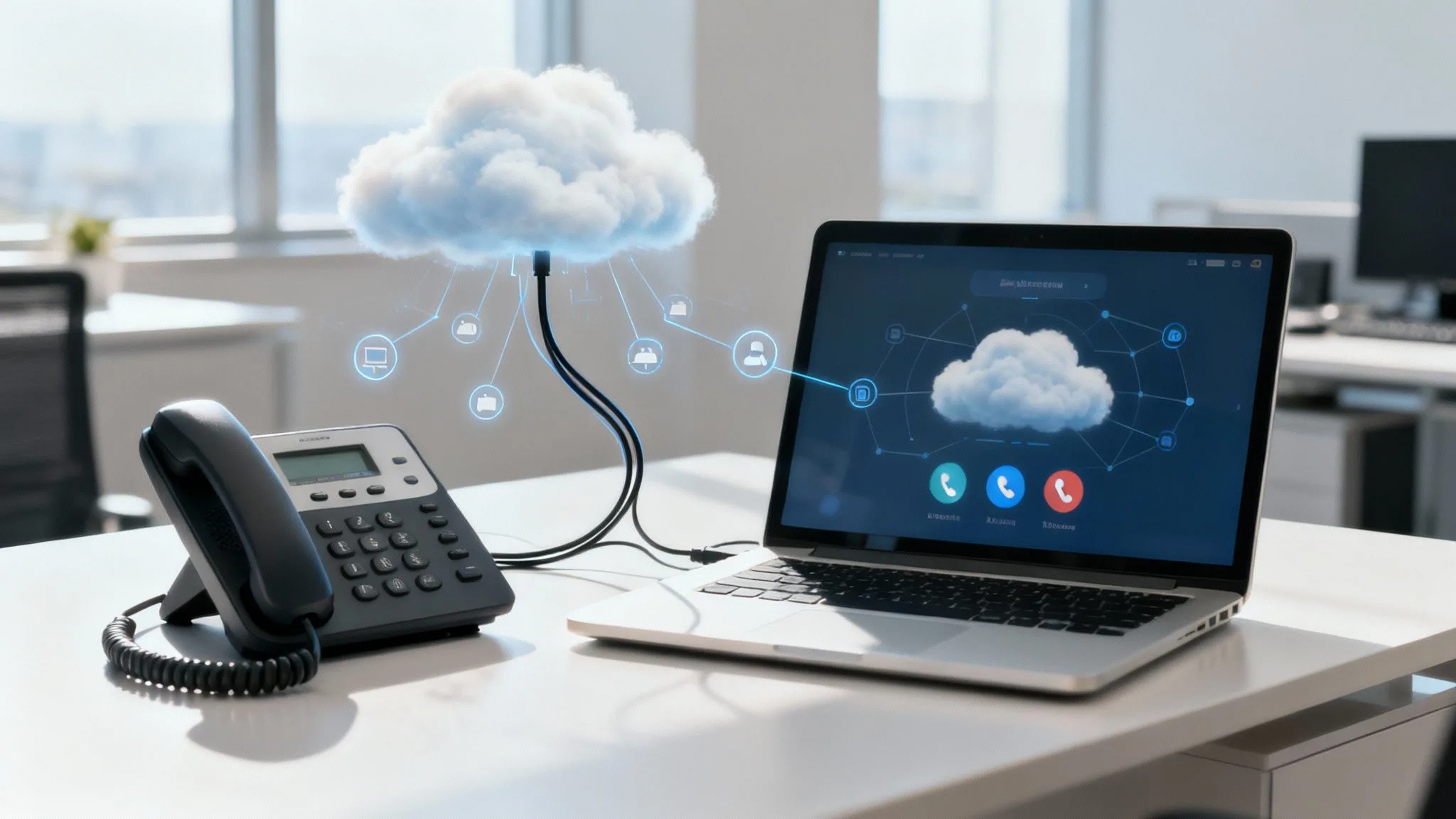
At its core, the difference between cloud and on premise PBX systems boils down to one simple question: who owns and manages the hardware? A cloud PBX is a flexible, subscription based service hosted by a provider, while an on premise PBX is a physical box you own and manage in your own office. That single choice ripples through everything from initial cost to long term flexibility, making it a critical decision for any growing Melbourne business.
This guide will provide an in depth comparison, examining the total cost of ownership, scalability, and security of both options to help you determine which model best suits your business needs. We will cover the core architectural differences and the practical implications for your IT team and budget. By the end, you’ll understand why cloud PBX has become the default choice for modern, agile businesses while recognising the specific scenarios where an on premise solution might still be viable.
Your Guide to Modern Business Phone Systems
Making the right call between a hosted or in house phone system for small business is crucial for your efficiency and growth. This isn’t just a tech decision; it directly impacts your budget, your team’s ability to work from anywhere, and how quickly you can adapt to changes like hybrid work.
This guide gives you a clear, practical comparison to help your business select the system that truly aligns with your day to day needs and long term goals.

TL;DR: A Quick Summary
A cloud PBX operates on a predictable monthly fee (OpEx), offering superior scalability, native remote work capabilities, and minimal in house IT management. For most modern small and medium businesses, its agility and lower total cost of ownership make it the logical choice. In contrast, an on premise PBX requires a significant upfront investment in hardware (CapEx) but grants you complete control, making you fully responsible for all maintenance, upgrades, and security. We’ll explore which model offers the best value for different business scenarios.
Core Differences at a Glance
Before we dive deep into the cloud versus on premise debate, it helps to have a solid grasp of general telephony requirements. Understanding the fundamentals of telephony and data connectivity solutions provides the foundational knowledge for making a smart choice.
The table below breaks down the key distinctions.
| Feature | Cloud PBX | On-Premise PBX |
|---|---|---|
| Cost Model | Operational Expenditure (OpEx) – Monthly subscription | Capital Expenditure (CapEx) – Large upfront purchase |
| Location | Hosted in provider’s secure data centres | Physical hardware located in your office |
| Maintenance | Managed entirely by the service provider | Your responsibility (or paid IT support) |
| Scalability | High – Add or remove users instantly via a portal | Low – Requires new hardware and professional installation |
| Remote Work | Natively supported with apps and softphones | Difficult and often requires complex configurations |
| Initial Setup | Fast and simple, often configured remotely | Slower, requiring physical hardware installation |
A Quick Comparison for Busy Decision Makers
If you’re a busy decision maker and just need the bottom line on the Cloud PBX vs On Premise debate, here’s the core difference in a nutshell.
Think of a Cloud PBX as a flexible, pay as you go subscription (OpEx). It’s the go to choice for modern SMBs that need to scale up or down, support remote teams, and stay agile. The beauty of this model is that it shifts all the heavy lifting—the maintenance, updates, and security—onto the provider, freeing up your team to focus on the actual business. You can explore our expert managed VoIP services to see exactly how this works in practice.
On the other hand, an on premise PBX is a one time hardware purchase (CapEx). You own the box, giving you total control, but it comes with a hefty upfront investment and requires dedicated in house IT staff to manage it.
For most growing Melbourne businesses, the cloud model nearly always delivers a lower total cost of ownership and the agility needed for today’s dynamic work environment. This guide will dig into the specific scenarios where each system truly shines, helping you make a confident, informed decision for your business’s future.
Understanding the Core Architectural Differences
Before we can really get into a proper comparison of Cloud PBX vs On Premise systems, we have to start with the fundamentals: how they’re built and where they live. This architecture is the foundation for everything else—cost, maintenance, flexibility, you name it. It’s the most important place to start.
An On Premise PBX is exactly what it sounds like. It’s a physical box, a server, that sits somewhere in your office—usually tucked away in a server closet or IT room. You buy it, you own it. This piece of hardware connects to your phone lines (whether they’re old school ISDN or a modern SIP trunk), and every handset in the office plugs back into it.
This setup gives you total, hands on control over your phone system. The flip side? Your business is on the hook for its entire lifecycle. That means you handle the initial setup, all the ongoing maintenance, software updates, hardware repairs, and even making sure the server room itself is secure.

The Cloud PBX Architecture
Now, a Cloud PBX (often called a Hosted PBX) works on a completely different model. The actual PBX hardware and software aren’t in your office at all. Instead, they’re managed by a provider in highly secure, purpose built data centres.
Your business just taps into this powerful system as a service, all through your internet connection. This virtual approach means there’s no bulky server for your team to worry about managing, maintaining, or updating. The provider takes care of all that complexity behind the scenes. If you’re new to the concept, this guide on what is a cloud phone system is a great primer on its functionality.
Key Takeaway: The fundamental architectural difference comes down to ownership and responsibility. With on premise, you own the gear and all the headaches that come with it. With the cloud, you’re subscribing to a service, and the provider owns the hardware and the responsibility for keeping it running.
This difference has massive implications. It frees up your internal IT team (if you have one) from the grind of managing a phone system, and it guarantees you’re always on the latest technology without needing to budget for expensive, disruptive upgrade projects. For a deeper look at the tech involved, our 3CX VoIP PBX guide breaks down how these modern systems work. Ultimately, this core architectural split is what drives the huge contrasts in cost, scalability, and flexibility between the two.
Breaking Down the Total Cost of Ownership
When you’re comparing a cloud PBX to an on premise system, the conversation often kicks off with price but needs to quickly pivot to value. If you only look at the initial invoice, you’re missing the bigger picture. The real story lies in the Total Cost of Ownership (TCO), which accounts for every single dollar you’ll spend over the system’s lifespan—usually three to five years.
This isn’t just about CapEx vs OpEx. A proper TCO analysis digs into the hidden expenses: the hours your IT team spends on maintenance, the unexpected repair bills, future upgrade projects, and even the cost of downtime. This is how you get a true feel for what each phone system will actually cost your business in the long run.
The On Premise CapEx Model
An on premise PBX is a classic Capital Expenditure (CapEx) investment. You buy the hardware outright, which means a hefty upfront financial commitment. But that initial purchase is just the first chapter of the financial story.
The TCO for an on premise system also has to include:
- Installation Fees: Getting specialised technicians to physically set up and configure the system doesn’t come cheap.
- Licensing Costs: Software licences for users and features often need to be renewed periodically, adding another recurring cost.
- Ongoing Maintenance Contracts: These are essential for support and hardware replacement, and they function as a recurring operational cost.
- IT Staff Time: Your internal team will sink valuable hours into managing, patching, and troubleshooting the system.
- Upgrade Costs: When the technology becomes outdated or the system hits its end of life, you’re looking at another huge capital spend to replace it all.
This model can create a lot of financial uncertainty. An unexpected server failure or the need for a critical security patch can lead to large, unbudgeted expenses that put a serious strain on your cash flow. For a deeper dive into managing these kinds of expenses, check out our guide on effective IT budget planning.
The Cloud PBX OpEx Model
A cloud PBX, on the other hand, runs on an Operational Expenditure (OpEx) model. You pay a predictable, per user monthly fee. This simple shift transforms your communication costs from a big, lumpy investment into a smooth, manageable operating expense.
This subscription fee typically bundles everything you need into one neat package:
- Access to enterprise grade hardware and software without buying it.
- All future software updates and new features as they’re rolled out.
- Comprehensive technical support and all system maintenance.
- Built in security and compliance management handled by the provider.
The real financial win with a cloud PBX is cost predictability. You completely eliminate surprise repair bills and expensive upgrade cycles. This allows for far more accurate budgeting and frees up capital that can be invested back into the core parts of your business.
A TCO Breakdown for a Melbourne SMB
To put this into perspective, let’s run the numbers for a typical 20 person business here in Melbourne over five years. This table gives a realistic snapshot of where the money goes.
Cloud PBX vs On Premise PBX Cost Breakdown Over 5 Years
| Cost Factor | On Premise PBX (Estimated 5 Year Cost) | Cloud PBX (Estimated 5 Year Cost) |
|---|---|---|
| Initial Hardware & Setup | $15,000 – $25,000 | $0 – $1,000 (for new handsets if needed) |
| Annual Maintenance | $2,000 – $4,000 | $0 (Included in subscription) |
| Licensing & Software | $1,000 – $3,000 (annually) | $0 (Included in subscription) |
| IT Staff Allocation | 5-10 hours/month | <1 hour/month |
| Major Upgrade (Year 4/5) | $10,000+ | $0 |
| Total Estimated TCO | $40,000 – $60,000+ | $24,000 – $36,000 |
As the numbers show, while the on premise system feels like a one off purchase, the cumulative costs of maintenance, staffing, and eventual replacement often lead to a much higher TCO.
This isn’t just theory; cost efficiency data from the Australian market backs this up, showing that businesses switching to a cloud PBX can save up to 60% on their telephony costs. It’s why by 2023, 70% of Australian SMEs had already moved to the cloud, citing a 40% lower TCO over three years and the ability to scale instantly with NBN upgrades. For organisations like Melbourne schools with tight budgets or startups needing advanced features without the capital outlay, the financial argument for cloud is incredibly compelling. You can find more insights on this shift in the global PBX market trends.
Comparing Scalability Features and Flexibility
This is where the real daylight appears between cloud and on premise systems. A business’s ability to pivot—whether that’s adapting to market shifts, team growth, or new ways of working—often comes down to how flexible its core tech is. Your phone system is a huge part of that.
For any growing Melbourne business, scalability isn’t just a buzzword; it’s a daily reality. This is where cloud PBX systems really show their strength.
Scaling Up and Down with Ease
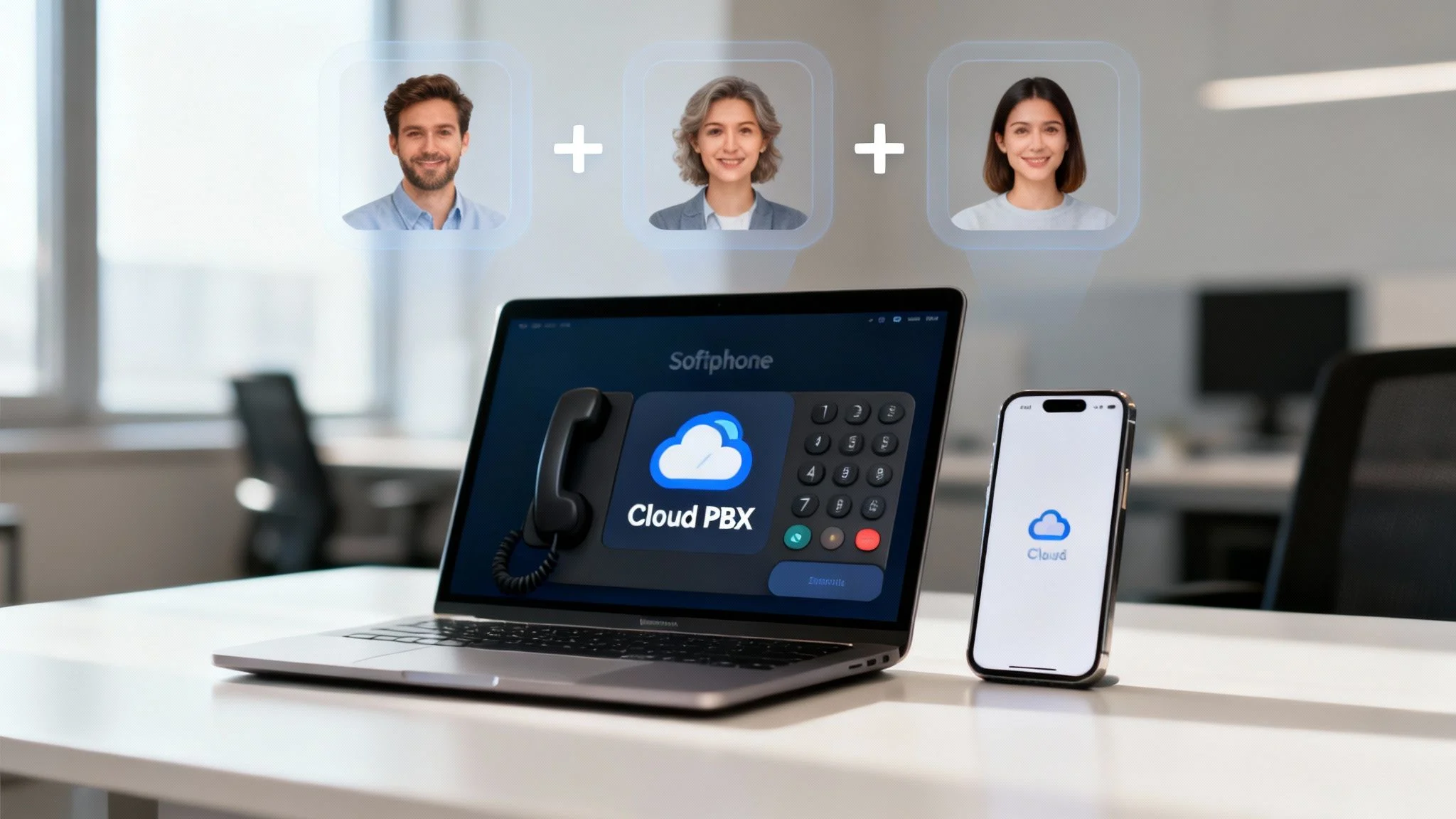
Need to add a new team member with a cloud PBX? It’s as simple as logging into a web portal, punching in their details, and assigning a licence. Their new extension is live and ready for calls in minutes. No new hardware, no technician visit, and zero system downtime.
Now, contrast that with an on premise system. Scaling up often means hitting a physical wall. Does the server have enough grunt for another user? Do you need to buy and install an extra hardware card? This simple task suddenly becomes a mini project involving ordering gear, scheduling a technician, and potentially taking the whole system offline for a bit. What takes minutes in the cloud can take days or weeks on site.
A cloud PBX lets your communications grow at the speed of your business, not at the speed of your hardware. This on demand scalability is a game changer for businesses that deal with seasonal peaks or are in a rapid growth phase.
Embracing a Distributed Workforce
The shift to hybrid and remote work isn’t a trend; it’s the new standard. A modern phone system has to work seamlessly for staff whether they’re at the office desk, the kitchen table, or on the road.
Cloud PBX solutions were practically built for this. They make location irrelevant with features like:
- Softphones: Apps that turn any laptop or desktop into a full featured business phone.
- Mobile Apps: Let staff use their business line on their personal smartphone, keeping their mobile number private.
- Seamless Call Transfer: Effortlessly flick a call from your desk phone to your mobile without the caller ever knowing.
An on premise PBX really struggles to keep up here. Getting remote access usually means wrestling with complex network setups like VPNs, which can be flaky and a headache for non technical staff to manage.
This flexibility is a key reason for the massive uptake in Australia. The local cloud contact centre market—which shares a lot of tech with cloud PBX—is tipped to surge at a CAGR of 22.72% between 2025 and 2034. This growth is being driven by businesses in hubs like Melbourne that need solutions to support remote work without the eye watering cost of old school hardware. In fact, around 70% of Australian SMEs have already switched to cloud telephony to slash communication costs by up to 60%. The winner on flexibility is crystal clear.
Access to Automatic Feature Updates
The world of business communication moves fast. New tools like AI powered call transcription, advanced analytics, and deeper CRM integrations are constantly being developed.
With a cloud PBX, your provider rolls these updates out automatically in the background. Your business gets to use the latest and greatest tools without your team having to lift a finger. It ensures your communication platform never gets stale.
On premise systems, on the other hand, are pretty much static from the day they’re installed. Getting new features usually means a major, expensive software upgrade or even a complete hardware replacement. This leaves businesses stuck with outdated tech, missing out on tools that could be boosting productivity and improving customer service until they’re ready for another big capital outlay.
Evaluating Security and Business Continuity
When you’re weighing up a cloud PBX against an on premise system, the conversation always, and rightly, turns to security and reliability. These two pillars are the bedrock of your business operations. After all, a downed phone system isn’t just a string of missed calls; it’s lost opportunities, frustrated clients, and a direct hit to your bottom line.
For many, the idea of an on premise system feels more secure simply because the hardware is physically within your four walls. You can see it, you can touch it, and you control who gets near the server room. But this physical control also means the entire security burden lands squarely on your shoulders.
That responsibility is a heavy one. It means you’re solely accountable for everything from network firewalls and urgent software patching to preventing unauthorised physical access and ensuring every bit of data is encrypted. For most small to medium businesses, maintaining this level of security is a constant, resource draining battle.
The Security Advantage of Cloud Providers
Reputable cloud PBX providers operate on a completely different scale. They invest millions in enterprise grade security infrastructure that’s simply out of reach for the average SMB. Their entire business model depends on protecting client data, so their security posture is necessarily far more robust.
This typically includes:
- Physical Security: Data centres with biometric scanners, 24/7 surveillance, and tightly controlled access protocols.
- Network Security: Advanced firewalls, intrusion detection systems, and real time threat monitoring to fend off cyber threats.
- Data Encryption: Calls and data are encrypted both in transit and at rest, protecting sensitive information from eavesdroppers.
- Compliance Certifications: Providers often hold certifications like ISO 27001, proving they adhere to strict international security standards.
By opting for a cloud solution, you are effectively outsourcing your communication security to a team of dedicated experts whose sole job is to keep your system safe and operational.
Ensuring Uninterrupted Business Operations
Business continuity is where cloud platforms truly pull ahead. An on premise PBX is a single point of failure. If your office loses power, the internet drops out, or the server hardware gives up, your entire phone system goes down with it.
Cloud PBX architecture, on the other hand, is inherently resilient. It’s built on a foundation of geographic redundancy, with services hosted across multiple data centres. If one location has an issue, traffic is automatically rerouted through another, often with no noticeable impact on your service.
This built in redundancy is a core part of a strong continuity strategy. A local internet outage at your Melbourne office no longer means a communications blackout. Calls can be automatically forwarded to mobile devices or softphones, ensuring you stay connected to clients no matter what happens on site. For a deeper look at building this kind of resilience, you can review some effective disaster recovery plan examples.
The Australian market’s preference for this model is clear. During the 2023 bushfire disruptions, businesses using cloud systems maintained 99.9% uptime through this geo redundancy, a stark contrast to the higher failure rates seen with on premise hardware. This reliability is a major driver behind the local market’s rapid growth, which has expanded by over 56% since 2021. For Melbourne businesses that cannot afford downtime, this level of business continuity isn’t just a feature; it’s a necessity. You can learn more about the research driving this cloud PBX market shift to see the data for yourself.
So, How Do You Choose the Right System for Your Business?
After weighing up all the technical details, the decision between a cloud and an on premise PBX really comes down to your business’s day to day realities. There’s no single right answer, but looking at a few common scenarios makes the choice a lot clearer.
For a growing Melbourne SMB that needs to stay flexible, keep costs predictable, and support a hybrid workforce, a Cloud PBX is the definitive modern solution. The ability to add or remove users on the fly and provide seamless remote access is exactly what today’s agile businesses need.
On the flip side, a large organisation with a dedicated IT department and strict compliance rules that demand on site data storage might still find an on premise system makes sense. This path gives you absolute control over your hardware and data, but it comes at the cost of a significant upfront investment and the ongoing headache of managing it all.
Visualising Your Decision Path
This decision tree helps map out the choice based on what truly drives your business—whether that’s security, business continuity, or the IT burden you’re willing to take on.
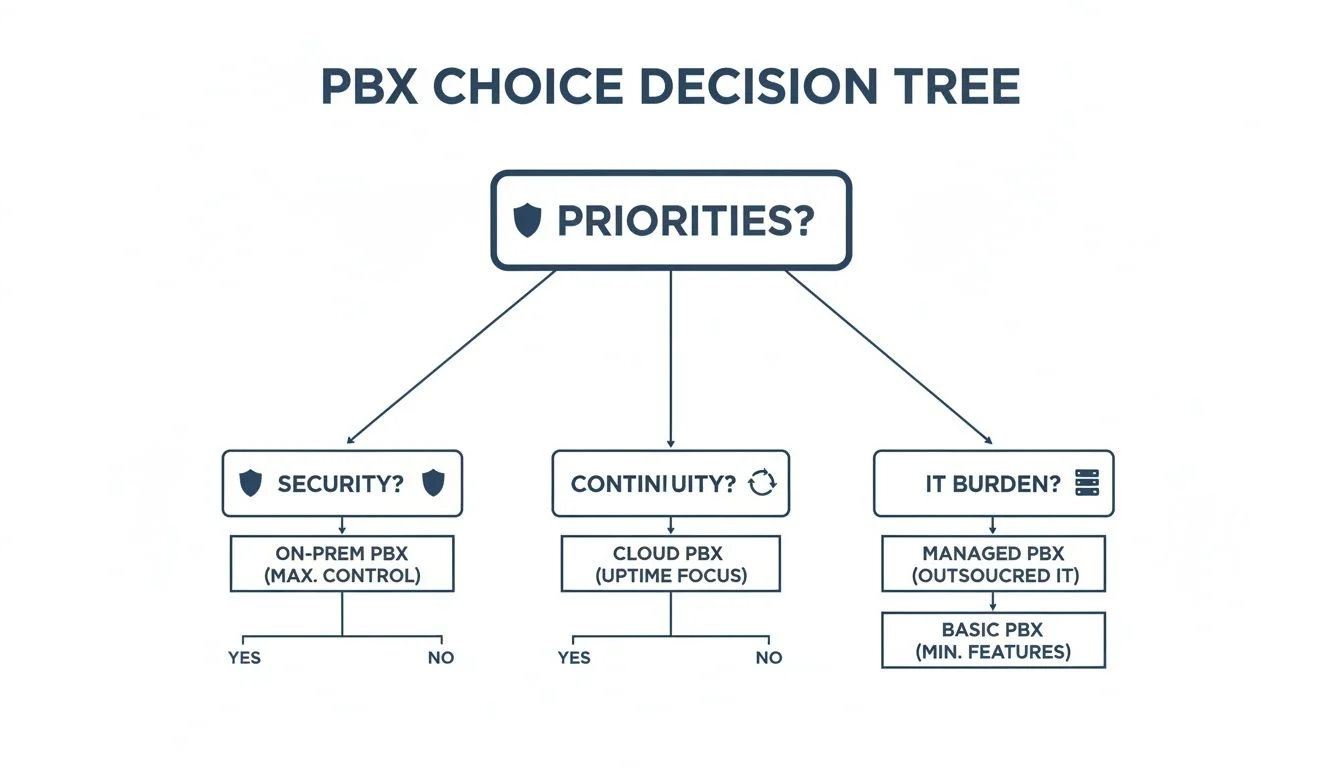
As the chart shows, if minimising IT management and ensuring you can keep operating no matter what are your top priorities, the path logically points straight to a cloud solution.
Common Cloud PBX vs On Premise FAQs
Here are the straightforward answers to the questions we hear most often from Melbourne businesses trying to make the right call.
What happens if our office internet goes down with a cloud PBX?
This is a valid concern, but modern cloud PBX systems are designed for resilience. If your primary office internet connection fails, calls don’t stop. They can be automatically rerouted to pre selected mobile numbers, softphones on devices with 4G/5G, or even another office location. It’s a built in business continuity feature that ensures you never miss a critical client call, a massive advantage over an on premise system which would be completely isolated during an outage.
How difficult is it to migrate from on premise to the cloud?
With an experienced IT partner, the migration is a carefully planned and managed project, not a chaotic overhaul. The process involves auditing your current setup, porting your existing phone numbers, configuring users and call flows on the new platform, and then deploying new desk phones or softphone apps to your team. A professional partner like Tbourke Solutions handles the entire process to ensure a smooth transition with minimal disruption.
Can we keep our existing business phone numbers?
Yes, absolutely. In Australia, your business has the right to port its phone numbers when you switch providers. The process is called Local Number Portability (LNP) and is a standard procedure. Your new provider manages the porting process, making the change invisible to your customers and preserving the numbers your clients have trusted for years.
Is a cloud PBX secure enough for sensitive industries like healthcare or finance?
Yes, provided you choose a reputable provider. Leading cloud PBX providers invest heavily in security infrastructure that often surpasses what a single business can afford. They offer end to end encryption, adhere to strict compliance standards like ISO 27001, and operate from physically secure data centres. For industries with stringent data handling requirements, it’s crucial to partner with a provider who can demonstrate their compliance and security posture.
How Tbourke Solutions Can Help You Choose
Navigating the choice between cloud PBX and on premise solutions requires a clear understanding of your specific business needs, budget, and long term goals. At Tbourke Solutions, we bring over 20 years of IT experience to the table, helping Melbourne businesses make this critical decision with confidence.
We offer:
- Expert Consultation: We start by assessing your current infrastructure and communication needs to recommend the best fit solution, not just sell a product.
- Seamless Migration: Our team manages the entire transition process, from number porting to user setup, ensuring a smooth cutover with minimal business disruption.
- Ongoing Local Support: As a Melbourne based provider, we offer reliable, hands on support to ensure your phone system always performs optimally.
Whether you are a small business needing flexibility, a school requiring a cost effective solution, or a startup looking to scale, we have the expertise to guide you.
Ready to modernise your business communications? Reach out to our expert team for a personalised consultation by submitting a query on our contact page, and we’ll be in touch.
Share This Story, Choose Your Platform!